


When people ask about a "standard" window screen size, the truth is there isn't one single, universal dimension that fits all. That said, after years in the business, we see certain sizes pop up far more often than others. For many common double-hung windows, a 24×36 inch screen is a frequent sight. For sliders, you'll often find 36×60 inches, and for those big, beautiful picture windows, 48×60 inches is a common dimension.
Think of these numbers as a helpful starting point, not a hard-and-fast rule.
Your Quick Reference for Common Screen Dimensions
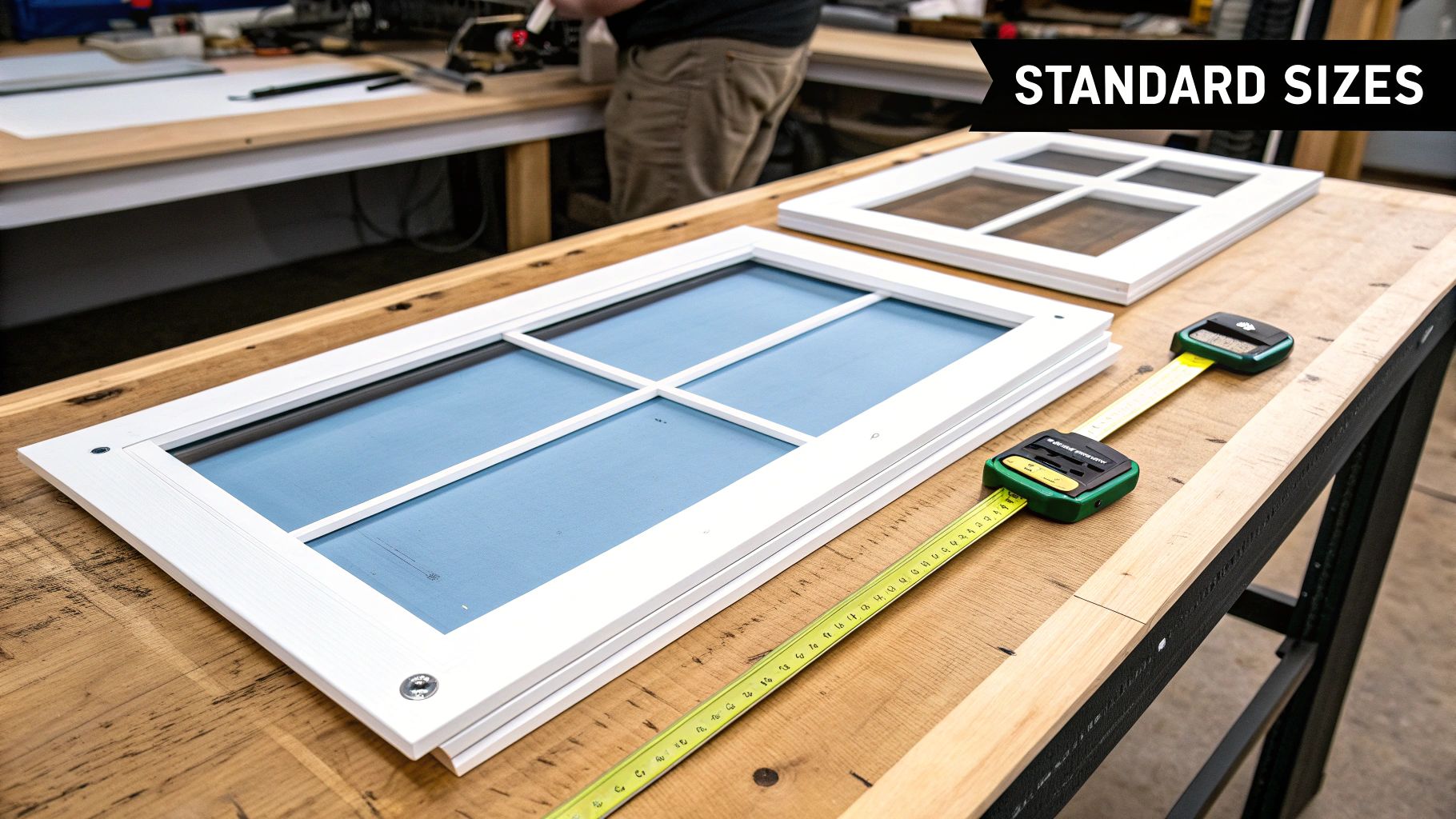
Knowing the most common screen dimensions can make finding a replacement a lot less daunting. Just remember, the word "standard" is more of a general guideline. The actual size you need can vary quite a bit depending on the window manufacturer and even when your home was built.
The best first step is always to identify what type of window you have, as that’s the biggest clue to the screen size you’ll be looking for. This quick guide will give you a solid overview of what to expect, whether you're tackling this yourself or getting ready for a perfect, custom fit from the team here at Sparkle Tech Screen Service.
Common Window Screen Dimensions by Window Type
Here’s a quick lookup chart covering the screen sizes we most frequently encounter for common residential window styles. It’s a great way to get a ballpark idea of the dimensions you'll be working with before you pull out the tape measure.
| Window Type | Common Screen Widths (Inches) | Common Screen Heights (Inches) | Primary Use Case |
|---|---|---|---|
| Double-Hung | 24", 28", 32" | 24", 36", 48" | Bedrooms, living rooms, and kitchens. |
| Sliding Window | 36", 48" | 48", 60" | Patios, sunrooms, and wider openings. |
| Casement | 20", 24" | 36", 48", 60" | Bathrooms, kitchens, and areas needing full ventilation. |
| Picture Window | 48", 60" | 60", 72" | Large, fixed openings in living or family rooms. |
Again, this chart is just a guide. Nothing beats an accurate, hands-on measurement of your specific window frame or existing screens to guarantee a flawless, bug-proof fit.
Decoding Double-Hung Window Screen Sizes
If you've ever looked into replacing a window screen, you've probably come across one size more than any other: 24 x 36 inches. This isn't just a random number; it's the go-to dimension for the classic double-hung windows found in millions of homes across the country. Think of it as the workhorse of the residential screen world.
This size became the standard largely thanks to the post-war housing boom. Builders needed to put up homes quickly and efficiently, so they relied on standardized window dimensions. The 24 x 36 size hit the sweet spot, offering a great balance of natural light, good ventilation, and simple construction for living rooms and bedrooms.
Why This Size Dominates the Market
Decades later, the 24 x 36 inch screen still reigns supreme. It’s not just a popular choice; it’s an industry powerhouse. Major suppliers report this single dimension accounts for over 40% of all replacement screen orders, and it’s estimated to fit about 35% of residential windows nationwide. You can find more details on these trends and common window screen statistics on ColumbusExterior.com.
You’ll see this size everywhere in planned communities and suburban neighborhoods. Here in the Phoenix area, homes throughout Scottsdale, Mesa, and Chandler are filled with double-hung windows that use this exact dimension.
At Sparkle Tech Screen Service, the 24 x 36 inch screen is one of our most common jobs. We see a huge spike in requests to rescreen this size right after Arizona's monsoon season rolls through and wreaks havoc on older, brittle mesh.
A Staple in Arizona Homes
The popularity of the 24 x 36 screen in the Valley comes down to a mix of architectural history and pure practicality. A huge number of homes built here from the 1960s to the early 2000s used this dimension because it was a reliable, cost-effective building standard.
Here’s why you’ll find it all over our local communities:
- Building Efficiency: Developers of tract homes in places like Peoria and Sun City leaned heavily on standardized parts to build quickly, making this screen size a default choice.
- Perfect Airflow: For a double-hung window, this size provides fantastic cross-ventilation—a must-have for anyone wanting to catch a cool evening breeze without cranking up the AC.
- Simple Repairs: Since it's so common, sourcing materials for a rescreening or ordering a complete replacement is easy. This helps keep repair costs down for homeowners.
Whether you're in Scottsdale dealing with sun-rotted mesh or in Phoenix with a screen torn by high winds, knowing your windows likely use this common size is a great starting point. It makes everything from getting an accurate quote to finishing the repair that much faster and simpler.
Sizing Up Your Sliding Windows
While double-hung windows get a lot of attention, horizontal sliding windows have their own set of typical dimensions, born from different architectural styles. Sliders are loved for their wide-open views and simple operation, which means they need screens that are wider and more durable. You'll often see them in living rooms, sunrooms, and other spaces that connect directly to the outdoors.
The popularity of mid-century modern and ranch-style homes created a huge demand for bigger glass panels and sliding windows. This design shift directly led to the need for a standard window screen size that could span these large openings. As a result, wider, landscape-oriented screen dimensions became common, especially in sunny places like right here in Arizona.
The Ever-Popular 36 x 60 Inch Screen
When we talk about sliding windows, one size tends to pop up more than any other: 36 x 60 inches. This dimension became the go-to for horizontal sliders and even some of the larger double-hung windows, fitting perfectly with the architectural trends that started back in the 1950s.
This 36 x 60 inch screen is a close second to the most common double-hung sizes, dominating about 25% of the market in sun-drenched areas like Phoenix and its suburbs. Here, patios and large windows need serious protection from bugs and the sun. It was a size born out of the postwar housing boom, perfectly matching the ranch-style homes and their big sliding windows. You can discover more insights on window size trends at LakeWashingtonWindows.com.
A Must-Have for Arizona Patios and Sunrooms
Here in Arizona, indoor-outdoor living is just part of our lifestyle, making large sliding windows and patio doors a standard feature. The 36 x 60 inch screen is absolutely essential for these setups, giving you a clear view while keeping pests out and letting that nice breeze in. For homeowners from Scottsdale to Peoria, these bigger screens are a non-negotiable part of home comfort.
A key consideration for these bigger screens in our climate is the mesh type. A standard fiberglass mesh might not be enough to combat the intense Arizona sun that beats down on a large glass door.
For these larger openings, I almost always recommend upgrading to a durable solar screen mesh. It's a smart move for a few key reasons:
- Blocks UV Rays: A good solar screen can block up to 90% of the sun's damaging UV rays, which goes a long way in protecting your furniture, floors, and artwork from fading.
- Reduces Heat: By stopping solar heat before it even hits the glass, these screens can make a noticeable difference in your indoor temperatures and give your AC unit a break.
- Maintains Views: The best part is that modern solar screens provide excellent outward visibility, so you don't have to trade your beautiful view for comfort.
Getting the fit right on these larger screens is absolutely critical for them to work properly. If you're looking for some help, take a look at our guide on sliding window screen replacement to learn more about professional installation.
Sizing Screens for Picture Windows and Large Openings
It's not just standard double-hung or sliding windows that need screens. Many homes today are designed with massive picture windows and oversized sliders to maximize views and natural light. These impressive openings require equally impressive screens, which is where the 48 x 60 inch size comes into play.
This size became popular for a reason. Back in the 1970s, architectural trends shifted toward creating brighter, more open living spaces. This meant bigger, uninterrupted panes of glass, which in turn meant screen manufacturers had to step up with larger, more robust solutions to match.
The Heavyweight: 48 x 60 Inches
Rounding out our list of common sizes is the heavyweight champion, the 48 x 60 inch screen. Built for those big picture windows and wide sliders, it accounts for a solid 20% of standard screen orders in many parts of the country. Think of the living room in a newer Tempe home or a Sedona retreat that needs maximum airflow without inviting in every bug.
This size really hit its stride by 1985, born from designs that favored large glazed areas with rough openings of 48 inches wide by 60 inches tall. You can actually find some interesting history on standard window dimensions at Fenbro.com.
Material and Structural Considerations for Large Screens
A 48 x 60 inch screen covers a lot of ground—20 square feet, to be precise. A screen that large is going to face more stress from wind, potential impacts, and its own weight, which can cause sagging over time. Your average, standard-duty frame and basic fiberglass mesh just won't cut it here.
Our Pro Tip: For any screen that's over 36 inches in either width or height, upgrading the frame and mesh isn't just a good idea—it's essential. A flimsy screen this big will bend, bow, or tear in no time.
To make sure your large screens last, a few upgrades are non-negotiable:
- Stronger Frames: We always recommend heavy-duty or extruded aluminum frames. They're far more rigid and won't bow under the tension required to keep the mesh taut.
- Crossbar Support: A horizontal crossbar (also called a muntin bar) installed in the middle of the frame is a must. It provides crucial stability and keeps the frame from flexing or warping.
- Pet-Resistant Mesh: If you have pets, this is a lifesaver. This vinyl-coated polyester mesh is up to seven times stronger than standard fiberglass and can easily handle claws and paws without shredding.
- Solar Screens: With a huge pane of glass comes a lot of heat. In a place like Arizona, high-performance solar screens are a game-changer. They can block up to 90% of the sun's heat before it hits your window, which can drastically lower your cooling bills and prevent your furniture from fading.
Here at Sparkle Tech Screen Service, building custom screens for oversized openings is our specialty. We know exactly which materials to use to ensure your screens stand up to the Arizona sun and provide years of reliable performance.
How to Accurately Measure for Replacement Window Screens
While knowing the common sizes is a good starting point, nothing beats taking your own measurements for that perfect, bug-proof fit. It’s an easy step to overlook, but believe me, being off by even a quarter-inch can mean the difference between a screen that seals tight and one that’s too loose to be effective or too tight to even install.
Taking a few minutes to measure correctly is the most critical part of the whole replacement process. The goal is to get a measurement that fits your specific window channel snugly, leaving no gaps for pests to find their way in.
Measure the Existing Screen or the Window Channel
You've got two solid options here: measure an old screen that you know fits well, or measure the window channel itself. If you have an old screen that wasn't bent or warped, measuring it is usually the quicker route.
However, if that old screen is damaged, bowed, or long gone, your best bet is to measure the window channel directly. This takes a little more attention to detail, but it’s the most foolproof method for getting the exact dimensions you need.
Pro Tip: Always measure the width and height in three different spots (top, middle, bottom for width; left, middle, right for height). Window frames aren't always perfectly square. Use the smallest of your three measurements for both width and height to guarantee the screen will slide into place without a fight.
The diagram below walks you through the basic flow for getting it right, whether you're starting with an old screen or the window channel.
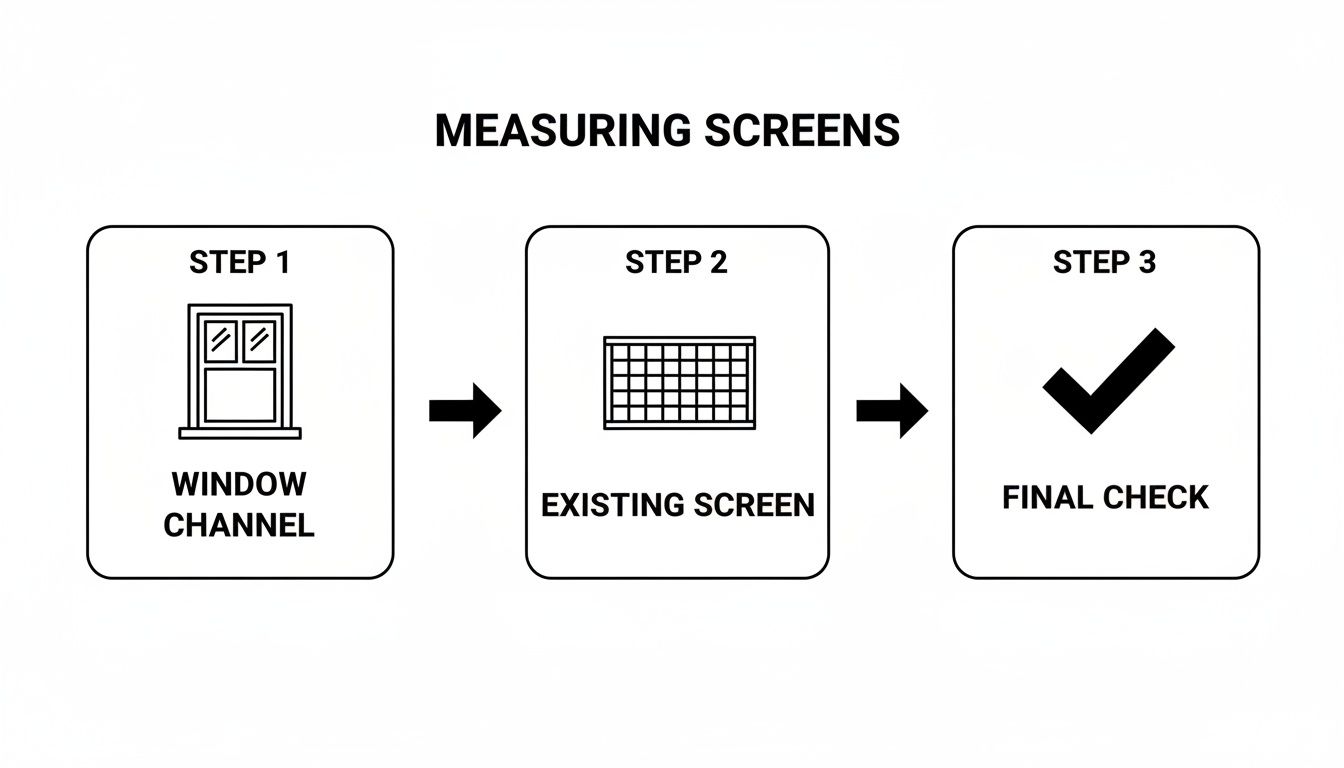
As you can see, it all comes back to the window channel for the most accurate baseline. An old screen is a great reference, but a final check against the channel dimensions is always a smart move.
Step-By-Step Measurement Instructions
Ready to get a flawless fit? Grab a good tape measure and follow these steps. Don't forget to write down your numbers to the nearest 1/16th of an inch—precision matters!
- Measure the Width: For the window channel, place your tape measure inside the screen track on the left and stretch it across to the inside of the track on the right. Take this measurement at the top, middle, and bottom, then jot down the smallest number.
- Measure the Height: Position the end of your tape measure at the very bottom of the top channel and pull it down to the very top edge of the bottom channel. Just like with the width, measure at three points—left, middle, and right—and use the smallest of the three.
- Account for Hardware: Take a close look at your screen. Do you see any spring clips, plungers, or leaf springs? You’ll likely need to make a small deduction (usually around 1/16" to 1/8") from your measurements to give this hardware room to work.
If you’re feeling unsure about making these kinds of adjustments, it's always best to call in a professional. At Sparkle Tech Screen Service, we take these precise measurements every day, so we can guarantee a perfect fit without the guesswork.
Choosing the Right Screen Material and Mesh Type
Once you’ve nailed down the right standard window screen size for your home, your next big decision is the material. This choice is just as important as the measurements, as the screen’s mesh and frame directly affect its durability, how clear your view is, and even how much you spend on cooling. It’s about more than just keeping bugs out—it’s about finding the right fit for your home’s needs.
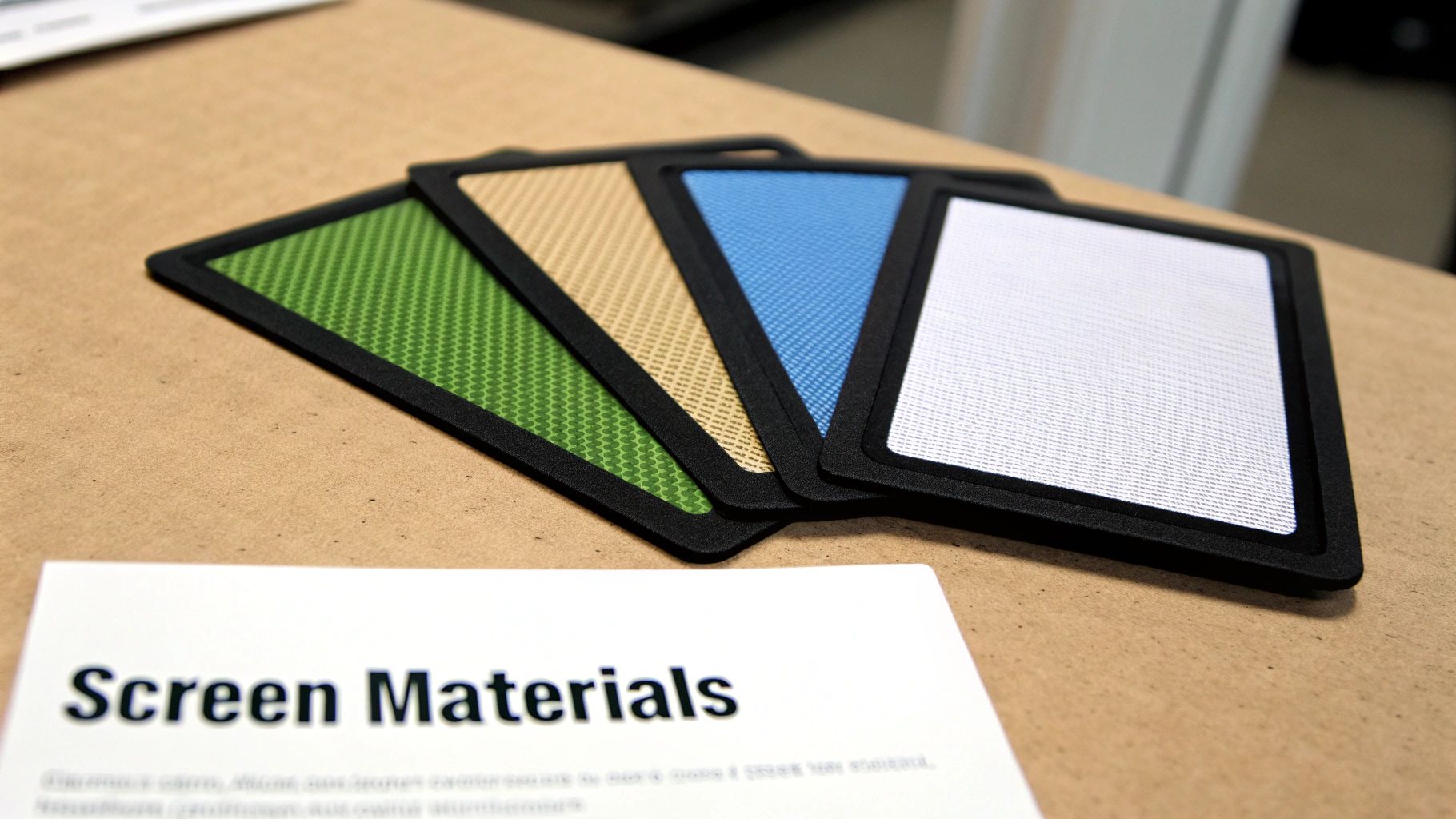
The market offers everything from basic fiberglass to heavy-duty pet screens and high-performance solar mesh. Each one has its own set of pros and cons, so thinking about your local climate, whether you have pets, and your budget is key to making the right call.
Comparison of Window Screen Materials
To help you sort through the options, we've put together a detailed breakdown of common screen materials. This table should make it easier to choose the best option for your home's needs and budget.
| Material Type | Key Benefit | Durability | Cost | Best For |
|---|---|---|---|---|
| Fiberglass | Most affordable and common | Moderate | $ | Basic insect protection in low-traffic areas. |
| Aluminum | Crisp view and stronger than fiberglass | Good | $$ | Clear visibility and resistance to sagging. |
| Pet-Resistant | 7x stronger than fiberglass | Excellent | $$$ | Homes with cats or dogs that claw at screens. |
| Solar Screen | Blocks up to 90% of solar heat | Excellent | $$$$ | Reducing cooling costs and UV damage in sunny climates. |
As you can see, what works best really boils down to your priorities. For a deeper look at these materials, you can learn more about the different types of window screen mesh we install.
A Closer Look at Mesh Options
Beyond the base material, the specific type of mesh is what truly defines your screen's performance. The tightness of the weave and thickness of the strands will influence everything from airflow to what size of insect it keeps out.
-
Standard Fiberglass: This is the go-to for many builders. It's affordable, provides good visibility, and keeps most common pests out. The downside? It's the most likely to get brittle from sun exposure or tear easily.
-
Pet-Resistant Screens: If you have pets, this is a must-have. Made from a tough, vinyl-coated polyester, this mesh can handle claws, paws, and general roughhousing. It’s a smart upgrade that saves you from the headache of frequent repairs.
For Arizona homeowners, solar screens are a game-changer. By blocking a significant portion of the sun’s heat before it even reaches your window glass, they can lower indoor temperatures by up to 15 degrees, leading to substantial savings on your summer energy bills.
- Solar Screens: In the intense Phoenix sun, there is no better option. Solar screens are engineered to block a massive percentage of solar heat and glare, which not only keeps your home cooler but also protects your furniture and floors from fading. While they cost more upfront, the energy savings over time make them a fantastic investment.
Deciding Between Rescreening and Full Replacement
When a window screen gets damaged, the big question is always the same: can I get away with a simple repair, or do I need to replace the whole thing? Making the right call here is key to getting your screen back in working order without spending more than you have to. It really all comes down to the condition of the screen mesh versus the aluminum frame.
If the frame itself is still in great shape, a simple rescreen is often the perfect, most budget-friendly fix. Take a close look at your frame. If it’s straight, solid, and doesn't have any major cracks or dents, but the mesh is torn or brittle, rescreening is the way to go.
When to Choose Rescreening
Rescreening is exactly what it sounds like—we carefully remove the old, damaged mesh and the rubber spline holding it in, then stretch brand-new mesh into the existing frame. This is the ideal solution for common problems that haven’t compromised the frame's structural integrity.
You should consider rescreening if you're dealing with:
- Small rips or holes caused by anything from an accidental poke to sun rot.
- Faded or brittle mesh that’s become discolored and weak after years of sun exposure.
- A desire to upgrade your mesh to something better, like a solar or pet-resistant screen, even if the current mesh is fine but the frame is still good.
This process is always going to be significantly cheaper than a full replacement. To give you an idea, a standard rescreening might cost between $15 and $50. Compare that to a full replacement, which averages closer to $316 per window. We break it down even further in our guide on rescreening a window screen.
When a Full Replacement Is Necessary
Sometimes, the problem is much bigger than just the mesh. A full replacement becomes unavoidable when the frame itself—the screen's foundation—is shot. You can put brand-new mesh on a bent frame, but it will never fit or function correctly.
A complete replacement is your only real option when you see these issues:
- The frame is bent, warped, or cracked, which will prevent it from sitting snugly in your window channel.
- Corner pieces are broken or have fallen out, making the frame wobbly and unstable.
- The hardware is missing or broken, such as pull tabs, leaf springs, or plunger bolts.
It's often easier to see what you're up against after a good cleaning. Some folks even hire professional window cleaning services to get a crystal-clear look at the condition of their windows and screens before making a decision. At the end of the day, if the frame is damaged, investing in a new, custom-fit screen from Sparkle Tech is the only way to ensure lasting protection and a perfect fit.
Got Questions About Window Screen Sizes? We’ve Got Answers.
Even after reading guides, it's normal to have a few lingering questions when you're staring at your windows, tape measure in hand. Getting things right from the start saves a lot of headaches (and money), so we've put together answers to the questions we hear most often from homeowners.
Think of this as your quick-reference guide to clear up any confusion before you measure, buy, or decide to call in a pro.
Do All Window Manufacturers Use the Same Standard Screen Sizes?
In a word: no. This is one of the biggest misconceptions we see. While you'll find common dimensions like 24×36 inches all over the place, there's no single, universal standard window screen size that every company follows.
Every manufacturer, from Andersen to Pella and everyone in between, has their own proprietary designs. A screen built for one brand's window won't just pop into another's, even if the glass looks to be the same size. That's why measuring your specific window frame's channel is the only way to guarantee a perfect fit. Don't fall into the trap of buying based on brand alone.
Pro Tip: For a snug fit that's still easy to install, your window screen's final dimensions should be about 1/16 to 1/8 of an inch smaller than the channel you're fitting it into. This slight tolerance makes all the difference.
Can I Just Buy a Pre-Made Screen and Cut It Down to Size?
I really wouldn't recommend it. Trying to cut down a factory-assembled screen frame is a recipe for frustration. Those frames are held together by corner pieces that are pressed in with precision, and once you cut the aluminum, you destroy the frame's rigidity. You'll almost always end up with a wobbly, weak screen that doesn’t seal properly against insects.
You can buy screen-building kits at the big-box stores, but those are meant for you to cut the individual frame pieces to length before you put them together. If you want a durable, professional-grade screen that will last for years, having one custom-built is always the way to go.
What’s the Best Screen Material for Intense Sun?
If your windows get blasted by the sun, especially in a hot climate like ours, a solar screen is hands-down the best choice. This isn't your standard fiberglass mesh. Solar screens are made from a unique, tightly woven material designed specifically to combat solar heat and UV rays.
- UV Protection: A quality solar screen blocks 80% to 90% of the sun's damaging UV rays from ever hitting your glass.
- Heat Reduction: By stopping that solar energy, they keep your home significantly cooler.
- Energy Savings: With less heat getting inside, your air conditioner doesn't have to work nearly as hard, which means lower energy bills.
Standard screens are great for keeping bugs out, but solar screens do that plus act as a powerful barrier against the sun. They're a smart investment that pays for itself.
Ready for a perfect fit without the hassle? The team at Sparkle Tech Screen Service handles professional measurements and installations for any window. We offer fast quotes and can often provide same-week service for new screens, rescreening, and repairs. Contact us today and let's get it done right.


