


That awful grinding sound? It’s not just annoying—it’s your sliding screen door telling you something is wrong. Thankfully, the solution is usually a simple sliding screen door adjustment, which often just means cleaning the track and tweaking a few screws on the rollers to get the door level again. Before you grab your tools, let's figure out what's really going on.
Why Your Sliding Screen Door Sticks and Scrapes
It’s easy to jump straight to the screwdriver, but taking a moment to diagnose the why behind the problem will save you a ton of hassle. A screen door that once glided perfectly doesn't just fail overnight. It’s almost always a slow-motion breakdown caused by a few common culprits.
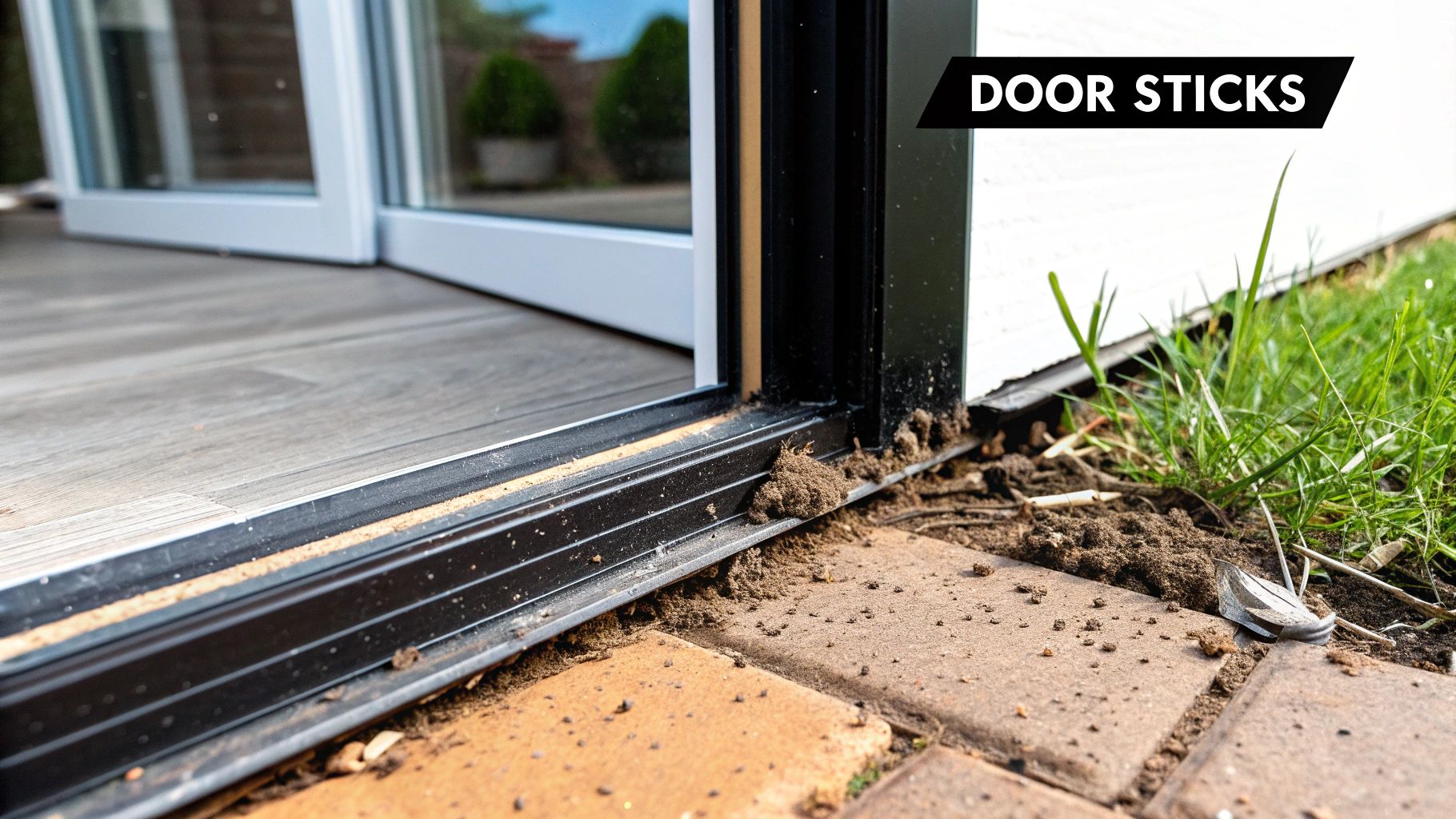
This slow accumulation of gunk and wear is exactly why a little bit of maintenance goes a long way. The best part? Most of these issues are well within the average homeowner's ability to fix.
What's Really Causing the Problem?
Let's break down the usual suspects behind a stubborn door. Knowing which one is affecting your door makes the repair process much faster and more effective.
- Junk in the Track: This is, without a doubt, the most common issue. Dirt, sand, pet hair, and tiny leaves build up in that bottom track, essentially creating an obstacle course for the poor little wheels.
- Worn-Out Rollers: Those little wheels at the top and bottom of the door don't last forever. They can get caked with grime, crack from age, or simply wear down, stopping them from spinning smoothly.
- A Bent or Damaged Track: It happens. Someone steps on the track, or a piece of furniture bumps into it, and suddenly you have a dent. Even a small warp in that soft aluminum can cause the rollers to bind up or jump the track.
- The Frame is Out of Square: Over years of use, the door itself can sag or get knocked out of alignment. When this happens, it puts uneven pressure on the rollers and causes the door to rub against the top or bottom of the frame.
A sticky screen door is more than just a nuisance. That daily friction wears down the frame, the rollers, and even the latch mechanism. A quick adjustment today can easily save you from having to buy a whole new door down the road.
It's no surprise that people want their doors to work properly. Functional, well-maintained entryways are a big deal. In fact, the global door market is expected to hit USD 169.46 million by 2032, which really shows how much homeowners value doors that are secure and glide smoothly. You can dig into these door market trends to see how important these small home details have become.
Diagnosing Common Sliding Screen Door Problems
Before you start, use this quick table to match your door's symptoms to the likely cause. It’ll help you focus your efforts right where they're needed most.
| Symptom | Likely Cause | Primary Solution Area |
|---|---|---|
| Grinding or scraping noise | Debris in the track or worn rollers | Track cleaning or roller inspection |
| Bumpy or jerky movement | Damaged track or dirty rollers | Track inspection and cleaning |
| Door rubs at the top or bottom | Door is out of alignment (not level) | Roller height adjustment |
| Door is difficult to move at all | Worn/broken rollers or severe track damage | Roller replacement or track repair |
| Door wobbles in the frame | Rollers are too low or frame is loose | Roller height adjustment or frame tightening |
Once you have a good idea of the problem, you can move on to the hands-on fix with confidence.
Gathering Your Tools for a Flawless Adjustment
Before we even think about touching a screw, let's talk prep. Turning a simple fix into an all-day project often starts with one simple mistake: not having the right tools ready. A successful sliding screen door adjustment doesn’t require a massive toolbox, just a few key items. Having everything within arm's reach means you can stay focused on the task instead of running back and forth to the garage.
The first, and honestly most critical, step is to give that door track a thorough cleaning. I can't tell you how many times a "broken" door was just a dirty one. In my experience, over 90% of sticking issues are caused by debris buildup. Years of dirt, pet hair, dust, and outdoor gunk get compressed into the track, basically acting like a brake on your door's rollers. A deep clean can often solve the problem entirely.
Your Essential Toolkit
Good news: you probably already have everything you need. This isn't a complex job, but the right tools make it significantly easier and prevent you from accidentally gouging the track or door frame.
- Phillips Head Screwdriver: This is your main tool for turning the roller adjustment screws. Find one that fits the screw heads snugly—the last thing you want is to strip them.
- Stiff Brush: An old toothbrush or a small scrub brush works wonders for dislodging that caked-on grime, especially in the corners of the track.
- Vacuum with a Crevice Tool: Once you've loosened all that gunk with your brush, the vacuum will suck it all up cleanly.
- Putty Knife or Flathead Screwdriver: For the really stubborn, compressed stuff that the brush can't handle, you can carefully use one of these to scrape it out.
Getting your tools together, cleaning the track, and checking for buildup is the foundation of any good adjustment. Skip this, and you're just guessing.
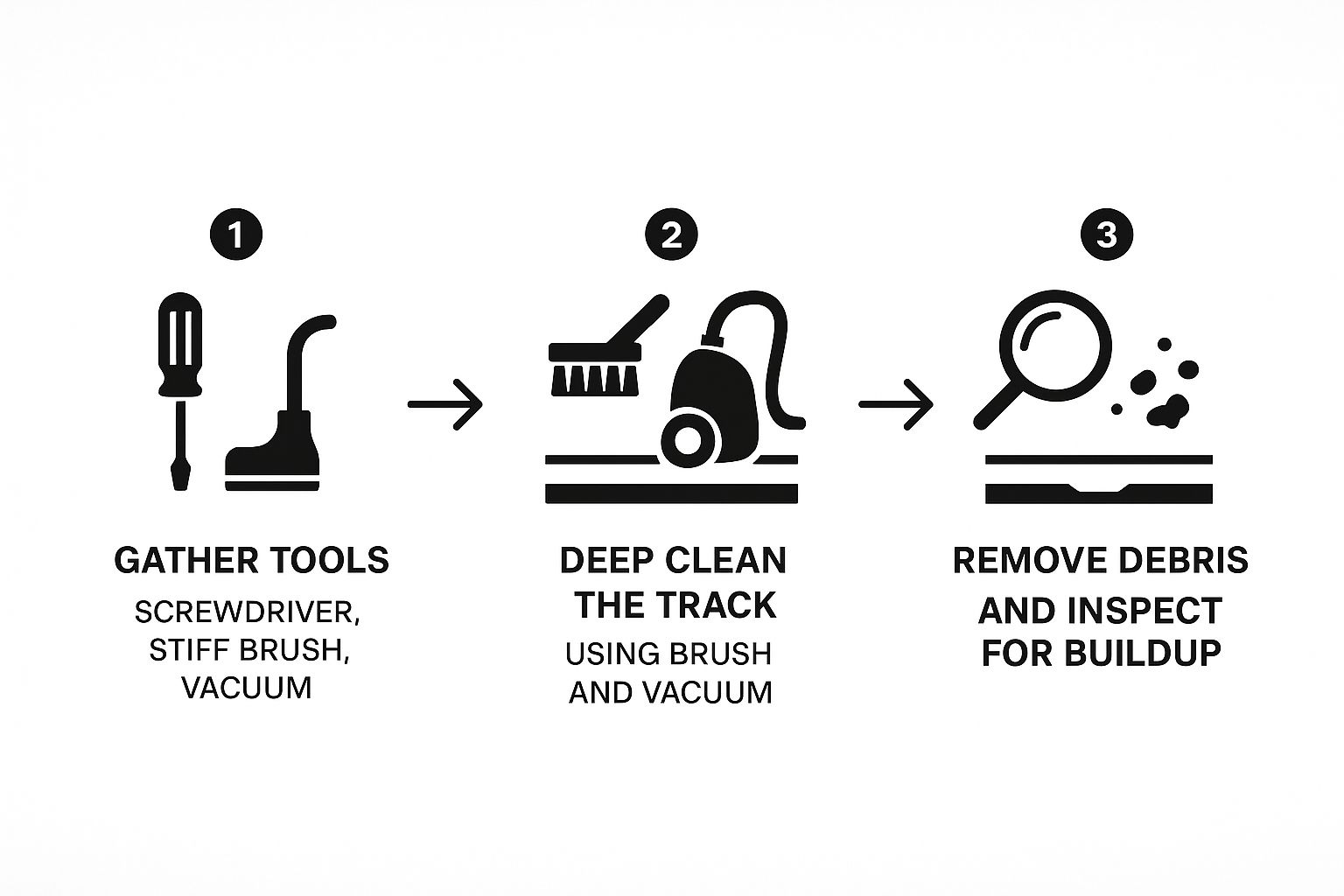
The graphic above breaks down the prep work into three simple actions. Following this flow ensures you're not just pushing dirt around but completely removing it, setting the stage for a smooth adjustment. If you're looking to build out your DIY kit, you might find this overview of essential window screen repair tools helpful for other projects around the house, too.
Pro Tip: When cleaning, really focus on the corners and the very bottom of the track channel. This is where debris gets compacted over time, causing the rollers to lift or bind and throwing the whole door out of alignment.
With the track spotless, slide the door back and forth. You might be surprised to find it glides much better already. If it still sticks, wobbles, or scrapes against the frame, then it’s time to move on to adjusting the rollers—and now you can do it on a perfectly clean surface.
Fine-Tuning the Rollers for That Perfect Glide

Now that you've got a spotless track, it’s time to dial in the rollers. This is where the real magic happens. The secret to a screen door that glides like it's on air usually comes down to two small, often overlooked, adjustment screws. These are what control the height of the wheels tucked into the bottom corners of your door, letting you lift or lower each side independently.
Think of it like leveling a wobbly table—you wouldn't just crank on all four legs at once. You make a small tweak to one leg, check it, and then adjust another if needed. We’re going to apply that same patient approach here. Small, deliberate turns are your best friend.
Finding and Turning the Adjustment Screws
On most sliding screen doors, you'll find small access holes on the face of the vertical frame, right down near the bottom corners. Peek inside, and you should spot the head of a Phillips screw. That's what you're looking for. On some models, they might be hiding behind a little plastic cap that you can gently pry off with a flathead screwdriver.
The adjustment itself is pretty intuitive:
- Turn it Clockwise: This usually raises that corner of the door. If you hear that awful scraping sound on the bottom track, a clockwise turn is your go-to move.
- Turn it Counter-Clockwise: This will lower that corner of the door. You'll want to do this if the top of the door is rubbing against the frame.
Your goal is to get a small, even gap all the way across the bottom. A perfectly adjusted door should hover about 1/8 of an inch above the track. That tiny clearance is what allows the rollers to spin freely without the door frame dragging.
Start with the corner that’s giving you the most grief. If the bottom right corner is scraping, for example, get your screwdriver in the right-side adjustment hole and give it a gentle quarter-turn clockwise.
The Secret is Small, Incremental Adjustments
I've seen it a hundred times: people get impatient and give the screw a full, aggressive turn. This is the biggest mistake you can make during a sliding screen door adjustment, as it almost always throws the alignment way off. A tiny tweak makes a massive difference.
Stick to this simple, repeatable process for the best results:
- A small turn is all it takes. Adjust one screw just a quarter-turn at a time.
- Give it a test slide. Gently roll the door back and forth across the track. Is it smoother? Is the scraping gone?
- Eyeball the alignment. Look at the gap between the door and the side jamb. It should be perfectly even from top to bottom. If it's wider at the top, the door is still crooked.
- Rinse and repeat. Keep making those small quarter-turns, testing after each one, until the door glides effortlessly and hangs straight.
Once one side is fixed, you might find you need a similar tiny adjustment on the other corner to get it perfectly level. Honestly, patience is your most valuable tool here. If you're running into more complex alignment problems, the tips on professional patio door slider repair can offer some more advanced troubleshooting advice.
What to Do with Stubborn or Stripped Screws
So, what happens if the screw refuses to turn, or worse, just spins without doing anything? If a screw is seized up from rust, a quick shot of penetrating oil is your best bet. Let it soak in for 10-15 minutes before you try turning it again.
If the screw spins freely but the door doesn't move up or down, that’s a classic sign of a broken roller mechanism. The internal threads are likely stripped. At this point, that entire roller assembly needs to be replaced. It's a bit more involved than a simple adjustment, but it’s the only way to get your door working properly again.
Solving Advanced Track and Roller Problems
If you've cranked on the adjustment screws and the door still won't cooperate, it's time to dig a little deeper. We're moving past simple tweaks and into real repair territory. A door that constantly jumps off its track, gets stuck in the same spot, or wobbles like crazy is usually screaming for help with either its track or its rollers.
The first step is to get down on your hands and knees and inspect the bottom track like a detective. Get your eye level with it and look down its entire length. You’re hunting for any dings, dents, or debris that could be derailing your door.
Handling a Damaged or Bent Track
Most screen door tracks are made of fairly soft aluminum, which is a nice way of saying they bend and dent easily. Dropping a tool or even just stepping on it by accident can create a problem spot that brings the whole door to a grinding halt.
Fortunately, minor damage is often fixable. If you find a small dent:
- Try a wood block and hammer. Place a small, flat block of wood over the dented part of the track. Then, give the wood a few light taps with a hammer. The idea here is to gently coax the metal back into shape, not pound it flat.
- Use pliers for fine-tuning. If the lip of the track is bent, you can often use a pair of pliers to carefully squeeze it back into alignment. I recommend wrapping the jaws of the pliers with a layer or two of electrical tape to avoid scratching up the track's finish.
A word of caution from experience: don't get aggressive. It's far better to use a dozen gentle taps than one or two heavy-handed whacks. You can always hit it again, but you can't undo a section you've accidentally flattened.
Sometimes, though, a track is simply too far gone. If you're looking at deep gouges, a long crushed section, or a significant warp, you’re probably better off replacing it. Trying to fix severe damage can just make the door's movement even worse.
When to Suspect Worn-Out Rollers
What if the track looks perfectly fine, but the door still fights you every inch of the way? If it grinds, stutters, or feels wobbly, the rollers are almost always the culprits. Over years of use, those little plastic wheels can crack, develop flat spots, or get so clogged with pet hair and dirt that they just stop spinning.
To get a good look, you'll need to take the door off. Lift it straight up until the bottom rollers clear the track, then swing the bottom of the door out toward you. Set it down on a flat, clean surface so you can see what's going on with the roller assemblies at the bottom corners.
You're on the lookout for a few key signs of failure:
- Cracked or Broken Wheels: This one's a no-brainer. Any visible crack means it's time for a replacement.
- Flat Spots: A wheel that gets stuck and dragged instead of rolling will wear down unevenly, creating a flat spot that causes that tell-tale thump-thump-thump as it moves.
- Excessive Wobble: The wheel should spin freely on its axle, but if it wobbles from side to side, the bearing is shot.
- Seized Wheels: Give the wheel a flick with your finger. If it doesn't spin easily, it's seized up from grime or rust.
Nailing these more advanced fixes is a crucial part of a complete sliding screen door adjustment. It’s no surprise that homeowners are increasingly looking for smoother, more convenient features. In fact, the market for retractable screen doors is expected to grow at a CAGR of 9.0% from 2024 to 2031. This trend really underscores how much people value doors that are easy to use and maintain. You can read more about these consumer trends in screen door technology to see just how a well-adjusted door fits into the bigger picture of modern home convenience.
Getting the Latch Just Right for a Secure Close
You've got the door gliding like it's on ice, but if it doesn't lock, the job's not done. Getting that latch to click shut securely is the final, crucial step. It's the difference between a door that works and a door that gives you peace of mind.
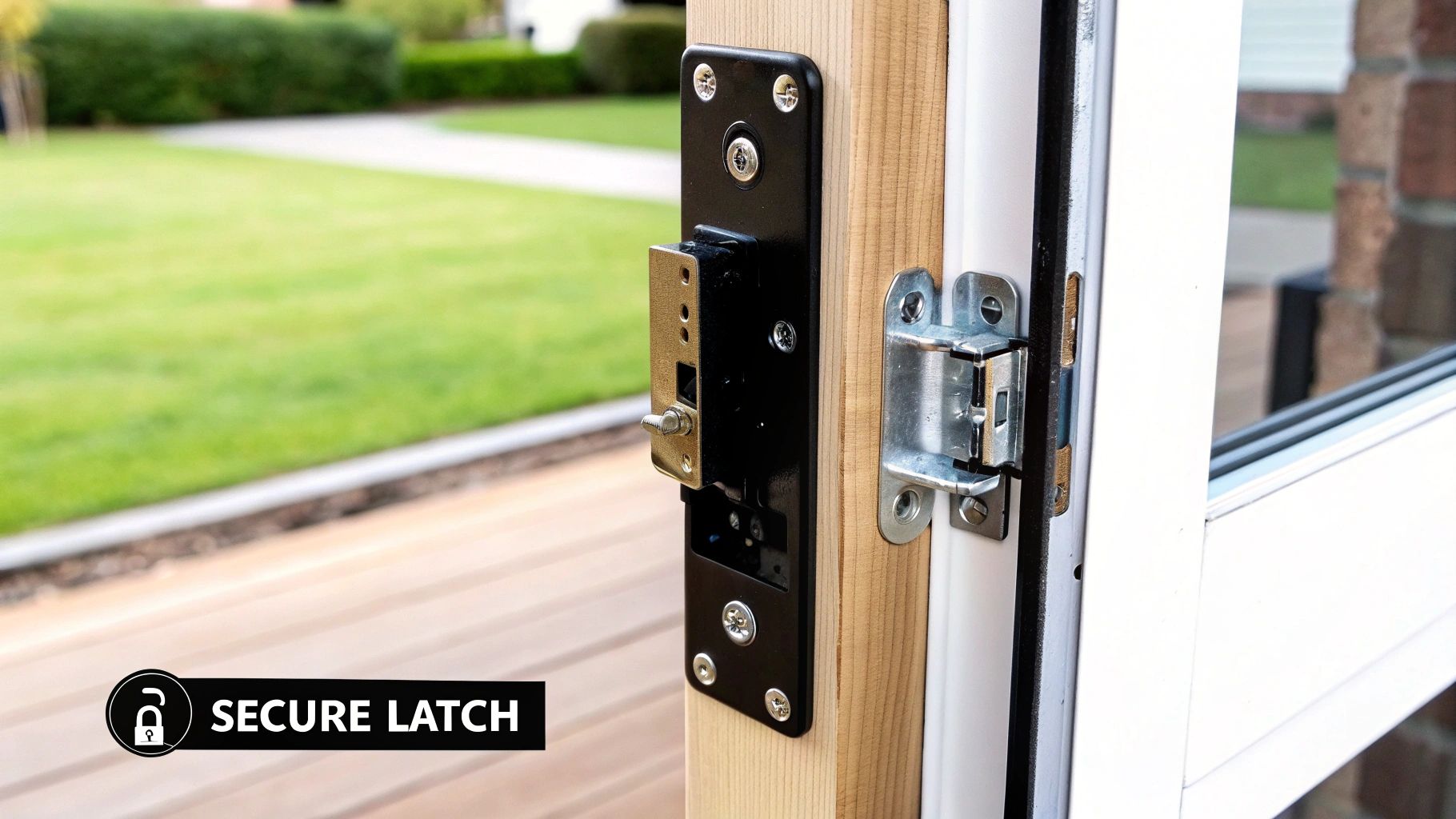
Here's a tip from experience: 9 times out of 10, the issue isn't with the latch mechanism on the door. It’s the strike plate on the door jamb—the part it's supposed to catch. When you adjust the rollers and change the door's height, you almost always throw off this alignment.
Aligning the Strike Plate
Thankfully, this is usually a simple fix. All you need is that Phillips head screwdriver again.
Look at the strike plate on the jamb; it's held in place by two screws. You don't need to take them all the way out. Just loosen them enough so you can move the plate up or down with a little effort.
Now, slide the door so it's almost shut. Eyeball the latch hook and see how it lines up with the opening on the strike plate. Gently nudge the plate up or down until they're perfectly aligned. Once you have it in the sweet spot, tighten those screws back down firmly. Give the door a few test closes to make sure it latches smoothly without any force.
If the latch itself feels loose or wobbly, take a look at the handle assembly on the door. Those screws can work their way loose over time from daily use, but a quick tightening is all it takes. Of course, if you're dealing with a fundamentally warped or damaged frame, no amount of adjustment will help. In that case, looking into a professional screen door installation is your best bet for a lasting fix.
The Final Touch for a Long-Lasting Glide
With the rollers set and the latch secure, there's one last thing I always do: lubrication. Don't skip this part! It’s a tiny step that makes a huge difference in how well your door works over the years.
- The Right Product: Get yourself a can of silicone-based spray lubricant.
- What to Avoid: Whatever you do, do NOT use WD-40 or any other oil-based products. I've seen it a hundred times—oil is a magnet for dust and grime, and you'll end up with a sticky, black gunk that makes the door even harder to slide.
Give the top and bottom tracks a light misting of the silicone spray. A quick shot on the rollers themselves is a good idea, too. This little bit of maintenance cuts down on friction and prevents unnecessary wear.
A smoothly operating door is more than just a convenience; it's a feature people value. You can see this trend even in high-end markets, where the automatic sliding door sector is expected to hit USD 3.93 billion by 2032.
That massive number just shows how much homeowners want doors that are safe, efficient, and easy to use—all qualities you get from a well-maintained screen door. It proves that taking a few minutes to get these adjustments right isn't just a simple repair; it's a real upgrade to your home.
Got Questions? We've Got Answers
Even the most straightforward DIY project can throw a curveball or two. Getting your sliding screen door just right often means knowing how to tackle those little "what if" moments that pop up along the way.
Let's walk through some of the most common questions we get from homeowners. Think of this as the expert advice you'd get from a seasoned pro who's seen it all.
How Often Should I Mess With This Thing?
There’s no strict schedule, but a good habit is to clean the tracks with the seasons—so about four times a year. This quick wipe-down prevents the grit and grime from building up and causing real problems down the road.
As for adjusting the rollers? Don't overthink it. Only touch those screws when the door starts telling you it needs help. If it’s sticking, making a grinding noise, or won't latch easily, it's time for a tune-up.
A little pro-tip: If you're in a dusty area or have pets, running a vacuum nozzle over the track once a month is a great preventative measure.
My Adjustment Screws Are Just Spinning. Now What?
Ah, the spinning screw—a classic and frustrating problem. If you turn the screw and nothing happens—the door doesn't go up or down—it's a sure sign that the roller assembly inside is broken. The screw has lost its grip on the mechanism that actually lifts the wheel.
Unfortunately, this isn't a simple fix. The entire roller assembly has to be replaced. You'll need to take the door off its frame, pop the old, busted roller out, and slide a new one in. It's the only way forward.
Can I Just Spray Some WD-40 in There?
Please don't! This is hands-down the most common mistake people make. You should absolutely avoid using WD-40 or any other oil-based lubricant on the track or rollers.
It might feel like it's working for a day, but oil is a magnet for every speck of dust, dirt, and pet hair in the vicinity. Before you know it, you'll have a thick, gummy paste clogging up the whole system, making the door even harder to slide than when you started.
The right tool for the job is a silicone-based spray lubricant. It goes on clean and dries without leaving a sticky residue, so it lubricates the parts without attracting gunk. This one small choice will save you so many headaches in the long run.
If you've tried everything and that door still won't cooperate, or if you'd just rather have an expert handle it, Sparkle Tech Screen Service is here to help. We offer professional repair and installation to get your screens working perfectly. Get a quick quote today!


