


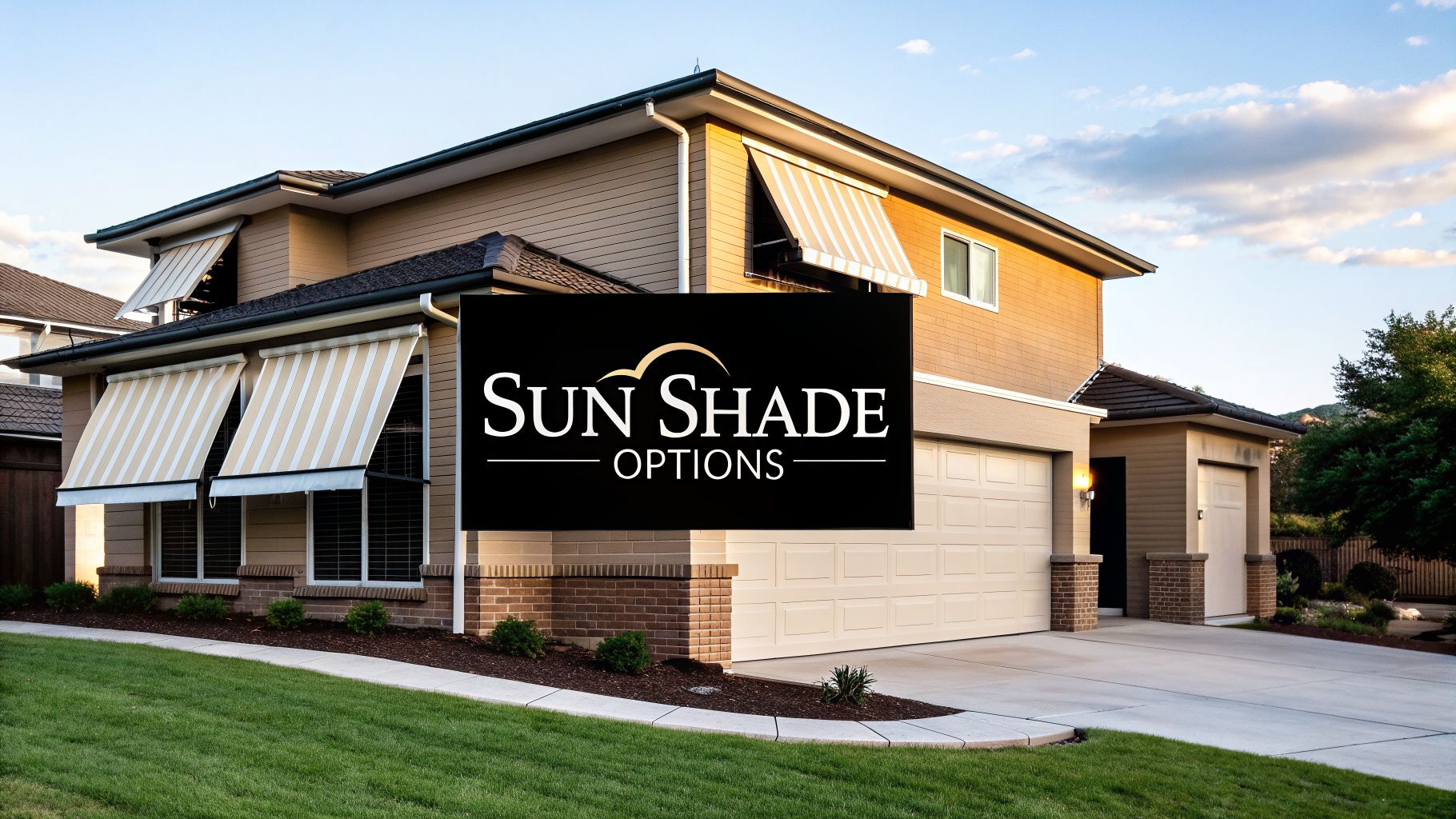

If you're living in Phoenix, you know the struggle. The relentless sun beats down, turning your windows into giant heat lamps and your AC unit into a money-devouring monster. Choosing the right sun shade for your house isn't just a home improvement project; it's one of the smartest moves you can make to get your comfort—and your budget—back under control.
These aren't your grandma's flimsy curtains. We're talking about exterior shades that stop the sun's blistering heat before it ever touches the glass, making a massive difference in how cool your home feels.
How a Sun Shade for Your House Beats the Arizona Heat
Picture a window on a hot summer afternoon. It's basically a small space heater, cranked to high, pouring heat into your living room. The glass intensifies the sun's energy, and your air conditioner has to fight a losing battle, running nonstop just to keep things bearable. That constant struggle is what creates those annoying hot spots and those painfully high SRP or APS bills.
A quality sun shade completely changes the game. It acts like a protective shield, intercepting the solar blast and reflecting most of the heat away from your home. It’s a simple concept, but it's the secret to a much cooler, more energy-efficient home, especially here in the Valley.
Your First Line of Defense Against the Sun
Putting up a sun shade is more than just adding an accessory to your house; it's a strategic upgrade that changes how your home handles the sun. The main goal here is to tackle "solar heat gain." That's a technical term for a simple problem: up to 76% of the sunlight that hits a standard double-pane window gets inside and turns into heat.
When you block that heat at the source, the benefits are immediate and obvious:
- Serious Heat Reduction: You can block up to 90% of the sun's heat. Rooms that used to be unbearable in the afternoon suddenly become cool and comfortable.
- Lower Energy Bills: Your AC gets a much-needed break. Less strain means less energy used, which translates directly into real savings every month.
- More Comfortable Living: Say goodbye to that blinding glare and those hot spots next to the windows. You can finally enjoy every room in your house, all day long.
- Protect Your Stuff: Those same powerful UV rays that give us sunburns also fade our furniture, floors, and art. Sun shades act as a powerful sunscreen for your belongings.
A well-placed sun shade doesn't just cool a room; it transforms it. That sun-blasted, glaring space becomes a comfortable, inviting part of your home again.
This guide is here to walk you through the best options out there, from permanent solar screens to retractable awnings, so you can make a smart investment that pays off for years. With energy costs only going up, getting a handle on your home's sun exposure is more important than ever. It's your ticket to a cooler, more affordable, and all-around more pleasant place to live.
Your Guide to Sun Shade Options, From Solar Screens to Awnings
Figuring out the right sun shade for your house can feel like a chore, but it really boils down to one question: what do you need? Are you after constant, set-it-and-forget-it protection, or do you want flexible shade you can control on a whim?
Each type of shade offers a unique way to fight back against the relentless Arizona sun. Let’s walk through the most popular options—solar screens, retractable awnings, and exterior shades—so you can find the perfect fit for your home and lifestyle. Think of it like picking the right tool for the job; each one shines in a different situation.
This simple flowchart can help guide your decision, showing how those sky-high bills and that uncomfortably hot house point directly to sun shades as the solution.

It’s a clear visual: if you're a Phoenix homeowner dealing with these common frustrations, there's an effective way to get both comfort and savings.
Solar Screens: The Workhorse of Sun Protection
For windows, solar screens are the undisputed champions, especially here in the sun-baked Phoenix area. Think of them as high-performance sunglasses permanently installed on your windows. They’re fixed to the exterior frame and work around the clock, blocking intense heat and damaging UV rays before they ever hit the glass.
Since they’re always in place, they provide consistent protection without you having to lift a finger. This makes them absolutely perfect for those hard-to-reach second-story windows or any window that gets blasted by direct sun—especially those facing west or south.
The Bottom Line: Solar screens are your best bet for maximum, hands-off heat reduction. They are simply the most efficient way to slash solar heat gain through your windows, which has a direct and immediate impact on your home's temperature and your AC bill.
One of the best things about modern solar screens is that they don't sacrifice your view. Even though they dramatically cut glare and heat, the specially designed mesh allows for excellent visibility, so you won’t feel like you're living in a cave.
Retractable Awnings and Shades: On-Demand Comfort
While solar screens lock down protection for your windows, retractable awnings and exterior shades bring flexibility to your outdoor living spaces. They are the perfect sun shade for a house with a patio, deck, or outdoor kitchen—anywhere you want shade sometimes, but not all the time.
With the push of a button or the turn of a crank, you can extend an awning to create a cool, shaded retreat for entertaining or just relaxing. Then, when you want to soak up some morning sun or on a cloudy day, you can retract it just as easily.
This versatility is their greatest strength. Here’s where they really come in handy:
- Patios and Decks: Instantly create a comfortable "outdoor room" that’s usable even in the afternoon heat.
- Poolside Areas: Offer a shady spot for lounging between swims without permanently covering the area.
- Over Large Windows or Sliding Glass Doors: Extend them during the hottest parts of the day, then retract them in the morning or winter to let natural light and warmth flood in.
You can explore various sun shade services to see just how these options can be tailored for your home. This level of control allows you to manage your environment perfectly.
Making the Right Choice for Your Home
So, what’s the right call for you? It often comes down to the specific spot you want to protect and how you use that space. Many homeowners find that a smart combination of different shade types gives them the most complete solution.
To make it even clearer, here’s a quick breakdown of how these options stack up against each other.
A Quick Comparison of Sun Shade Options
This table compares the primary types of sun shades across key features, helping you quickly see which one might be the best fit for your needs.
| Shade Type | Primary Benefit | Best For | Flexibility | Typical Cost |
|---|---|---|---|---|
| Solar Screens | Constant heat & UV blocking | Windows, especially west/south facing | Low (fixed in place) | $$ |
| Retractable Awnings | On-demand shade for spaces | Patios, decks, outdoor living areas | High (extends & retracts) | $$$$ |
| Exterior Shades | Flexible vertical sun blocking | Porches, pergolas, large window banks | High (rolls up & down) | $$$ |
Ultimately, the goal is to find what works for your home's unique layout and your family's lifestyle.
The demand for these solutions is growing fast for a reason. The global market for blinds and shades was valued at $5.48 billion in 2024 and is expected to hit $9.71 billion by 2034. Homeowners are actively looking for products that can cut heat transfer by up to 60%.
Here in places like Phoenix, Peoria, and Mesa, a high-quality sun shade for a house isn't just a nice extra—it’s a critical part of keeping your home comfortable and your energy bills in check.
Understanding Sun Shade Materials and Technology
When you're looking to add sun shades to your home, it’s easy to get caught up in picking the right color. But the real magic, the part that actually saves you money and makes your home more comfortable, is in the material and the technology behind it. Getting a handle on these details is what separates a decent shade from a game-changing investment against the Arizona sun.
Think of it like this: the technical specs are the "nutrition label" for your windows. You wouldn't buy food without knowing what's in it, right? The same goes for shades. A few key numbers and terms tell you everything you need to know about how they'll perform in the real world.

Cracking the Code on Mesh Openness
The single most important factor for a sun shade is its mesh openness, also called density. This is basically an SPF rating for your home—it tells you exactly what percentage of the sun's heat and UV rays the fabric is going to block.
For instance, an 80% screen blocks 80% of the sun’s heat while still letting 20% of the natural light filter through. Bump that up to a 95% screen, and you’re blocking a massive 95% of the heat with only 5% of the light getting in.
The higher the percentage, the stronger the protection. An 80% screen is a fantastic all-around choice, but for those brutal west-facing windows that get hammered by the afternoon sun, a 90% or 95% screen is a true powerhouse.
It all comes down to finding that sweet spot between blocking the heat and keeping the natural light you love.
Built to Survive the Arizona Sun
Let's be honest, not all materials can handle a Phoenix summer. A quality sun shade needs to be incredibly tough. The two most common and reliable materials you'll find are PVC-coated polyester and fiberglass.
- PVC-Coated Polyester: This stuff is the industry workhorse for good reason. It’s exceptionally strong, resists tearing, and holds its color for years without fading under that relentless UV exposure.
- Fiberglass: The main advantage of fiberglass is its stability. It won’t stretch or shrink when the temperatures swing from a cool morning to a scorching afternoon. This means it maintains excellent clarity and is highly resistant to moisture.
Both of these materials are engineered to last for over a decade, giving you a long-term barrier that keeps paying for itself. Of course, shades are just one part of the puzzle. Combining them with other technologies like radiant barrier insulation can create an even more effective defense against solar heat.
How Color Shapes Your View and Savings
This might surprise you, but the color of your shade fabric does a lot more than just match your trim. It actually plays a huge role in performance, directly affecting heat absorption, glare, and how clearly you can see outside.
- Darker Colors (Black, Charcoal, Brown): Think of these like a good pair of sunglasses. They are fantastic at cutting glare and give you the absolute crispest, clearest view looking out. They work by absorbing solar heat and then radiating it away from the window.
- Lighter Colors (White, Beige, Tan): These shades are masters of reflection. They bounce a lot of the sun’s heat away before it can even be absorbed. The trade-off is that this high reflectivity can sometimes create more noticeable glare, making the view a little less sharp.
There's no single "best" choice—it's about what you value most. Do you want the best possible view, or is maximum heat reflection the top priority? Understanding how these core elements work together puts you in the driver's seat, allowing you to pick the perfect sun shade for your home.
Calculating Your Sun Shade Cost and Savings in Arizona
So, let's talk about what really matters for most homeowners: the bottom line. How much do these things cost, and when will you start seeing a return? Investing in sun shades for your house isn't just about comfort; it's a smart financial decision, especially here in the Phoenix metro where our AC units are the hardest-working appliances we own.
When you look at the numbers, the story becomes pretty clear. You’ve got a one-time cost for the materials and installation. But the savings? Those show up on your electricity bill month after month, year after year. It's one of the best ways to proactively prevent unusually high air conditioning bills when the Arizona heat really kicks in.
Breaking Down the Initial Investment
The upfront cost to outfit your home with sun shades can swing a bit depending on a few things. We have to consider the total number of windows you want to cover, their exact sizes, the type of mesh you go with (like an 80% versus a 90% block), and how complex the installation is.
Think of it as a custom-fit solution for your specific home. A cozy patio home in Sun City will have a completely different price tag than a big two-story in Scottsdale with a wall of west-facing windows getting blasted by the afternoon sun.
Your initial investment is directly tied to your future savings. It can be tempting to go with the cheapest option, but choosing a higher-density screen for those sun-drenched windows often pays you back faster by maximizing your energy savings from day one.
It's no surprise that the market for good shading solutions is growing. Homeowners are catching on to the real value. Globally, the blinds and shades market hit $14.82 billion in 2024 and is expected to climb to $24.63 billion by 2030. That growth is fueled by people who see the clear financial benefit of making their homes more energy-efficient. You can read more about this trend and the impact of smart shading devices and their impact on energy use.
Unpacking Your Return on Investment
The payback from sun shades is about more than just a lower SRP or APS bill, though that's certainly the most obvious perk. Here in places like Phoenix, Avondale, and Queen Creek, we know that top-notch sun shades can slash solar heat gain by up to 60%. That takes a massive load off your AC unit.
But the savings don't stop there. Here’s a quick look at all the ways your investment pays you back:
- UV Protection for Your Stuff: Those same UV rays that give you a sunburn are also fading your expensive couches, rugs, and artwork. Solar screens are like SPF for your home, preserving the value of everything inside and saving you thousands in replacement costs down the road.
- A More Comfortable, Valuable Home: Let's be honest, a cooler home is a better home. When it's time to sell, having energy-efficient upgrades like solar screens is a huge plus for potential buyers who know what an Arizona summer feels like.
- Longer HVAC Lifespan: Your air conditioner is a machine, and the harder it works, the faster it wears out. By giving it a break every day, you can extend the life of your HVAC system and put off the massive expense of a full replacement.
Estimated Sun Shade ROI for a Phoenix Home
To make this all a bit more concrete, let's look at some sample numbers. The table below shows a typical cost-versus-savings scenario for a 2,000 sq. ft. home in the Phoenix area. It's a great way to see just how quickly these screens can pay for themselves.
| Shade Solution | Estimated Initial Cost | Projected Annual Energy Savings | Payback Period (Years) |
|---|---|---|---|
| 80% Solar Screens (10 Windows) | $1,200 – $1,800 | $250 – $400 | 4 – 6 |
| 90% Solar Screens (10 Windows) | $1,500 – $2,200 | $350 – $550 | 3 – 5 |
| Retractable Patio Shade (1 Large) | $2,500 – $4,500 | $150 – $250 | 10+ |
As you can see, a quality sun screen installation often pays for itself in just a handful of years. Once you hit that payback point, all the future savings are just pure profit, putting money right back into your pocket every single summer. It really changes the conversation from a simple home expense to a long-term financial asset.
Choosing Between DIY and Professional Sun Shade Installation
So, you've picked out the perfect sun shades for your house. Now for the final piece of the puzzle: getting them up on the windows. This brings you to a classic homeowner crossroads: do you break out the tools and tackle it yourself, or is it better to call in a pro? The right answer really comes down to your own skills, what tools you have on hand, and how much a perfect, long-lasting fit matters to you.

Don't underestimate this decision. A sun shade that’s installed poorly won’t just look a little off—it won't give you the energy savings and cooling comfort you’re paying for.
The Do It Yourself Approach
For the confident DIY-er, installing your own sun shades can feel like a smart way to save some money. If you’re comfortable with a drill and have a bit of patience, it’s definitely a project you can knock out over a weekend. But it's important to be honest about what you're getting into before you start making holes in your home.
Here are a few common DIY pitfalls to watch out for:
- Improper Fit: Measuring for solar screens is an exact science. Being off by even a quarter of an inch can leave ugly gaps that let heat and pests sneak right in, defeating the whole purpose.
- Incorrect Tension: The screen mesh needs to be pulled perfectly taut—not too loose, not too tight. A saggy screen looks unprofessional and will flap around in the wind, while a screen that's too tight can actually warp your window frames over time.
- Safety Risks: Let's face it, getting up on a ladder, especially for second-story windows, is risky business. A professional crew has the right safety equipment and years of experience to do the job without any accidents.
If you do decide to go for it, make sure you have a quality drill, a reliable measuring tape, and a very sturdy ladder. And never forget the carpenter's golden rule: measure twice, cut once.
The Case for Professional Installation
While there's a certain satisfaction in doing it yourself, there are some very strong arguments for hiring an expert to install a sun shade for your house. Think of professional installation not just as a service, but as an insurance policy on your investment, guaranteeing it performs at its best from day one.
A professional installation ensures that every screen fits flawlessly, is tensioned correctly, and is securely attached to your home. This precision maximizes heat blockage and guarantees the product's longevity, protecting your investment for years to come.
Bringing in a pro takes all the guesswork and stress out of the equation. They’ve got the specialized tools and the experience to handle anything, from odd-shaped custom windows to tricky mounting surfaces. You can learn more about the specific benefits of a professional solar screen installation service and see how the experts handle every last detail.
Maintenance and Simple Repairs
Whether you install them yourself or hire a pro, your sun shades will need a little TLC to keep them in top shape. The good news is, the maintenance is incredibly easy. A quick wash with some mild soap and water a couple of times a year is usually all it takes to clear off any dust and grime.
Down the road, you might run into a minor problem. The most common repair is re-screening, which just means swapping out the old, worn-out mesh for a new piece. While you can buy DIY kits, getting the screen stretched just right without the proper tools can be a real headache. If you spot a tear or notice the screen is starting to sag, calling a local service for a quick fix is usually faster and more effective, ensuring your home stays cool and protected.
Your Local Experts for Sun Shades in Phoenix
We've covered a lot of ground in this guide, and if one thing is clear, it's that installing high-quality sun shades on your house is one of the smartest moves any Arizona homeowner can make. It's a straight line to a cooler home, smaller energy bills, and just a more pleasant life here in the desert. You've seen the tech, run the numbers, and weighed the installation options—now it’s time for the final step.
And that’s where we come in. At Sparkle Tech Screen Service, we’re the local pros dedicated to bringing all those benefits right to your doorstep with professional, no-fuss service.
Your Go-To Service in the Valley
We get the unique challenges of the Phoenix climate because we're not just a company—we're your neighbors. Our team is out here every day providing top-tier sun shade installation, repairs, and re-screening services across the entire Valley.
Here at Sparkle Tech, we don't think beating the heat should be complicated. Our goal is simple: deliver fast, dependable solutions that protect your home and your wallet, making sure you get the most out of your investment from the day we're done.
We're proud to serve a wide range of communities, so you can be sure that expert help is just around the corner. If you're wondering if we work in your area, homeowners can explore our extensive Phoenix-area service locations to see how we've got you covered.
Our primary service areas include:
- Phoenix
- Scottsdale
- Mesa
- Tempe
- Chandler
Ready When You Are
We believe getting new screens should be easy. From the first phone call to the finished installation, we’re all about making the experience a smooth one. We stick to our promise of quick quotes and reliable same-week service so you can start enjoying a cooler home right away, without the long wait times.
Don't let another summer go by fighting with high AC bills and rooms you can't even use in the afternoon. It's time to take control of the sun and turn your house into the cool, comfortable oasis it's meant to be.
Ready to make a change? Let's talk.
Call or Text Sparkle Tech Screen Service today at 623-233-0404 for your free, no-obligation quote!
Got Questions About House Sun Shades? We’ve Got Answers.
It's smart to have questions before you invest in something for your home. We get it. We've talked to hundreds of homeowners across the Phoenix area, and the same handful of concerns always seem to pop up.
So, let's tackle those head-on. Getting clear, honest answers is the best way to feel great about your decision to make your home a cooler, more comfortable place.
Will Dark Solar Screens Make My Home Feel Like a Cave?
This is easily the number one myth we hear, and the answer is a firm no. It's a logical assumption—dark screen equals dark room, right? But the technology is much smarter than that.
Think of solar screens less like blackout curtains and more like a premium pair of sunglasses for your house. They’re designed to cut the harsh, blinding glare while keeping your view of the outside sharp and clear. You’ll still have plenty of soft, natural light filling your rooms, just without the intense heat and the need to squint.
High-performance solar screens don't darken your home; they perfect the light. They block the oppressive solar heat while preserving a bright, open atmosphere and your connection to the outdoors.
In fact, many of our customers are amazed at how much better their view is once the overpowering glare is gone.
How Long Do Sun Screens Last in the Brutal Arizona Climate?
A fantastic question. The Arizona sun is relentless, and it's tough on just about everything. But a professionally installed, top-tier solar screen is engineered for this exact environment. With a quality product, you can realistically expect a lifespan of 10 to 15 years, sometimes even longer.
The two biggest factors in how long they last are:
- The Quality of the Material: We insist on using durable, UV-resistant fabrics like PVC-coated polyester. This is key to preventing the material from getting brittle, fading, or tearing prematurely.
- A Proper Installation: A screen that’s measured perfectly and tensioned just right will hold up to monsoon winds and daily sun exposure far better than a sloppy, loose-fitting job.
Can I Still Open My Windows with Solar Screens On?
Absolutely! This is a simple but crucial point. Solar screens are mounted on the outside of your window frame, completely independent of the window itself.
They don't interfere with your window’s operation at all. You can still open and close them whenever you want to catch a cool morning breeze or let in the evening air.
Are Sun Shades Worth It During the Winter?
Yes, they still pull their weight even when it's not scorching hot outside. While their main job is blocking summer heat, their benefits don't hibernate for the winter.
During the cooler months, they continue to provide excellent daytime privacy. They also add a subtle layer of insulation, which helps reduce a bit of heat loss and keeps your home feeling just a little cozier. This makes a sun shade a smart, year-round addition to any house.
Ready to stop the sun in its tracks and start saving money? Sparkle Tech Screen Service provides fast, reliable, and professional sun screen installation across the Phoenix area. Get your free, no-hassle quote today and find out how easy it is to make your home more comfortable. Learn more at https://sparkletechscreenservice.com.


