



When you start looking into solar screens, one of the first questions is always about the cost. So let's get right to it: a professionally installed solar screen is typically going to run you between $80 and $280 per window.
For most homeowners here in the Phoenix area, that usually means a total project cost somewhere in the neighborhood of $1,200 to $4,200. Of course, that depends on how many windows you have and the quality of the materials you choose.
Breaking Down The Price Of Solar Screens
To really understand the numbers, you have to look at what you're actually paying for. It’s not just an off-the-shelf product. The final price is a blend of the screen and frame materials, the skilled labor to build and install them perfectly, and the unique details of your home. Think of it like getting a custom suit—the fabric is one part, but the expert tailoring is what makes it fit flawlessly.
Here at Sparkle Tech Screen Service, we’re all about transparency. Our quick, no-hassle quotes lay everything out clearly so you know exactly where your investment is going. We want you to see the direct line between the initial cost and the long-term energy savings and comfort you're about to enjoy.
Quick Overview of Solar Screen Installation Costs
To give you a clearer picture at a glance, here’s a table summarizing the typical cost ranges. Think of this as a solid starting point before we dig into the details that can move the price up or down.
| Cost Metric | Average Low End | Average High End | Notes |
|---|---|---|---|
| Per Window | $80 | $280 | Includes materials and professional installation for a standard window. |
| Per Square Foot | $4 | $8 | This is for the screen material only, not including the frame or labor. |
| Typical Home | $1,200 | $4,200 | Based on a home with 15-20 standard-sized windows. |
These numbers give you a practical budget range and help you see how different factors contribute to the final cost.
National Averages And What They Mean For You
It's always helpful to see how local Phoenix prices stack up against the rest of the country. Looking at nationwide data, the average U.S. homeowner pays about $160 per window for a solar screen, which includes both the materials and the installation.
Most projects fall within that same $80 to $280 per window range, with the labor portion alone typically making up $35 to $90 of that total. If you're curious, you can explore more about these national cost averages to see how pricing trends vary in different markets.
The real value of professional installation isn't just in the final product; it's in the precision, speed, and peace of mind that come with it. A perfect fit guarantees maximum energy efficiency and longevity for your screens.
Knowing these benchmarks empowers you to look at quotes with a critical eye. When you get an estimate, you can compare it to these figures and feel confident you’re getting a fair price for quality work.
What Drives the Final Price of Your Solar Screens?
Getting a ballpark average for solar screen installation is a good first step, but the quote you get will be specific to your home. Several key variables can swing that final number up or down. Knowing what they are helps you make smart choices that fit your budget and meet your home's cooling needs.
Think of it like getting custom shades for your windows. The basic model works fine, but when you start looking at blackout fabrics, custom fits, or trickier installations, the price changes. The same idea applies here—the materials you pick and the complexity of the job really shape the final cost.
Screen Fabric and Weave Density
The fabric is the core of your solar screen, and it's one of the biggest factors in the price. The two most popular choices you'll see in Phoenix are 80% and 90% blockage fabrics. An 80% screen is a fantastic all-around option, blocking a ton of heat while still giving you a crisp, clear view outside.
A 90% screen, on the other hand, has a much tighter weave for maximum heat and UV rejection. This is the go-to choice for those west-facing windows that get absolutely hammered by the afternoon sun. Because it’s a denser material, 90% fabric usually costs a bit more than 80% fabric. While color doesn't change the performance, darker fabrics tend to be easier to see through from the inside.
Window Size and Shape
This one's pretty straightforward: bigger windows cost more. A huge picture window in your living room will naturally require more material and time than a small bathroom window. But it's not just about the square footage; the shape is a huge deal.
Custom shapes like arches, circles, or angled windows demand a lot more skill and time to get right.
- Standard Rectangles: These are the easiest and most affordable to make and install.
- Arched Windows: They need custom-bent frames and perfectly cut fabric, which adds to the labor and material cost.
- Geometric Shapes: Triangles and other odd shapes take serious craftsmanship to create a tight, effective seal.
The more unique the window, the more specialized the work. That extra attention to detail is what guarantees the screen works perfectly, and it will be reflected in the final quote.
Window Location and Accessibility
Where the windows are on your house matters, too. First-floor windows are a breeze—installers can access them easily, which keeps labor costs down.
Once you get to the second or third story, things get more complicated. Our team needs to bring out the tall ladders and take extra safety precautions to work up high. That extra equipment, setup time, and risk will add to the labor cost. Things like dense bushes, awnings, or tricky rooflines can also make a window harder to get to, bumping up the installation time.
Finally, the frame material itself plays a role. We almost always use durable, long-lasting aluminum—it's the industry standard for a reason. While other options might exist, they come with different price points and lifespans. Each of these pieces—the fabric, the size and shape, and the window's location—comes together to build your final price. Understanding how they all connect helps you see exactly where your money is going.
Comparing Professional And DIY Installation
So, you’re ready for solar screens. One of the first big questions you'll face is whether to hire a pro or go the DIY route. It's tempting to think you can save a good chunk of change by tackling the project yourself, and sometimes you can. But it’s not always that simple.
This isn't just about the initial cash outlay. It's about what your time is worth and whether you're willing to trade a weekend (or more) of work for the guaranteed precision you get from an experienced installer. Let's walk through what each path really looks like so you can make the right call for your home.
The True Cost Of A DIY Project
Going the do-it-yourself route can definitely be satisfying, but the costs can sneak up on you. While you’re not paying for labor, you're on the hook for every single material and tool, and some of those tools you might only use once.
First, you have to buy the screen fabric and frame materials. You'll likely need to buy extra to account for any "oops" moments during cutting. More importantly, you'll need the right tools to get a clean, professional-looking result. We're not just talking about a screwdriver and a tape measure.
- Screen Rolling Tool: This is a must-have for pressing the spline neatly into the frame's groove.
- Miter Saw or Hacksaw: You need this to cut aluminum frames at perfect 45-degree angles for tight corners.
- Drill with the Right Bits: You'll need it for attaching mounting hardware to your window frames.
- Heavy-Duty Utility Knife: A sharp, sturdy knife is crucial for trimming the screen fabric without snagging it.
- Measuring Tape and Level: Close isn't good enough. Your measurements have to be exact for the screens to fit properly.
Just renting or buying these tools can tack on $100 to $300 to your project budget. Then there's your time. Between researching how to do it, meticulously measuring every window, cutting, assembling, and finally installing, you could easily lose an entire weekend—or more if you're new to this. One wrong cut on a frame or a tear in the screen, and you're headed back to the store to buy more materials.
The Value Of Professional Installation
Hiring a team like Sparkle Tech Screen Service turns a potentially frustrating project into a completely hands-off experience. The price you pay covers way more than just someone showing up to install screens; it covers years of expertise, specialized equipment, and a quality guarantee.
Professionals come equipped with commercial-grade tools and top-tier materials. They’re trained to take hyper-accurate measurements, which is the secret to a perfect, airtight fit that actually maximizes your energy savings. A screen that's even slightly off can leave gaps, letting that Phoenix heat right in and defeating the whole purpose of your investment.
The biggest peace-of-mind factor? The guarantee. If a professional mis-measures, damages a screen during install, or it just doesn't fit right, they fix it. It's on them, not you.
This diagram shows the key things an expert considers when pricing a job—it's more than just the window size.
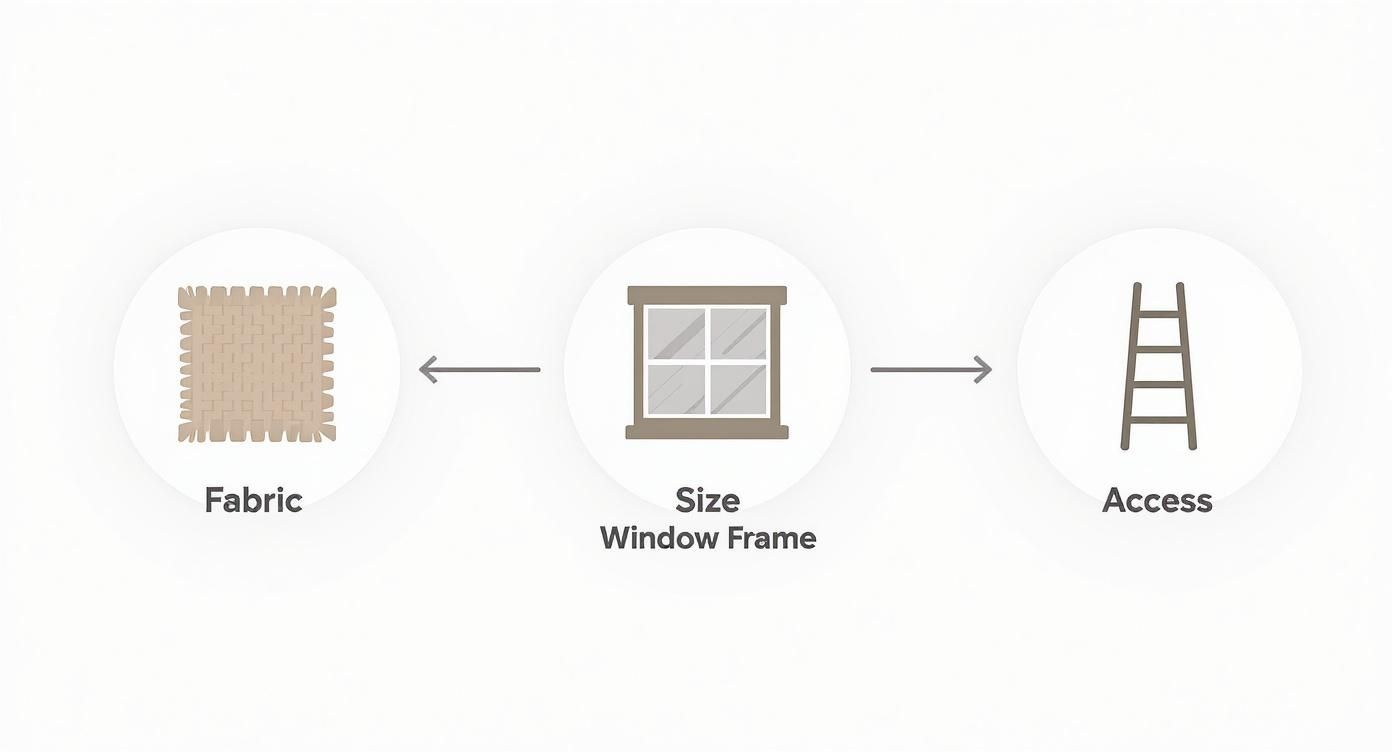
As you can see, the fabric type, window dimensions, and how easy (or difficult) it is to get to the window all play a role in the final cost. It highlights the kind of details that professionals handle every day.
Cost And Effort Comparison: DIY Vs Professional Installation
To help you decide, let's put both options side-by-side. This table breaks down the key differences in cost, effort, and what you can expect from the final result.
| Factor | DIY Installation | Professional Installation (e.g., Sparkle Tech) |
|---|---|---|
| Upfront Cost | Seems lower, but you have to buy or rent specialized tools. | Higher all-inclusive price, but it covers materials, labor, and expertise. |
| Time Commitment | High. Expect to spend hours on research, measuring, cutting, and assembly. | Minimal. A pro team can usually finish an entire house in just a few hours. |
| Required Skill | Moderate to high. You need to be precise with measurements and cuts. | None. You just have to be home to let them in. |
| Risk of Error | High. One mistake means wasted materials and buying more supplies. | Low. The installers are responsible for any errors, damages, or misfits. |
| Final Quality | Varies with your skill level. You might end up with a poor fit or imperfections. | Guaranteed perfect fit, a clean look, and maximum energy efficiency. |
When it's all said and done, the DIY approach can save you a bit of money upfront, but it demands a serious commitment of your time and comes with the risk of expensive mistakes. For most homeowners in Phoenix who want a fast, flawless result without the headache, professional installation offers unbeatable value and ensures your solar screens start working perfectly from day one.
Calculating The Real Return On Your 'Investment'
It’s easy to look at the cost of new solar screens and chalk it up as another home expense. But that's not the right way to think about it. This is a home improvement that starts paying you back the minute we finish the installation. It’s not just about feeling more comfortable; it’s about a real financial return you’ll see on your power bills.
Here in Phoenix, your air conditioner is the heavyweight champion of your energy usage. Solar screens act as your home's first line of defense, stopping the sun's blistering heat before it ever hits the glass. By blocking up to 90% of solar heat gain, these screens give your HVAC system a much-needed break.
That means your AC runs less often and for shorter cycles. The result? A direct drop in your electricity consumption and real, measurable savings month after month. The money you spend isn't gone—it's been put to work.
Your Payback Period And Long-Term Savings
So, how fast do you get your money back? The "payback period" is simply how long it takes for your energy savings to cover the initial installation cost. For most homes in the Valley, that can be as quick as three to five years.
Let's break it down with a typical example:
- Initial Cost: A homeowner invests $2,000 to have solar screens professionally installed on their house.
- Monthly Savings: They start seeing their summer cooling bills drop by $40-$60 every single month.
- Annual Savings: That adds up to a very real $480 to $720 back in their pocket each year.
With those numbers, the entire $2,000 investment is paid off in just over three years. Every dollar saved after that is pure profit, and that continues for the entire 10+ year lifespan of the screens. Thinking about home improvements this way is smart, and for a deeper dive into the numbers, this rental property ROI calculator guide provides great insights into calculating returns.
By easing the constant strain on your cooling system, solar screens not only cut your bills but can also help extend the life of your expensive HVAC unit, saving you from costly repairs or premature replacement down the road.
The Added Value Beyond Your Energy Bill
The financial upside doesn't stop with your SRP or APS bill. Solar screens deliver a ton of "invisible" returns that add serious value to your home and daily life, making the upfront cost an even smarter decision.
One of the biggest perks is the powerful UV protection. The same rays that cook your home are also the ones that fade everything you own.
- Protect Your Interiors: Think of solar screens as SPF for your house. They stop expensive furniture, hardwood floors, rugs, and artwork from getting sun-bleached and ruined over time.
- Reduce Annoying Glare: They cut that harsh glare, so you can actually watch TV or work on a computer near a window without squinting. Best of all, you can do it without losing your view.
- Enhance Daytime Privacy: During the day, it's incredibly difficult for anyone outside to see in. You get a great layer of privacy without having to shut your blinds and live in a cave.
Each of these benefits is part of the total return. Protecting a $5,000 sofa from fading or making your living room usable on a bright afternoon adds real, tangible value. When you add these perks to the direct energy savings, the cost to install solar screens shifts from a simple expense to one of the smartest upgrades you can make for your Arizona home.
How To Get A Clear And Accurate Quote

Trying to get a straightforward quote for solar screens shouldn't be a guessing game. A good, detailed estimate is the bedrock of a successful project, giving you total clarity on what you're paying for—no hidden fees or last-minute surprises.
To get a price you can rely on, you'll just need to provide a few key details about your home. Think of it like giving a painter the dimensions of a room; the more info they have upfront, the more precise their estimate will be. Being prepared helps a professional give you a quote that's both fair and accurate from the get-go.
Information To Have Ready
Before you pick up the phone or start filling out an online form, spend a few minutes gathering some basic info. Having these details on hand will speed things up and help us give you an initial quote that’s incredibly close to the final price.
- Window Count: A simple tally of every window you want a screen for.
- Window Locations: How many are on the first floor? What about the second story? Access is a factor in labor costs, so this is important.
- Approximate Sizes: You don’t need to be a professional surveyor here. Just noting whether you have mostly standard windows or some extra-large picture windows is a huge help.
- Special Shapes: Definitely mention any non-rectangular windows. Arches, circles, and other custom shapes require a bit more craftsmanship.
Armed with these details, a company like Sparkle Tech can usually give you a quick and remarkably accurate estimate right away.
Key Questions To Ask Your Installer
Getting a quote is a two-way conversation. It's your chance to really understand who you're hiring and what kind of quality you can expect. Asking the right questions helps you compare apples to apples and pick an installer you can trust for years to come.
A trustworthy installer welcomes questions. Their willingness to provide clear, detailed answers about their products, process, and guarantees is a strong indicator of their professionalism and commitment to quality.
Here are a few crucial points to bring up:
- Material Quality: Ask what brand of screen fabric they use. High-quality, American-made materials like Phifer Suntex are built to last over a decade, while cheap imports can start to fail in just a few years.
- Warranty Details: What, exactly, does their warranty cover? A solid guarantee should protect you against defects in both the materials (like fading) and the installation labor.
- Installation Timeline: How long will it take to get the job done? Here at Sparkle Tech, we’re known for our same-week service because we know you want to start saving and feeling comfortable ASAP.
- Insurance and Licensing: Make sure you confirm they are fully licensed and insured. This is non-negotiable—it protects you and your home if an accident happens on your property.
The answers you get will paint a full picture of the value you're receiving, which goes far beyond just the price tag. At Sparkle Tech Screen Service, we build our entire process around transparency. We give quick, clear quotes that break down every part of the job, so you can make your decision with total confidence.
Common Questions About Solar Screen Costs
Even with all the numbers laid out, it’s completely normal to have a few more questions. After all, this is an important investment in your home's comfort and energy bills, and you deserve to have all the facts.
Let's dive into the most common questions we hear from homeowners here in the Phoenix area. We'll give you straight, practical answers to help you feel 100% confident about your decision.
How Much Can I Really Expect To Save On My Energy Bill?
This is the big one, and the answer is pretty significant. While every home is different, most of our customers in Phoenix see their summer cooling costs drop by 15% to 30% after we install solar screens.
Think about it this way: if your typical summer electricity bill is around $400, that’s a real-world savings of $60 to $120 every single month. Over a long, scorching Arizona summer, that adds up to hundreds of dollars back in your pocket. You'll feel the biggest difference in those west-facing rooms that used to feel like an oven in the afternoon—they become comfortable and usable again almost instantly.
Do Higher Priced Screens Actually Offer A Better Value?
Yes, they absolutely do. It really comes down to two key things: durability and performance. Cheaper, often imported screen fabrics might look fine at first, but they simply aren't engineered to handle the relentless Arizona sun. They tend to get brittle, fade, and start falling apart in just a few years.
Investing in a premium, American-made fabric like Phifer Suntex is the smart long-term move. Here’s why it’s worth it:
- Longevity: These top-tier materials come with a 10-year warranty and frequently last much longer, giving you over a decade of solid performance.
- Consistent Performance: They hold their color and heat-blocking power for years, so your energy savings don't fade away over time.
- Superior Construction: They’re built to resist tears, punctures, and mildew—all crucial for an exterior product that's exposed to the elements.
Think of it like buying tires. You can grab a cheap set that will get you by for a while, or you can invest in a quality brand that offers better performance, is safer, and lasts twice as long. Premium solar screens deliver that same superior long-term value for your home.
What Is The Typical Lifespan Of Quality Solar Screens?
When you have quality solar screens professionally installed, you can expect them to last for 10 to 15 years, and often even longer. The secret is in the materials—both the screen fabric and the frame.
We use heavy-duty aluminum frames that won't warp or rust, paired with industry-leading screen fabrics designed specifically for harsh climates. These materials are built to resist fading and breaking down under constant UV exposure. While a screen might show a little fading after a decade, its ability to block heat remains strong, continuing to save you money year after year.
Will Solar Screens Make My House Too Dark Inside?
That’s a very common concern, but the reality is much more pleasant than you might think. Solar screens don't make your home dark; they just cut the harsh, uncomfortable glare.
An 80% screen, for example, provides fantastic heat reduction while still leaving your home feeling bright and preserving a clear view outside. A 90% screen will dim the room a bit more, but it's a lifesaver for windows that get blasted with direct afternoon sun. Honestly, most of our customers are surprised by how much they enjoy the soft, filtered light and the fact they can finally see their TV or computer screen without any glare.
Can I Still Open My Windows With Solar Screens On?
Absolutely! We install solar screens on the exterior of your window frame, so they operate completely independently from the window itself. You can open and close your windows just like you always have.
This is a massive advantage over something like window film. With solar screens, you can still let in that cool evening breeze without having to remove anything. They essentially become a permanent, high-performance upgrade that adds protection and efficiency without taking away any function.
How Do Solar Screens Compare To Window Tinting?
When it comes to blocking heat, solar screens are far more effective than window tinting. The reason is simple physics: solar screens stop the heat before it even hits your window glass.
- Solar Screens (Exterior): They absorb and reflect the sun's energy on the outside of your house, keeping the glass itself cool.
- Window Tint (Interior): Tint is applied to the inside of the glass. The sun still bakes the glass, and that heat then radiates right into your room.
By creating that insulating buffer of air between the screen and the glass, solar screens prevent the main source of heat gain. Real-world results show they can be up to 30% more effective at cooling a room compared to tinting, making them the clear winner for Phoenix's intense climate.
Are The Screens Removable For Cleaning Or Winter?
Yes, they are. While they’re designed to be a long-term fixture, solar screens can be removed if you need to. Most are attached with simple clips or screws, making it easy to take them down for a deep window cleaning.
That said, for most Phoenix homeowners, there's really no reason to ever take them down. They provide year-round UV protection for your floors and furniture and add great daytime privacy. A simple wash with mild soap and water once in a while is all they need to look and perform great for years.
Ready to stop overpaying on your summer energy bills and make your home dramatically more comfortable? At Sparkle Tech Screen Service, we make it easy. We offer quick, clear quotes, same-week service, and same-day pickup to get you the relief you need, fast.


