


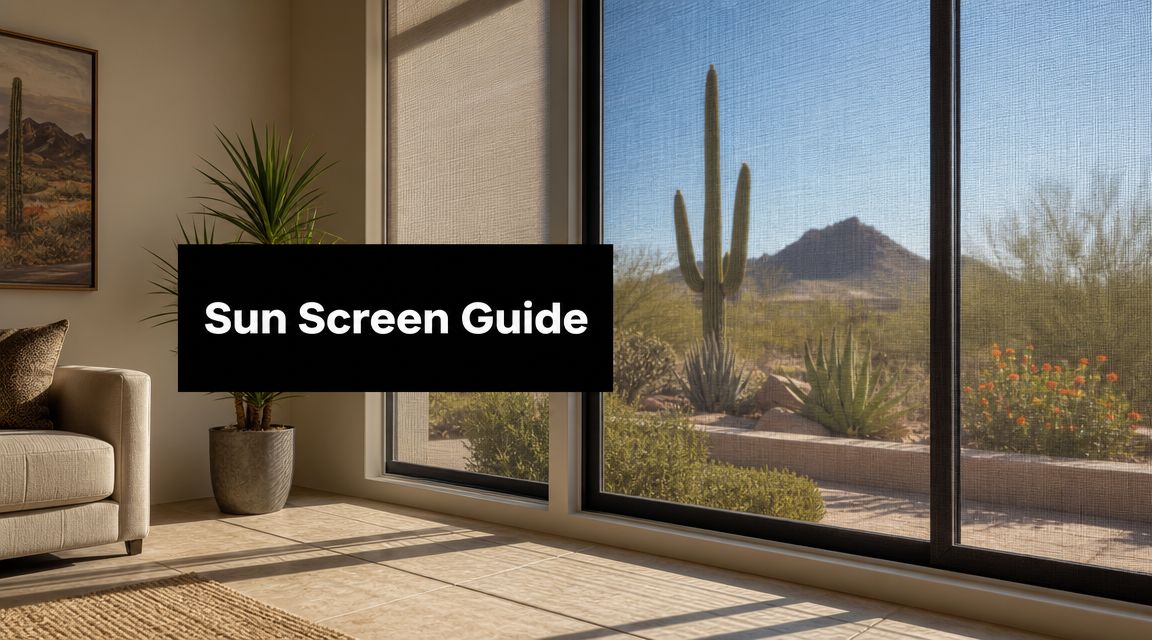

By midafternoon in a Phoenix summer, a lot of homes start losing the fight at the windows. The AC is running, the thermostat says one thing, and the room by the west-facing glass feels completely different. The couch arm is warm. The floor is bright. The glare makes you close the blinds, and then the room feels darker without feeling cooler.
That's the moment when many homeowners realize the problem isn't only the air conditioner. It's the sun getting through the glass and turning the window area into a heat source the AC has to chase all day. Sun screens for windows solve that problem at the outside of the home, where the heat starts.
Beat the Heat Your AC Cannot Handle
Phoenix homeowners usually describe the same pattern. Morning sun starts warming one side of the house. Afternoon sun hits harder, especially on large living room windows, sliders, and west-facing bedrooms. The AC keeps cycling, but comfort still drops in the rooms that take direct sun.
That's why sun screens have stayed relevant for so long. Window screening as a technology goes back to the 1820s and 1830s, and it became widely popular after the Civil War. Over time, it evolved from insect mesh into purpose-built solar screening. Historical and industry background tied to that development shows how modern screen materials moved toward PVC-coated polyester and related solar-control fabrics designed to block heat, glare, and UV rather than just keep bugs out, with products in common practice marketed to block up to 90% of solar heat in many applications according to this history of window screens.

What that means in real life
A sun screen isn't there to make a room cave-dark. A good one controls the sunlight before it turns into indoor heat. You still keep daylight. You still keep a usable view. What changes is the harsh edge of direct sun and the extra burden that falls on your cooling system.
Practical rule: If a room feels hottest near the glass, the window is part of the cooling problem.
Homeowners sometimes treat hot rooms by lowering blinds and turning the thermostat down. That helps with glare, but it doesn't address the heat early enough. Exterior sun screening does. In Phoenix, that difference matters because the goal isn't decorative shading. The goal is a house that stays more even from room to room without forcing the AC to do all the work.
How Sun Screens Actually Cool Your Home
The easiest way to think about exterior sun screens is this. A blind inside your house is like putting a barrier behind the heat after it has already reached the glass. A sun screen mounted outside is closer to parking your car under shade instead of waiting for the seats to heat up and then cracking a window.
The location changes everything. Exterior sun screens intercept solar radiation before it reaches the glass, so the heat can dissipate outdoors instead of building up at the window. Technical comparisons show exterior solar screens can reach a shading coefficient of about 0.14 to 0.33, while interior installations are roughly 0.50 to 0.70, depending on mesh openness, according to this exterior solar screen performance guide.

Why outside mounting works better
A proper exterior screen doesn't sit tight against the glass. Installers typically leave a small air gap so absorbed heat can release to the outdoor air rather than conduct straight into the pane. That small detail is part of why a real solar screen performs differently from a basic bug screen.
Here's the practical breakdown:
- Exterior placement: Stops a large share of solar energy before the window heats up.
- Air gap: Gives heat room to dissipate outdoors.
- Dense solar mesh: Cuts glare and heat gain while still allowing daylight and view-through.
- Interior blinds: Help with brightness, but they deal with heat after it has already reached the glass.
Bug screen versus solar screen
A standard insect screen is mostly about airflow and keeping pests out. A solar screen is engineered for thermal control. The weave is tighter, the material is chosen for solar performance, and the goal is to reduce heat gain, glare, and UV exposure while keeping the window functional.
That matters when homeowners say, “I already have screens.” If those are ordinary bug screens, they won't perform like a dedicated exterior sun screen.
If your room still feels hot with the blinds closed, the issue usually isn't a lack of window covering. It's where that covering sits.
Sun screens also work best when you think of them as one part of the cooling system around the house. Window orientation, insulation, weatherstripping, and AC efficiency all work together. If you're comparing broader cooling upgrades, this guide with expert advice on AC for warmer climates is useful because it looks at the equipment side of the same comfort problem.
Choosing Your Ideal Screen Mesh and Material
Picking the right screen is where most homeowners either solve the problem well or end up disappointed. The wrong choice usually isn't a bad product. It's a mismatch between what the window needs and what the homeowner expects.
For Phoenix homes, the two big decisions are mesh density and material/color. Those control how much heat gets blocked, how much glare you cut, how much view you keep, and how much daytime privacy you gain.
What 80% and 90% really mean
In common industry practice, 80% and 90% products are marketed as blocking roughly 80% or 90% of incoming heat and UV in many applications. The higher-blocking option usually gives you stronger heat control and better daytime privacy, but it also reduces outward visibility more than the more open option.
That tradeoff is normal. There isn't one perfect mesh for every opening.
| Feature | 80% Sun Screen | 90% Sun Screen |
|---|---|---|
| Heat and UV blocking | Commonly marketed to block roughly 80% in many applications | Commonly marketed to block roughly 90% in many applications |
| Outward view | More open feel | Tighter view-through |
| Daytime privacy | Good | Stronger |
| Glare control | Strong improvement over plain glass | Better for harsh direct sun |
| Best fit | Windows where you want more view | West-facing and high-exposure windows where cooling and glare matter most |
Color and weave matter more than people think
Phifer's SunScreen, a vinyl-coated fiberglass material made for solar control, is reported to absorb and dissipate up to 70% of the sun's heat and glare before it reaches the window, and broader product guidance notes that darker fabrics can block 94% to 96% of visible light for glare control. The same guidance also makes clear that denser weaves generally improve thermal performance, while color affects glare, privacy, and visibility. That information comes from Phifer's SunScreen material overview.
The practical takeaway:
- Darker mesh: Usually gives a clearer outward daytime view and better glare control.
- Denser weave: Usually improves thermal control and privacy.
- Lighter or reflective options: Can make sense when heat rejection is the top priority, but the look and view experience change.
Common materials homeowners will see
Most homeowners shopping for sun screens for windows run into a few common material categories.
- PVC-coated polyester: Common in modern exterior solar screens and widely used for durability and solar control.
- Vinyl-coated fiberglass: A proven option for solar mesh. It holds shape well and is commonly chosen where heat and glare reduction matter.
- Basic insect mesh: Fine for bugs. Not the same thing as a solar screen.
A quick way to narrow your choice is to match the screen to the room, not the whole house at once. A front sitting room with a view may need one setup. A west bedroom that gets blasted every afternoon may need a tighter screen.
Buyer's shortcut: Put your highest-blocking mesh on the windows that create the most afternoon discomfort, not automatically on every opening.
If you want a practical walkthrough of how to match screen type to your priorities, these expert tips for finding the best sun screen for your home are a useful place to compare options before ordering.
A Guide to Measuring and Installation
A sun screen only works well if it fits the frame correctly and sits securely. Most installation problems start before the screen is ever built. The measurements were rushed, the frame type wasn't identified, or the wrong mounting method got chosen.
How to measure without creating a remake
Measure the width and height of the actual screen opening, not the glass. On many homes, the frame dimensions matter more than the visible pane because the screen has to seat against the outside of the window frame cleanly.

A careful process looks like this:
- Measure width in more than one spot. Frames can be slightly out of square.
- Measure height the same way. Don't assume the top and bottom match.
- Write each window down separately. Similar openings often vary more than homeowners expect.
- Note the window style. Single-hung, slider, casement, and specialty windows may mount differently.
- Check obstacles outside. Security bars, trim detail, stucco edges, and shutters can affect fit.
Where DIY goes right and where it goes wrong
Ground-floor, standard-size windows are usually the easiest DIY candidates. Straight rectangular frames with clear mounting access are much simpler than second-story windows or custom shapes.
Common mistakes include:
- Measuring the glass only: That produces a screen that doesn't fit the frame.
- Ignoring hardware clearance: Clips, plungers, or springs need room to function.
- Forgetting orientation: A screen might fit one opening but not another if latches or tabs are placed wrong.
- Skipping a final check: One small writing error can turn into a full remake.
Hardware you should recognize
Most homeowners don't need to become screen fabricators, but it helps to know the basic mounting styles:
- Spring plungers: Often used where the screen needs to snap securely into place.
- Tension springs: Helpful for holding the frame snug in the opening.
- Casement clips or turn clips: Common where the screen mounts against the frame face.
If you want a more detailed walkthrough before ordering, this guide on how to measure window screen size is useful to keep open while you work.
Understanding Cost Lifespan and Maintenance
Most homeowners ask two sensible questions. What will this cost me, and how long will it last? The exact price varies by window size, frame condition, material choice, and whether you're replacing a few screens or outfitting a whole house, so the honest answer on cost is always project-specific.
What matters more is whether the upgrade holds up and keeps doing its job in Arizona sun. Well-made solar screen fabrics are commonly described by installers as lasting 10 years or more with proper installation and maintenance, according to independent guidance on exterior solar screens.
What drives the price
A few things change the final number quickly:
- Screen size and quantity: Larger openings and whole-home projects require more material and labor.
- Frame condition: Bent or damaged frames may need repair or replacement, not just new mesh.
- Mesh selection: Higher-performance fabrics and specialized colors can change the quote.
- Access difficulty: Upper-story windows and hard-to-reach locations take more time.
For homeowners comparing home-upgrade payback in general, not just window screening, it can help to look at how other energy-related projects are costed. This 2026 Florida solar cost breakdown is about a different category of upgrade, but it's a good example of how installation scope, equipment choices, and project size affect total investment.
What maintenance actually looks like
Sun screens aren't high-maintenance, but neglect shortens their useful life. Dust, pollen, and grime build up on the exterior side, especially in dry climates and windy seasons.
A sensible maintenance routine includes:
- Gentle cleaning: Use mild soap, water, and a soft brush or sponge.
- Rinse well: Soap residue attracts dirt.
- Inspect frames and corners: Loose spline, bent corners, or damaged clips can turn into bigger problems.
- Check after storms: Wind exposure can stress mounts and frame edges.
Don't scrub solar mesh aggressively. The goal is to remove buildup without stretching, tearing, or loosening the material.
If you're trying to budget the project, this page on how much solar screens cost gives a practical starting point before you request a quote.
Why Sun Screens Are Essential for Phoenix Homes
In Phoenix, window heat isn't a seasonal annoyance. It's a long-running load on the house. That changes the role of sun screens for windows from optional upgrade to practical protection.
The most important point is simple. In an extreme-heat climate, the goal is often cooling savings and HVAC load reduction, not just glare control. Guidance tied to the U.S. Department of Energy notes that exterior shading is far more effective than interior treatments for reducing solar heat gain, which is why it's such an important passive cooling strategy in very hot markets. That's outlined in this discussion of exterior shading for extreme-heat climates like Phoenix.

Why they matter more here than in milder climates
A Phoenix home gets punished by long sun exposure, especially on west and south-facing glass. That creates three daily problems at once:
- Hot spots indoors: Some rooms become uncomfortable even when the central AC is running.
- More AC strain: The system has to offset solar gain that could have been reduced at the window.
- Interior fading: Furniture, flooring, and fabrics take more UV exposure.
A well-chosen exterior screen helps on all three fronts because it works as a passive layer. It doesn't consume energy. It doesn't depend on someone remembering to close blinds at the right hour. It sits outside the glass and cuts the solar load before the window becomes part of the problem.
The comfort payoff homeowners notice first
The improvement isn't usually described in technical terms. Instead, observations mention the room feeling less harsh in the afternoon. Individuals can sit near the window again. The TV isn't fighting glare as much. The floor isn't heating up like it used to.
That comfort effect matters because it changes how the home is used. In Phoenix, a passive cooling measure that reduces sun impact at the windows can make a house feel more balanced from one room to the next.
Homes in hot climates work better when the windows stop acting like heat collectors.
Sun screens also protect parts of the house that are expensive to replace. Upholstery, wood floors, rugs, and artwork all benefit when less direct sun reaches the interior. Even when a homeowner starts shopping for screens to cut cooling strain, the preservation side often becomes part of the value.
DIY or Hire a Pro Sparkle Tech Screen Service
Some sun screen jobs are reasonable DIY projects. Others are better handled by someone who builds and installs screens every week. The right choice depends less on confidence and more on window type, access, and how exact the fit needs to be.
When DIY makes sense
DIY can work well if you have a small number of standard ground-floor windows, clear access around the frames, and accurate measurements. It also helps if you're replacing existing screens and can match the hardware and frame style without guesswork.
A do-it-yourself route is usually more practical when:
- The windows are easy to reach
- The openings are simple rectangles
- You're comfortable measuring carefully
- You have time to correct mistakes if one screen needs adjustment
When hiring a pro is the smarter move
Professional installation is usually the safer choice for second-story windows, large or oddly shaped openings, and homes with a mix of old hardware styles. It's also the better option when you want the screen fit, mesh choice, and mounting method handled in one pass instead of through trial and error.
For Phoenix-area homeowners who need new sun screens, rescreening, repairs, slider work, or screened patio rescreening, Sparkle Tech Screen Service offers those services along with same week service, quick quotes, and same day pickup as listed by the business.
Here's the direct contact information in one place:
| Service | Contact Information |
|---|---|
| Text or Call | 623-233-0404 |
| Alternate Phone | 800-370-3998 |
| Website | Sparkle Tech Screen Service |
The biggest advantage of hiring out isn't convenience alone. It's avoiding small fit errors that reduce performance, create rattling in wind, or leave you with a screen that looks custom-made for the wrong opening.
If your home heats up at the glass every afternoon, it's worth getting a real quote for properly fitted sun screens instead of guessing with interior blinds alone. Sparkle Tech Screen Service handles new, rescreened, and repaired bug and sun screens, plus slider and patio screen work for Phoenix-area homeowners who want a practical fix for heat, glare, and worn-out screens.


