


When you start looking into solar screens, the first question is always about cost.To give you a straightforward answer, most homeowners in the Phoenix area can expect to pay somewhere between $65 and $150 per window for a professional installation. That range gives you a solid ballpark figure to start with as you plan your budget.
Your Quick Guide to Solar Screen Costs in Phoenix
Thinking about solar screen pricing is a bit like buying tires for your car. The standard tires for a family sedan are one price, but the specialized, high-performance ones for a sports car are in a different league altogether. It's the same principle with solar screens. A small, easy-to-reach window on the ground floor will sit at the lower end of that range, while a huge, custom-arched window two stories up will naturally be more.
Let's break it down with some typical price ranges you'll see around the Valley. These numbers aren't just for the screen itself; they include the professional measurement, the custom build of your screens, and the full installation.
We believe in giving you a realistic estimate from the get-go. Every home is a bit different, of course, but these numbers are based on what we see every day in Arizona homes. They're meant to give you a clear expectation before you even get a detailed quote.
Estimated Costs for Common Window Sizes
Keep in mind, these are average costs. The final price tag will shift depending on the specific materials you go with—for instance, a heavy-duty 90% blockage mesh will cost more than the standard 80% mesh, but it also blocks more heat. Our guide on the comprehensive Phoenix window screen service dives deeper into how these choices impact both performance and your wallet.
To make it easier to visualize, here’s a quick breakdown of what you might expect to pay for different window sizes.
Estimated Solar Screen Costs in Phoenix
This table gives you a snapshot of typical costs for standard solar screen installations in our area.
| Window Type or Size | Average Cost Range Per Window |
|---|---|
| Small Window (e.g., 24" x 36") | $65 – $95 |
| Standard Window (e.g., 36" x 60") | $85 – $125 |
| Large Window (e.g., 48" x 72") | $110 – $160 |
| Sliding Glass Door Panel | $150 – $225 |
Think of these numbers as a reliable starting point. Next, we'll get into the nitty-gritty of what makes these prices move up or down, so you can see exactly what goes into the final cost of your project.
What Goes Into Your Solar Screen Quote?
When you start getting quotes for new solar screens, you'll probably notice the numbers can swing quite a bit from one company to the next. This isn't random—it’s all about the specific materials and labor that go into your project. Think of it like buying a car; the base model is one price, but adding the sunroof, leather seats, and a bigger engine will change the final sticker price.
The cost of your solar screens works the same way. A few key "ingredients" dictate their performance, how long they'll last, and what they look like on your home. It helps to have a good grasp of the different understanding blind screen types and what they offer, as this knowledge directly impacts the price and shows you exactly where your money is going.
The Two Biggies: Mesh and Frames
The two things that will influence your quote the most are the screen mesh itself and the frame that holds it all together. These are the workhorses doing the heavy lifting to block that intense Arizona sun and withstand our weather.
- The Screen Mesh Itself: The fabric you pick is a huge price driver. Standard fiberglass is the budget-friendly choice, but a lot of homeowners in our climate upgrade to a premium polyester vinyl-coated mesh. It's just tougher, way more resistant to rips and tears, and a lifesaver if you have pets or kids.
- How Much Sun it Blocks: Solar screens usually come in 80% or 90% blockage ratings. That 90% mesh is woven tighter, so it blocks more heat and gives you more privacy. Naturally, it costs a bit more. Deciding between them is really a balancing act between getting maximum cooling and staying within your budget.
This chart gives you a quick visual on how those costs typically break down for different window sizes.
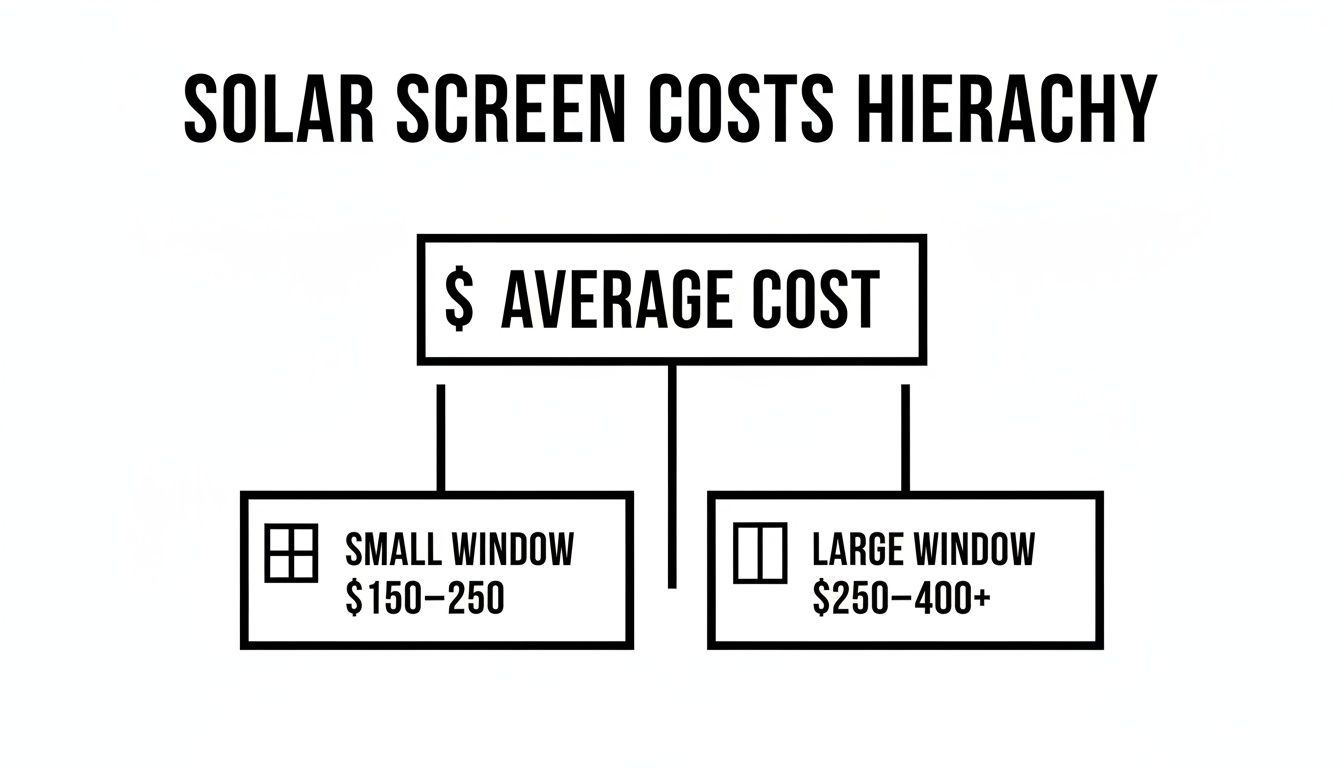
As you can see, the bigger the window, the wider the cost range. It's a simple reflection of needing more materials and more time to build and install it properly.
The Details: Installation and Your Home's Unique Layout
Beyond the raw materials, the specifics of your home and the installation itself play a huge part in the final price. This is all about the hands-on labor and the complexity of the job.
It's clear people are catching on to how effective these solutions are. In fact, the global market for solar shading systems is expected to hit a massive $15.80 billion by 2031. This shows a huge demand for sun-blocking tech that's more advanced than basic bug screens.
Here are a few key variables that affect the installation side of your quote:
- Window Size and Shape: Your standard rectangular windows are a piece of cake. But if you have custom shapes—think arches, circles, or those angled trapezoid windows—it takes more time, specialized cuts, and creates more material waste, which nudges the price up.
- Accessibility: Is the window on the first floor right by the patio? Easy. Is it a second-story window over a sloped roof? That's a different story. Hard-to-reach windows require tall ladders, extra safety precautions, and more time, so the labor cost is naturally higher.
- Frame Material and Color: Most new screens are built with sturdy aluminum frames, and you'll have a choice of colors to match your home's trim. The frame thickness and color can slightly adjust the cost. The bigger picture of what makes a job simple or complex is something we cover in our guide to window screen installation cost.
Real-World Pricing for Phoenix Homes
It’s one thing to talk about cost factors in theory, but it’s much more helpful to see how it all shakes out in the real world. Let's walk through a few common projects we handle every week here in Phoenix, Scottsdale, and Peoria to give you a solid idea of what to expect.
These examples should help you ballpark a budget, whether you’re just dipping your toes in or ready to go all-in on a more comfortable, energy-efficient home.
Tackling the West-Facing Wall
A lot of Phoenix homeowners start smart. They target the side of the house that gets absolutely baked by that brutal afternoon sun. This is the definition of "bang for your buck" because you feel the difference in comfort and see it on your energy bill almost immediately.
A typical starting project might be two standard bedroom windows and a larger picture window in the main living area.
- Project Scope: Two 36" x 60" windows and one 48" x 72" picture window.
- Estimated Cost: For a professional, all-inclusive installation, you're looking at a range of $280 to $410. It's a perfect entry-level project.
The Full Home Makeover
If you're after the biggest possible energy savings and a sharp, uniform look for your home, outfitting every window is the way to go. This approach creates a complete thermal shield, blocking heat and boosting privacy from every angle.
Think about a classic single-story ranch home in the Valley, which usually has about 10 to 12 windows.
A full-home solar screen installation doesn't just maximize your energy savings; it gives your home a clean, cohesive look that boosts curb appeal. It’s an upgrade that pays off in both comfort and property value.
Let's break down the numbers for a house with 10 standard windows and a sliding glass door.
- Project Scope: Ten standard 36" x 60" windows and one sliding glass door.
- Estimated Cost: A project of this size typically runs between $1,000 and $1,475. This is a serious investment in your home's thermal envelope that can lead to major savings on those summer AC bills.
Rescreening vs. Full Replacement
What if your screen frames are still in great shape, but the mesh is torn, faded, or just not cutting it against the Arizona sun? This is where rescreening comes in as a fantastic, budget-friendly option. We simply replace the old, worn-out mesh with new, high-performance solar screen fabric in your existing frames.
Think of it like getting new lenses put into your favorite pair of glasses—you keep the frames you love and just upgrade the part that does all the work. It’s a great way to get the benefits of new solar screens at a fraction of the cost.
To give you a clearer picture, I've put together a table showing some common projects we see around Phoenix. This should help you visualize the cost difference and decide which route is best for your home.
Phoenix Solar Screen Project Cost Examples
Here's a look at some typical project costs, showing the price for brand-new screens versus simply rescreening your existing frames.
| Project Type | Typical Size | Estimated Cost Range |
|---|---|---|
| Single Standard Window | 36" x 60" | $85 – $125 |
| Sliding Glass Door | 36" x 80" | $150 – $225 |
| Patio Enclosure Rescreen | 10' x 20' | $450 – $850+ |
| Full Home (10 Windows) | Various | $1,000 – $1,475 |
As you can see, the final price depends heavily on the scope of your project, but this gives you a realistic starting point for planning your upgrade.
Calculating Your Return on Investment
It’s easy to look at solar screens as just another line item on a home improvement budget. But that’s missing the bigger picture. A better way to think about them is as a smart investment in your home's long-term efficiency and comfort.
Yes, there's an upfront cost. But the savings—especially here in the relentless Arizona heat—are very real and add up quickly. The biggest return you'll see is a direct hit to your monthly utility bills.
By stopping the sun’s heat before it even penetrates your window glass, solar screens give your air conditioning system a much-needed break. We’re not talking about a tiny adjustment; this is a major reduction in heat gain that translates into real money back in your pocket.
The Payback Period Unpacked
So, how long does it take to get your money back? That’s the bottom line for any home project, and with solar screens, the payback period is often shorter than people expect.
In a sun-drenched climate like ours, a professional installation can slash your cooling needs by a whopping 30% to 50%. That level of efficiency means most homeowners recoup their initial investment through lower energy bills in just two to five years. Sometimes, government incentives or tax credits can shrink that timeline even further.
Think of it this way: You're essentially pre-paying for a few years of lower energy bills. Once the screens have paid for themselves, every dollar you save from then on is pure financial gain.
Beyond the Energy Bill
While lower cooling costs are the most obvious return, the value of solar screens doesn't stop there. They deliver a handful of other fantastic benefits that protect your home and improve your quality of life, making the initial expense feel even more worthwhile.
These "hidden" returns are what really complete the value proposition.
Key Added-Value Benefits:
- UV Damage Prevention: Those same UV rays that bake your home are also fading your furniture, flooring, and artwork. Solar screens act like sunscreen for your house, preserving your valuables for years to come.
- Enhanced Daytime Privacy: During the day, solar screens make it incredibly difficult for anyone outside to see in. You get to enjoy an open, airy feel without feeling like you're on display.
- Reduced Glare: Finally, you can enjoy natural light without that frustrating glare on your TV and computer screens. It just makes your rooms more comfortable and usable, all day long.
Each of these perks adds to a more comfortable, protected home. We dive deeper into these advantages in our guide to high-quality solar window screens. When you add it all up, the question really shifts from "how much do solar screens cost?" to "how much am I saving?"
How to Choose the Right Solar Screen Installer
Once you've got a handle on your budget, it's time to tackle the next big step: finding the right crew to do the work. The quality of your solar screen installation is every bit as important as the quality of the screens themselves. A screen that's installed poorly won't just look bad—it won't perform correctly and could even end up damaging your window frames.
Hiring an installer is a lot like finding a good mechanic. You're looking for someone with real experience, who is upfront and honest, and won't sneak in a bunch of surprise fees on the final bill. In a busy market like Phoenix, spending a little extra time checking out your options will absolutely save you from major headaches later on.
The whole point is to find a partner who gets the job done right the first time, making sure your investment is protected for years to come.
Your Vetting Checklist
Before you sign on the dotted line, you need to ask the right questions. Any company worth its salt will be happy to give you straight answers. Think of it as a quick interview to make sure you're bringing a true pro onto your property.
A detailed, itemized quote isn't just a suggestion—it's a sign of a professional and transparent installer. If a company is hesitant to break down the costs for materials, labor, and any extra fees, consider it a major red flag.
Run through this checklist with any contractor you're considering. It’s the best way to protect yourself and ensure you’re getting real value for your money.
Essential Questions for Your Installer:
- Are you licensed and insured? This one is non-negotiable. It protects you from liability if someone gets hurt or something gets damaged during the job.
- What specific materials do you use? Don't be shy—ask for brand names. Are they using proven screen fabric like Phifer or Twitchell? What's the gauge of the aluminum for the frames? Better materials mean a longer lifespan for your screens.
- What does your warranty cover? Get the details. Does it cover the screen fabric if it fades or tears? Do the frames have a warranty against defects? What about the installation work itself? Make sure you understand exactly what’s covered and for how long.
- Can you provide recent local references? There’s no better gut check than talking to a company's recent customer, especially someone right in your neighborhood. This is where you’ll hear about their punctuality, professionalism, and the quality of their work.
- Is your quote all-inclusive? The number on the quote should be the final number. Confirm that it includes everything: the initial measurement, all materials, the complete installation, and any extra fees for things like high-ladder work or hauling away your old screens.
Taking these steps helps you compare quotes based on real value and reliability, not just the rock-bottom price. Finding an installer you can trust is the secret to a smooth project and a finished product that you'll be happy with for a long, long time.
A Few More Questions We Hear All The Time
Even with all the numbers laid out, you probably still have a few questions rolling around in your head. That's perfectly normal. We get them all the time from homeowners across Phoenix who are trying to make the best decision for their home.
Let's walk through some of the most common ones we answer. Think of this as the final bit of insight to help you feel completely confident about your choice.
How Much More Do 90% Screens Cost?
This is easily one of the top questions we get. You can expect a 90% screen to run you about 10% to 20% more than an 80% screen for the same window.
So, if a standard window with an 80% screen costs $100, bumping it up to a 90% mesh would put you in the $110 to $120 range. It’s a pretty small jump in price for a noticeable jump in performance.
The real decision here is balancing cost against what you need for a specific window. Those west-facing windows that get absolutely blasted by the afternoon sun are prime candidates for 90% screens. For the rest of the house, an 80% screen often hits the sweet spot, giving you great heat reduction with a bit more natural light and visibility.
The modest price increase for 90% screens often pays for itself through enhanced energy savings, especially on the sunniest sides of your home. It’s a small upfront difference for a noticeable boost in comfort.
How Long Do Quality Solar Screens Last?
When you're investing in your home, you want to know it's going to last. We get it. A professionally installed solar screen, made with high-quality materials like Phifer SunTex or Twitchell Textilene, is built tough enough for the Arizona climate. Realistically, you should expect these screens to last 10 to 15 years, though we often see them going strong for even longer.
The secret is in the fabric. This isn't your standard, flimsy screen material. It's a heavy-duty, PVC-coated polyester designed to resist fading, tearing, and mildew. While you might save a few bucks on cheaper, overseas-made materials, they often fail in just a few years. A quality, American-made product is a long-term investment that keeps on performing.
What Is The Best Color For Solar Screens?
This is a great question, and the answer usually surprises people. From a pure performance standpoint, the color of the screen doesn't change how well it blocks heat. A black 80% screen blocks the exact same amount of heat as a tan 80% screen. The choice really comes down to aesthetics and your view.
Here's the simple breakdown:
- Darker Colors (Black, Dark Bronze): These colors are pros at absorbing light, which cuts down on glare and gives you the sharpest, most unobstructed view looking out. They tend to fade into the window, making them less noticeable from the street.
- Lighter Colors (Beige, Grey, Stucco): These colors reflect more light, so they can be a bit more visible. They're great for daytime privacy but can create a little more glare when you're looking through them from inside.
At the end of the day, the "best" color is the one that you think looks best with your home’s trim and gives you the view you prefer.
Do Solar Screens Qualify For Energy Tax Credits?
This is where things can get a little confusing. A few years back, solar screens were often eligible for federal energy tax credits. However, recent programs like the Inflation Reduction Act have shifted their focus more toward things like windows, doors, and insulation.
As of right now, exterior solar screens do not typically qualify for the federal energy tax credit on their own. But things can always change. Sometimes, local utilities like SRP or APS run their own rebate programs for energy-efficient upgrades. Your best bet is to check the Database of State Incentives for Renewables & Efficiency (DSIRE) or your utility company’s website for the most current information before you buy.
Ready to block the Arizona heat and start saving on your energy bills? Sparkle Tech Screen Service offers quick, transparent quotes and same-week service for new solar screens, rescreening, and repairs. Get the professional installation you deserve without the wait. Text or call us today at 623-233-0404 for your free estimate!


