


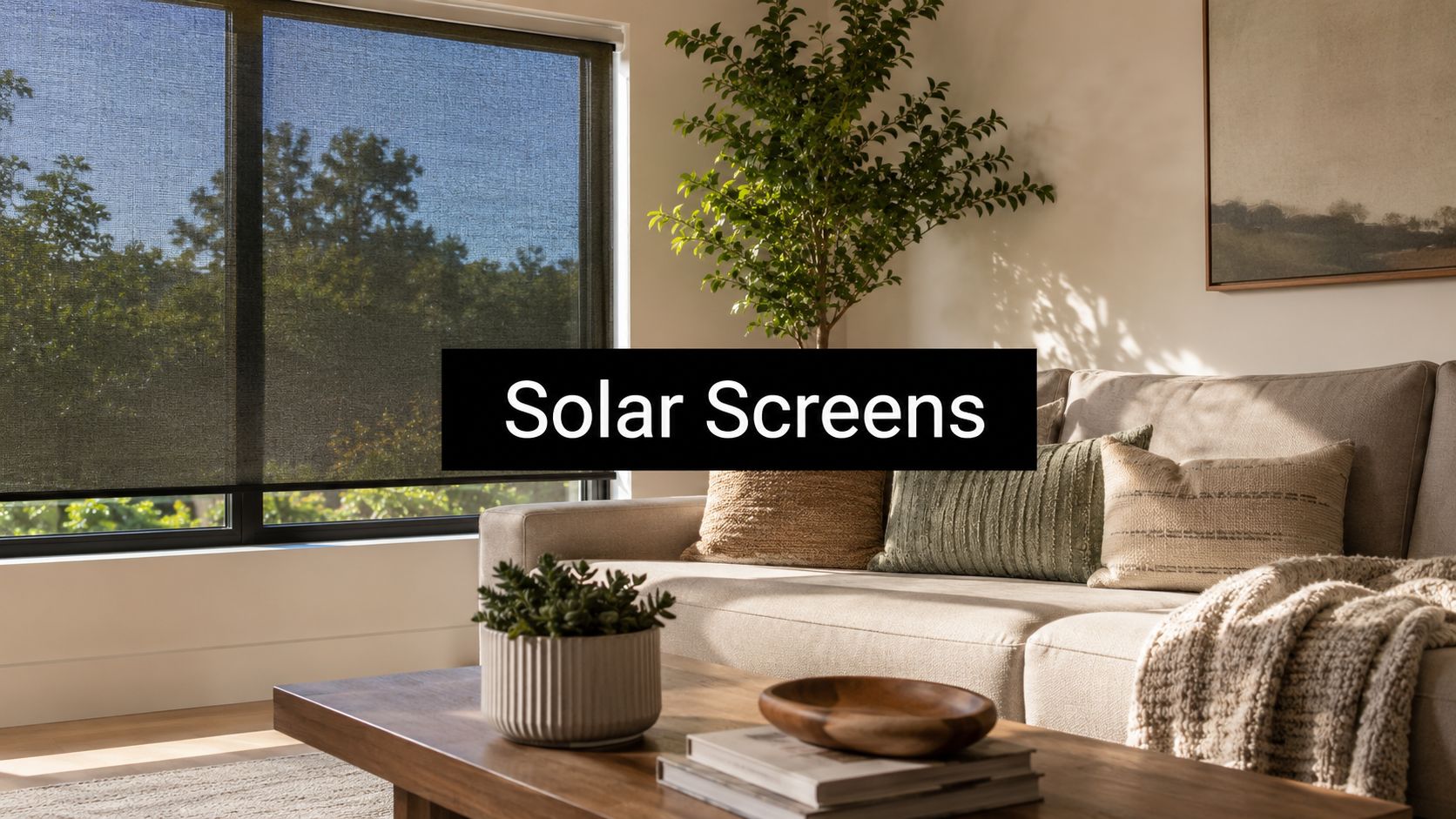

If you're dealing with a room that turns into an oven every afternoon, you're not alone. In Arizona, the problem usually shows up the same way. The west side of the house gets hammered, the AC runs longer, the TV starts reflecting sunlight, and the couch by the window feels like it's sitting under a heat lamp.
A lot of homeowners try blinds first. Some try curtains, tint, or heavier drapes. Those can help with brightness, but they don't solve the main issue when the heat has already reached the glass. That's where solar screens become worth a serious look, especially if your goal is to keep rooms usable during peak sun instead of just making them darker.
What Are Solar Screens and Why Do They Matter
Solar screens are exterior-mounted screen panels made for solar control, not just bug control. That difference matters. A regular window screen mainly lets air pass while keeping insects out. A solar screen is built to reduce heat, glare, and harsh light before that solar load ever hits the window.
That outside placement is the whole game. When a screen sits on the exterior, it can intercept a meaningful share of the sun before the glass heats up. In a hot climate, that's a much smarter place to fight the problem than inside the room.
More than a basic mesh
Homeowners sometimes assume solar screens are just darker bug screens. They're not. The fabric, weave, and color are chosen around solar performance. Some materials are made to reject more heat. Others preserve a better daytime view out. The right choice depends on the window's sun exposure and what you care about most.
If you want a quick overview of practical window applications, this page on solar screen windows is a useful starting point.
Solar screens make the biggest difference on windows you already avoid in the afternoon.
Why they became important
People have been managing sunlight for a very long time, but the modern technical foundation goes back to the discovery of the photovoltaic effect in 1839 by Edmond Becquerel, and by 1960 the U.S. solar industry had produced a 14% efficient solar cell, which helped push broader demand for materials that manage sun, heat, and glare in buildings, as outlined in this history of solar energy development.
That doesn't mean your window screen is a solar panel. It does mean the modern market for solar-control materials grew alongside better understanding of how sunlight affects comfort, surfaces, and buildings.
Homeowners often end up researching all kinds of “solar” products before they land on screens. If you're sorting through different solar-related terms online, a separate guide to C lead solar Aurora can help clarify one of those topics outside the window-screen world.
How Solar Screens Cool Your Home
The easiest way to think about solar screens is this. They're high-tech sunglasses for your house. They don't cool the room by themselves. They reduce how much solar energy gets to the glass in the first place, which lowers the heat load the room has to absorb.
That's why exterior control beats interior control in many hot-window situations. Blinds and curtains can dim a room, but the sunlight has often already heated the window by then. A solar screen starts working sooner, at the outer layer.
Here's a visual that shows the basic idea:

What the screen is actually doing
High-performance fabrics such as Phifer SunTex 80/90 are engineered to block 80% to 90% of the sun's hot rays before they reach the window, according to Phifer's solar screening specifications.
That matters because the glass itself is part of the problem. Once the window heats up, it starts transferring that heat inward through radiation and conduction. A screen mounted outside cuts that process earlier.
Why exterior placement matters
Think about standing in direct sun versus stepping under shade. The air temperature may not change much, but your body feels a big difference because the direct solar hit is gone. Windows behave the same way. Shade the glass from the outside, and the room usually feels more manageable.
A good solar screen setup often helps with:
- Afternoon comfort: Rooms near direct-sun windows stay more usable.
- AC workload: The system doesn't have to chase as much heat coming through the glass.
- Uneven rooms: Hot spots near west-facing windows feel less extreme.
Later, if you want to combine screens with other cooling measures, this guide on how to beat the summer heat at home is a practical complement.
A short video can also help if you want a visual explanation of the concept:
Practical rule: If the sun is hitting the window directly for long stretches, stopping it outside will usually outperform trying to manage it only from inside.
The Triple Benefit UV Protection Glare Reduction and Privacy
Energy savings get most of the attention, but many homeowners decide they love solar screens for three day-to-day reasons. The room feels calmer, the glare stops fighting every screen in the house, and people outside have a harder time seeing in during the day.
That combination is why solar screens are often one of the most practical upgrades for family rooms, home offices, front-facing living spaces, and large patio sliders.
UV protection for the space you already paid for
Direct sun is rough on interiors. It beats up floors, fades furniture, and punishes fabrics that sit in the same bright patch every day. Solar screens act like a protective outer layer for the home.
The logic behind measurable sun protection isn't new. In sunscreen science, Franz Greiter developed and commercialized “Gletscher Crème” in 1946, later receiving credit for inventing the SPF rating system in 1962, and the original product reportedly had an SPF of 2, as described in this history of sunscreen and SPF. That same general thinking matters in architecture too. Homeowners want sun control they can compare and choose with purpose, not just by guesswork.

Glare reduction that changes how a room works
Glare is one of those problems people normalize until it's gone. You stop shifting on the couch to find a better angle. You stop closing interior blinds in the middle of the day. You stop seeing washed-out computer screens near bright windows.
For homes with open layouts, this benefit often lands faster than the cooling benefit because it's immediate and obvious. The room becomes easier to use, not just cooler.
Daytime privacy without sealing the house off
A well-chosen solar screen can also improve daytime privacy. From inside, you still get light and a view out. From outside, the darker exterior appearance makes it harder to see in during bright conditions.
That doesn't mean total privacy around the clock. At night, if the interior is brightly lit, the advantage changes. Solar screens help most with daytime exposure, street-facing windows, and homes where people want less visibility without shutting the room down.
A lot of buyers are surprised by this. They expect one product to cool the room, cut glare, and still keep the backyard visible. A properly selected solar screen can do all three, but not equally in every fabric and color.
Choosing the Right Solar Screen Mesh and Color
Mistakes frequently arise as homeowners often ask for “the darkest one” or “the strongest one” without thinking about what they'll be looking through every day. The biggest trade-off is heat reduction versus visibility. If you ignore that, you can end up with a screen that works on paper but annoys you every time you look outside.
Independent guidance notes that darker fabrics improve view-through clarity, while lighter or more reflective fabrics offer better heat management, which is especially important when different sides of the house get very different sun exposure, as explained in Insolroll's overview of how solar screen shades work.
Start with window orientation
Don't choose one fabric for the whole house by default. A west-facing bedroom and a shaded north-facing office don't need the same thing.
Use this basic approach:
- West-facing windows: Prioritize stronger sun control first. These usually take the hardest hit.
- East-facing windows: Morning glare can be sharp, but comfort goals may differ from west exposures.
- South-facing windows: Consistent sun can justify a balanced screen choice.
- Front or backyard view windows: Visibility may matter almost as much as cooling.
On a view window, the “best” screen isn't always the one that blocks the most heat. It's the one you can live with every day.
Mesh density and what those ratings really mean
You'll often hear products described with names like SunTex 80 or SunTex 90. In practical terms, that points you toward stronger or lighter solar control. Tighter, more heat-rejecting fabrics usually give up some openness. Looser options preserve more of the outside feel.
That doesn't make one universally better. It means the right choice depends on what the room is for.
| Solar Screen Mesh & Color Trade-Offs | Heat Block | Visibility | Best For |
|---|---|---|---|
| Darker, more open-looking screen | Moderate to strong, depending on fabric | Better daytime view-through | Backyard-facing windows, living rooms, view preservation |
| Darker, tighter solar screen | Stronger solar control | Less open feel than lighter weave options | West-facing rooms that overheat |
| Lighter or more reflective screen | Strong heat management | Can soften or flatten the view out | Harsh sun exposures where cooling matters more than scenery |
| Balanced mid-range choice | Mixed performance | Mixed performance | Homes with several exposures and no single dominant priority |
If you want to compare common material options beyond just solar fabrics, this guide to types of window screen mesh helps sort out the broader category.
Color matters more than many people expect
Dark colors usually give the cleanest outward view. Your eyes look through them more easily in daylight. That's why many homeowners prefer dark bronze or black-style screens on windows where they care about the yard, pool area, or mountain view.
Reflective or lighter fabrics can help with heat management, but they can also make the outside view feel flatter. Some people don't mind that on a stairwell or laundry room. They absolutely mind it on the main family room window.
The material itself also changes performance
Construction matters too, not just the look. Insolroll's SilverScreen uses PVC-coated fiberglass yarn, is woven to 2400 mm width, and is listed with 78% solar reflectance, along with being flame retardant, according to the SilverScreen technical data sheet.
That's a good reminder that some products are built not only for shading but also for reflectance, durability, and dimensional consistency on larger openings.
A good installer usually walks the window line with you and asks a simple question at each opening: do you care more about the view, the heat, or a middle ground? That's the conversation that leads to a smart result.
Solar Screens vs Standard Bug Screens
This mix-up happens all the time. Someone has a bug screen, notices the room is still hot, and assumes a tighter insect mesh will solve it. It usually won't. Bug screening and solar screening are different jobs.
A standard insect screen is designed around airflow and pest control. A solar screen is designed around sun management first. Some products try to blend those jobs, but they're still a compromise compared with a purpose-built solar fabric.

The performance gap is real
One independent guide notes that no-see-um bug screens typically block about 15% to 25% of UV and visible light, while purpose-built solar screens can block from 65% to over 90%, as described in this comparison of sun screens versus no-see-um screens.
That's why a homeowner can spend money upgrading insect mesh and still feel disappointed. They bought a better bug screen, not a real heat-control product.
When a hybrid screen makes sense
Some in-between options exist. Phifer's solar insect screening is documented to block up to 65% of the sun's heat and glare in the same product family where SunTex 80/90 is specified to block 80% to 90% of the sun's hot rays, as noted earlier in the Phifer specifications. That kind of product can make sense on openings where insect control and moderate solar relief both matter.
Still, it's important to be honest about the trade-off:
- Choose a bug-first screen when insects are the main problem and view/airflow come first.
- Choose a solar-first screen when the room overheats or gets blasted with glare.
- Choose a compromise screen only when you understand you're giving up some specialized performance either way.
A tighter bug mesh can dim sunlight a little. It usually won't deliver the kind of heat control people expect from a true solar screen.
Patio areas, sliders, and enclosures are where people most often try to make one mesh do everything. Sometimes that works well enough. Sometimes it's better to treat each opening according to its actual job.
Installation Options and Long-Term Maintenance
A solar screen only performs well if it fits right and stays tensioned correctly. Good fabric on a sloppy frame won't give you the result you expected. That's why installation is less about “can I clip a screen into place” and more about measurement, fit, and choosing the right attachment method for the opening.
DIY can work on simple, accessible windows. It gets harder when you're matching multiple openings, dealing with older frames, or working on upper-story windows.
DIY versus professional installation
Here's the honest split.
- DIY makes sense if the openings are easy to reach, the frames are square, and you're comfortable measuring carefully.
- Professional installation is safer when the windows are high, inconsistent, or exposed to strong sun and wind.
- Custom fitting matters when you want a clean appearance across the front of the home.
One local option homeowners use for this kind of work is Sparkle Tech Screen Service, which handles new screens, rescreening, repairs, sliders, and sun-screen work.
What to check before the screens go in
Don't focus only on the fabric sample. Look at the whole assembly.
- Frame condition: Bent or weak frames can create gaps and poor tension.
- Mounting style: The attachment method should suit the window type and access.
- Sun exposure: The harshest exposures deserve the most careful selection.
- Sightlines: Stand inside and make sure you're comfortable with the view change.
Simple maintenance that extends service life
Solar screens aren't high-maintenance, but they do need occasional care. Dust, pollen, and grime can collect on the fabric and reduce clarity.
Use a simple routine:
- Rinse gently: Light washing with mild soap and water is usually enough.
- Check corners and spline: Loose edges or bowed frames should be fixed early.
- Inspect after storms: Wind and debris can stress the mesh or frame.
- Watch for rubbing: A misfit screen can wear where it contacts surrounding surfaces.
If a screen starts sagging, tears at a corner, or no longer sits flush, repair it sooner rather than later. Small problems spread fast in strong sun and heat. In Arizona, that's especially true on west and south exposures where materials take the most punishment.
FAQs for Phoenix Homeowners and Your Next Steps
Phoenix-area homeowners usually ask the same final questions. Not whether solar screens work in general, but whether they make sense for their house, their windows, and their view.
Are solar screens worth it on every window
No. The strongest candidates are windows with direct sun problems, especially the ones you already avoid in the afternoon. If a window rarely gets harsh exposure, the benefit may be more about glare or privacy than cooling.
Will they make the house too dark
Sometimes homeowners overestimate how dark the room will feel and underestimate how much glare is currently washing it out. The result can feel more comfortable and more usable. The right answer depends on fabric color, density, and the room's existing light level.
Can I still see outside
Usually yes, especially with darker fabrics. But, expectations must be realistic. Stronger solar control often means giving up some openness. If preserving the backyard view is your top priority, say that upfront before ordering.
What about outdoor living spaces
Solar-control products aren't only for windows. Guidance around the category also notes demand beyond standard openings, including pergolas and gazebos, in the no-see-um versus solar-screen comparison cited earlier. If you're also thinking about outdoor shade and comfort, browsing a company like Outdoorbrite can be useful for ideas on how homeowners improve exterior spaces more broadly.
Who should I call if I'm in the Phoenix area
If you want local help comparing options, getting measurements, or replacing older sun screens, this page for solar screen installation near me is the right next stop.
The key is to start with the windows causing the biggest problems. Don't treat the whole house the same if the sun doesn't hit the whole house the same. A west-facing slider, a front office, and a shaded guest room often need different answers.
If you want a practical recommendation instead of guessing from samples, contact Sparkle Tech Screen Service . They handle new solar screens, rescreening, bug screens, slider work, screened patio rescreening, and repairs. You can text or call 623-233-0404 or 800-370-3998 for a quick quote, same-day pickup on some jobs, and same-week service availability.


