



By late June in Phoenix, a lot of homeowners are dealing with the same pattern. The west side of the house gets hammered all afternoon, one or two rooms turn into hot boxes, and the AC seems like it never shuts off. You close the blinds, but then the room gets dark. You open them, and the glare hits the TV, the floor, and the couch.
That's usually the moment solar screens start making sense.
In Arizona, they're not a decorative extra. They're a practical exterior barrier that cuts sun before it pounds the glass. For homes in Phoenix, Scottsdale, Peoria, Mesa, and the rest of the Valley, that matters more than it does in milder climates. If your house has west-facing bedrooms, a bright living room, or large front windows with long summer exposure, solar screens windows can be one of the most useful upgrades you make.
What Are Solar Screens and Why Do Arizona Homes Need Them
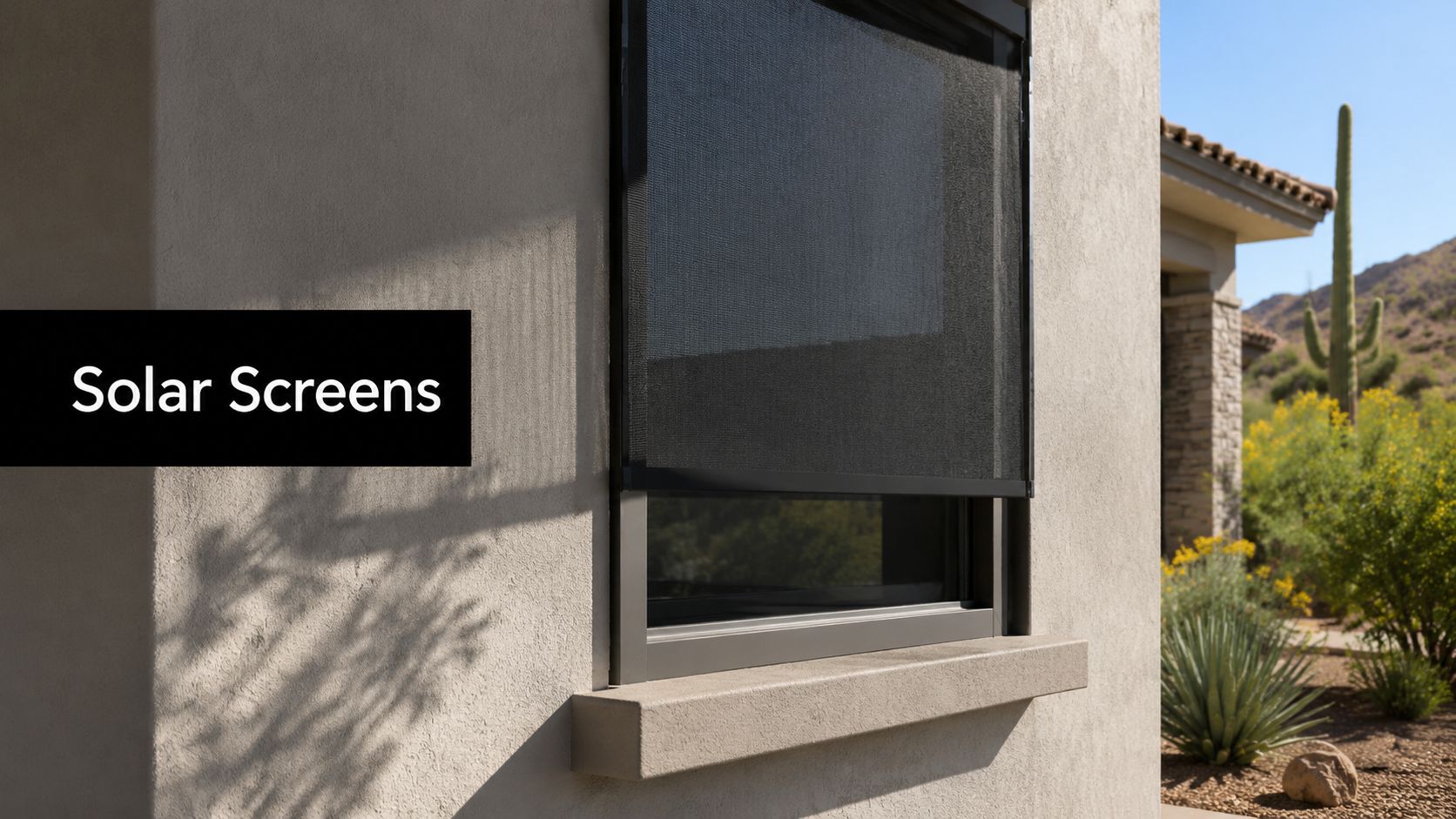
Solar screens are exterior-mounted mesh screens designed to block a large share of solar heat and glare before it gets through the window. Think of them as sun control at the outside edge of the house, where they can do the most good.
In Phoenix, that solves a very specific problem. A standard bug screen keeps insects out, but it doesn't do much against intense afternoon sun. Regular blinds help with brightness, but by the time the light reaches the blind, the heat has already hit the glass. Solar screens change that equation by putting the protection outside.
A common Arizona setup looks like this: east-facing windows are manageable in the morning, north-facing windows are usually less urgent, and major trouble starts on the south and west exposures. Those are the windows that turn offices, bedrooms, and family rooms into the least comfortable parts of the house during summer.
On Arizona homes, the worst-performing windows are often the ones people use the most. The living room picture window, the sliding door, the front bedroom facing west.
That's why solar screens windows have become such a practical choice in the Valley. They target the problem where it starts. They also work well for older homes that don't have the newest glass package, and for newer homes where the owner still wants less glare and better comfort during peak heat.
Arizona homes need them because our sun is less forgiving. In Phoenix and Scottsdale, the issue isn't just bright light. It's long-duration solar exposure, hot glass, and rooms that feel uneven even when the thermostat says everything should be fine.
How Solar Screens Deliver Comfort and Savings
The main advantage of a solar screen is simple. It cuts down solar heat before that heat loads up the glass and starts radiating into the room.
That outside placement matters a lot in Phoenix and Scottsdale. On a west-facing bedroom or a big family room window, the difference shows up in the part of the day homeowners feel most. Late afternoon. The room stays more usable, the glass runs cooler, and the AC does not have to fight the same spike in heat gain.

They block heat before the window heats up
This is the performance piece that matters most in Arizona. The U.S. Department of Energy notes that standard window glass can let in a large share of the sun's heat, and exterior shading products reduce solar heat gain before it enters the home. High-quality solar screens are built to do exactly that on the hottest exposures. You can see the practical differences in solar screen material and openness options for Arizona windows when you compare lighter weaves to tighter, darker mesh.
On the house, that usually means fewer hot spots near windows, less radiant heat rolling off the glass, and better comfort in rooms that used to feel off even with the thermostat set correctly.
They reduce glare without making the room useless
A good solar screen softens harsh daylight instead of forcing you to shut the room down with blinds at 2 p.m.
That helps in the spaces Arizona homeowners use every day:
- TV rooms where reflections wash out the screen
- Home offices with monitor glare in the afternoon
- Kitchens and great rooms where bright sun hits counters and floors for hours
The trade-off is real. As screen density goes up, glare control and heat reduction improve, but you also lose some brightness and a little sharpness in the outward view. On west and south windows in Phoenix, many homeowners are happy to make that trade.
Practical rule: If you close blinds every afternoon on the same side of the house, those windows are strong candidates for solar screens.
They slow interior fading and sun wear
Arizona sun is hard on flooring, upholstery, wood finishes, and artwork. Solar screens reduce direct sun exposure and cut down UV reaching the room, which helps slow that wear.
They are not a full substitute for every interior covering. Bedrooms may still need blackout curtains. Rooms with delicate finishes may still benefit from additional protection. But in living rooms, offices, kitchens, and large front windows, solar screens handle a big part of the daily sun load.
They improve daytime privacy
This benefit gets noticed quickly after installation. A darker exterior mesh makes it harder for people outside to see in during the day, while you still keep a usable outward view from inside.
Nighttime is different. Once the interior lights come on, you still need blinds, shades, or curtains for privacy. Solar screens help most with daytime privacy, glare, and heat control.
They can lower cooling demand in real Phoenix conditions
The savings are usually most noticeable on homes with older windows, large west-facing glass, or rooms that get hit for several hours every summer afternoon. In those homes, solar screens can reduce the amount of heat the AC has to remove day after day.
That does not mean every window needs one. North-facing windows often deliver less payoff. The best return usually comes from being selective and screening the exposures that take the worst sun. In the Valley, that targeted approach is where solar screens start paying for themselves in comfort first, and then on the electric bill.
Choosing Your Ideal Solar Screen Material and Density
Once you decide solar screens make sense, the next question is which kind to install. Many homeowners get mixed messages on this point, because the right answer depends on your exposure, your view, and how much darkness you're willing to accept indoors.
Start with material that can handle Arizona conditions
In the field, the practical concern is durability. Arizona sun is hard on anything that lives outside year-round. High-quality vinyl-coated polyester or PVC-coated fiberglass are common choices because they hold up well and are built for exterior use.
For most homes, the material decision is less confusing than the density decision. The bigger real-world choice is how tight the weave should be.

Density is where the trade-off happens
The performance of a solar screen is defined by its weave openness. Tightly woven fabrics with 1% openness can block up to 99% of UV and radiant heat, while more common 80% to 90% screens absorb and dissipate up to 70% of solar heat before it penetrates the window, according to published guidance on solar screen openness and density.
That sounds technical, but the takeaway is simple. A tighter screen gives you more heat blocking and more daytime privacy, but less outward visibility. A more open screen preserves the view better, but it won't be as aggressive against sun load.
How that plays out on a Phoenix house
Here's the practical way to think about common density choices:
| Screen choice | What it feels like in real use | Best fit |
|---|---|---|
| More open weave | Brighter room, easier view out, lighter appearance | Patio areas, front windows where view matters most |
| Mid-range solar screen | Strong balance of glare control, visibility, and comfort | Most living rooms and general-purpose windows |
| Tighter weave | Darker inside, stronger privacy, more aggressive heat control | West-facing bedrooms, offices, and problem windows |
A lot of homeowners make the mistake of choosing every screen the same way. That's not always the best call. A patio slider facing a yard may need a different screen than a west-facing bedroom in Scottsdale that gets hammered for hours every afternoon.
The right screen isn't the darkest one. It's the one that solves the actual problem on that specific window.
Match the screen to the window, not the whole house
If you want a deeper breakdown of fabric options and how they perform, this solar screen material for windows guide is a useful reference point.
In practice, I'd separate windows into three groups:
Heat problem windows
These are the ones baking a room in late afternoon. Prioritize stronger solar control.View windows
These are large living-room or patio windows where homeowners care more about seeing out cleanly during the day.Mixed-use windows
Most homes have these. You want better comfort, but you don't want the room to feel too dim.
That's why a one-size-fits-all recommendation usually falls short. In Arizona, orientation matters more than brochure language.
Solar Screens Compared to Window Tint and Blinds
Most Phoenix homeowners don't start with solar screens. They start by asking whether they should add tint, keep using blinds, or do both. That's the right question, because each option solves a different part of the problem.
Blinds are common because they're already there. Tint appeals to people who want a cleaner look on the glass. Solar screens are usually the strongest option when the priority is stopping heat before it gets inside.
Where each option helps and where it falls short
Interior blinds are useful for privacy and light control. They can darken a room fast, and they're simple to operate. The weakness is placement. They're inside the house, so they don't stop the sun from hitting the glass first.
Window tint sits directly on the glass. That can help with glare and some sun control while keeping the exterior appearance subtle. The trade-off is that the window still takes the exposure directly. On very hard-hit Arizona windows, many homeowners still feel the room load up in the afternoon.
Solar screens sit outside. That's their edge. They intercept sun before the glass becomes part of the problem.
Comparison of sun control solutions
| Feature | Solar Screens (Exterior) | Window Tint (Film) | Blinds (Interior) |
|---|---|---|---|
| Heat control approach | Stops a large share of sun before it reaches glass | Reduces sun at the glass surface | Manages light after it enters |
| Glare reduction | Strong daytime glare control | Good glare reduction | Good glare reduction when closed |
| Daytime privacy | Usually good, especially with darker mesh | Limited privacy effect depends on film | Depends on blind position |
| Nighttime privacy | Limited on its own | Limited on its own | Strong when closed |
| View preservation | Usually good during daytime | Good | Reduced when blinds are closed |
| Exterior appearance | Visible screen frame and mesh | Minimal visual change | No exterior change |
| Best use case | Hot west and south exposures | Homeowners wanting a glass-applied option | Privacy and room darkening |
One useful side-by-side read is this solar screens vs window tint comparison, especially if you're deciding between exterior screening and film for the same set of windows.
What works best in Arizona homes
For pure heat control on west-facing and south-facing windows, exterior solar screens usually make the most practical sense. For bedrooms where privacy and darkness matter after sunset, blinds or curtains still have a role. For homeowners who want a layered setup, combining exterior solar screens with interior shades often produces the most comfortable result.
If your main complaint is heat, start outside the glass. If your main complaint is privacy at night, start inside the room.
That's the simplest way to avoid buying the wrong fix for the wrong problem.
The Real Cost and Payback of Solar Screens in Phoenix
By late July in Phoenix, the expensive windows usually identify themselves. One west-facing bedroom stays warm until bedtime. The family room gets blasted in the afternoon. The AC runs longer, and you feel it on the utility bill.
That is why cost and payback matter more here than they do in milder climates. In Phoenix and Scottsdale, solar screens are often a targeted heat-control upgrade for the windows that take the worst sun.
Installed price varies by window size, frame condition, screen density, and how many openings are being done at once. Small one-off jobs usually cost more per screen than a full-house project. Reusing solid existing frames can help. Custom sizes, large picture windows, and second-story access usually push the price up.
For a local benchmark, this breakdown of how much solar screens cost gives a better starting point than a national average because Arizona jobs tend to revolve around intense west and south exposure, not just basic shade.
What changes the price on a Phoenix job
A few job details make a noticeable difference:
Window size and shape
Bigger openings need more material and more careful fitting. Arched or oversized windows take more labor.New frame vs. rescreen
If the frame is still square and usable, replacing mesh is usually less expensive than building a new screen from scratch.Number of screens ordered
Whole-home projects usually bring the per-window cost down compared with doing two or three problem windows.Access
Ground-floor windows are simpler. Second-story installs or tight exterior access add labor time.
How payback works in Arizona
The payback question is straightforward. How much heat are these screens keeping off the glass during the longest cooling season of the year?
In Phoenix, that answer can be meaningful, especially on homes with large west-facing windows, older glass, or rooms that get hammered from noon to sunset. A screen that cuts afternoon heat on the worst exposures can reduce AC runtime and make those rooms usable sooner in the evening. That savings is not identical from house to house. Orientation, insulation, thermostat settings, tree cover, and the condition of your existing windows all change the result.
I would not promise the same payoff for every home. I would say this with confidence. Arizona homeowners usually see the best value when they treat solar screens as a problem-window upgrade first, then decide whether a full-house package makes sense.
Start where the sun costs you the most
If you want the fastest return, begin with the windows that create the biggest comfort and energy complaints:
- The west-facing bedroom that stays hot after sunset.
- The living room window that turns bright and uncomfortable every afternoon.
- The office, sliding door, or bonus room window that gets long hours of direct sun.
That approach works well in older Phoenix homes and many Scottsdale stucco homes where one side of the house takes a beating all summer. You get a clearer before-and-after result, and you avoid spending money on shaded windows that were never the problem.
If lowering summer cooling costs is part of a bigger plan, this guide to saving electricity in Tucson homes covers a few related upgrades that pair well with better window shading.
Installation and Maintenance Guide
In Phoenix, poor screen fit shows up fast. A loose corner rattles in monsoon winds, a bowed frame looks worse every time the afternoon sun hits it, and a bad measurement leaves light gaps right where the heat comes through.
The first decision is simple. Are you reusing an existing frame, or are you ordering and fitting a brand-new solar screen? The tools, margin for error, and labor are different.

DIY makes sense for some rescreening jobs
Rescreening is a reasonable DIY project if the frame is still square, the corners are tight, and the tabs are not worn out. In that case, the job is mostly prep and patience. Pull the old spline, remove the damaged mesh, clean the channel, install the new material evenly, and trim it clean.
Where DIY jobs usually go wrong is tension. Solar mesh needs to sit flat without being stretched so hard that it twists the frame. Too loose, and the screen looks wavy or flaps. Too tight, and the frame can bow enough that it stops fitting the window opening correctly.
A few checks save a lot of frustration:
Inspect the frame before buying mesh
Bent aluminum, loose corners, cracked plastic pieces, and worn pull tabs can ruin the job before the new screen goes in.Set up on a stable table
A flat work surface helps keep the frame square. Garage-floor installs often end with uneven pressure and sloppy cuts.Match spline size to the frame channel
Using the wrong spline can leave the mesh loose or make the frame hard to reassemble.Cut with extra material first
Leave enough overhang to tension the mesh evenly, then trim after the spline is fully seated.
Frame condition matters as much as the mesh.
Professional installation helps on full replacements and tricky openings
New screens require cleaner measurements than many homeowners expect, especially on older Phoenix houses where window openings are not perfectly consistent. That is where professional installation usually earns its keep. The value is not just labor. It is getting the frame size, corner fit, attachment hardware, and mesh choice right the first time.
That matters more on street-facing windows, large west-facing openings, slider screens, and patio areas where a poor fit is obvious. It also matters when one side of the house needs darker solar mesh and the shaded side does not. A good installer will measure each opening, check how the frame mounts, and flag windows that need repair before new screens go in.
Sparkle Tech Screen Service handles new sun screens, rescreening, repairs, sliders, and screened patio work. For homeowners who do not want to sort out frame measurements, material ordering, and pickup, that kind of local service can cut down on wasted trips and mismatched parts.
A quick visual on the install process helps if you want to see how these screens are handled in practice.
Maintenance is simple if you stay gentle
Arizona dust is hard on every exterior screen, but aggressive cleaning does more harm than normal buildup. The goal is to remove dirt without stretching the mesh or wearing down the coating.
| Task | What to do | What to avoid |
|---|---|---|
| Cleaning dust and dirt | Use mild soap, water, and a soft brush or sponge | Harsh scrubbing |
| Rinsing | Rinse lightly and let the screen air dry | High-pressure washing |
| Routine checks | Look for small tears, loose corners, and worn spline | Waiting until the frame fails |
A light cleaning during dusty periods and a quick inspection before peak summer usually does the job. If a screen starts pulling loose at one corner or the spline shrinks and backs out, fix it early. Small repairs are cheap. Waiting often turns a simple rescreen into a full replacement.
Frequently Asked Questions and Your Local Screen Solution
A few questions come up on almost every Arizona solar screen job.
Do solar screens make the house too dark
Not usually if the density is chosen correctly for the room. The windows that need the strongest solar control are often the same ones bringing in more aggressive sun than you want. Most homeowners adjust quickly because the room feels more usable, not cave-like.
Can you still open the windows
Yes, in normal use solar screens still function as screens. You can open the window for airflow when weather allows. That's part of their appeal compared with some other sun-control options.
Do they provide privacy at night
Not by themselves. They help with daytime privacy, but once interior lights are on, people outside can see in more easily. Bedrooms and street-facing rooms still benefit from interior blinds or curtains after dark.
Are they worth it in Phoenix and Scottsdale
For homes with problem exposures, usually yes. The value is practical. Better comfort, less glare, more protection for interiors, and a stronger case for reducing cooling strain in a climate where summer sun is relentless.
If you need help with new solar screens, bug screens, slider screens, screened patio rescreening, or sun screen repair, a local screen company should be able to measure the openings, recommend mesh choices based on exposure, and handle replacement or repair work without turning it into a trial-and-error project.
For Phoenix-area homeowners and surrounding communities, that includes service in places such as Scottsdale, Peoria, Surprise, Mesa, Tempe, Chandler, Cave Creek, Anthem, Carefree, Buckeye, Queen Creek, Prescott, Sedona, Payson, Flagstaff, and more.
If your windows are taking the full hit of the Arizona sun, Sparkle Tech Screen Service offers quick quotes for new, rescreened, and repaired bug and sun screens, along with window sliders and screened patio rescreening. Text or call 623-233-0404 or 800-370-3998 to ask about same week service, same day pickup, and options for your Phoenix-area home.


