


Ever walked into a room on a sunny afternoon and felt like you'd just stepped into an oven? That oppressive heat is called solar heat gain, and it's exactly what solar window screens are designed to fight.
Think of them as a set of high-tech sunglasses for your entire home. A solar screen is a specialized mesh panel installed on the outside of your windows, creating a powerful shield that blocks intense heat and glare before it ever has a chance to touch the glass.
What Is a Solar Screen for Your Windows
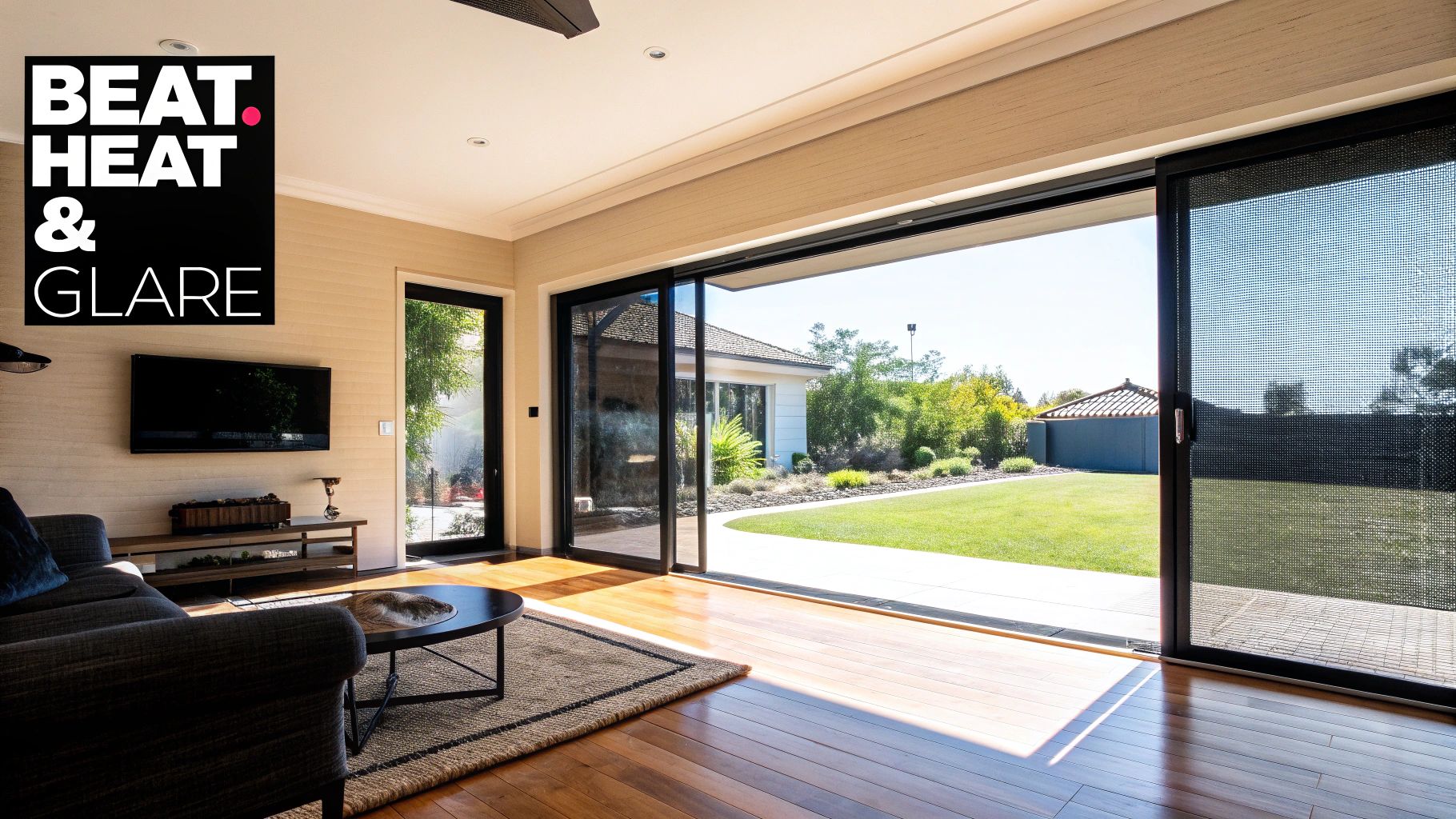
Unlike indoor solutions like blinds or curtains, which trap heat after it’s already passed through the window, a solar screen for windows is your home's first line of defense. They tackle the problem at the source.
The magic is in how they absorb and radiate a huge chunk of the sun's thermal energy away from your house. This simple-but-brilliant process stops the windowpane from getting hot in the first place, keeping your rooms significantly cooler. The payoff? A much more comfortable home and an air conditioner that doesn't have to run constantly just to keep up.
More Than Just Temperature Control
The benefits don't stop at a cooler room. Installing a solar screen for windows brings a whole host of improvements to your daily life.
- Slash Energy Costs: By blocking up to 95% of the sun's heat, these screens can make a serious dent in your summer cooling expenses. Many homeowners see savings of up to 30% on their energy bills, turning this upgrade into a smart investment that pays for itself.
- Cut Annoying Glare: Ever tried to watch TV or work on a laptop with a blinding ray of sun in your eyes? Solar screens diffuse that harsh light, making your indoor spaces more comfortable and usable throughout the day.
- Protect Your Furnishings: The sun's UV rays are notorious for fading furniture, rugs, and artwork. Solar screens act as a powerful UV blocker, preserving your valuable interiors for years to come.
- Boost Daytime Privacy: From the outside, the dark mesh makes it tough for anyone to see in. From the inside, however, you can still see out clearly, enjoying your view without feeling like you're in a fishbowl.
The core principle is simple: it's far more efficient to stop heat on the outside than to deal with it on the inside. A solar screen for windows addresses the problem at its source, leading to immediate and measurable results in both comfort and energy savings.
For a clearer picture of what these screens can do for you, take a look at this quick summary.
Key Benefits of Solar Window Screens at a Glance
| Benefit | Impact on Your Home |
|---|---|
| Energy Savings | Lower air conditioning bills by reducing solar heat gain. |
| Glare Reduction | Makes rooms more comfortable for work, relaxation, and screen time. |
| UV Protection | Prevents fading and sun damage to your furniture, floors, and decor. |
| Enhanced Comfort | Keeps indoor temperatures more stable and pleasant, especially in south-facing rooms. |
| Daytime Privacy | Obscures the view into your home from the outside without blocking your view out. |
When you combine these benefits, you can see why solar screens are one of the most effective upgrades for creating a more efficient and livable home, especially in sunny climates.
Beyond the immediate comfort, solar screens contribute to significant long-term savings. You can learn more with these proven tips to lower your electric bill and see how this upgrade fits into a larger energy-saving strategy.
How Solar Screens Keep Your Home Cool
Ever wonder how a simple mesh screen can drop the temperature in your home so dramatically? It's a clever concept, really. Think of it like having a permanent shade tree planted right in front of your window, blocking the sun before it ever gets a chance to bake your living room.
The main culprit behind a sweltering home is direct sunlight. When those rays hit a standard window, the energy blasts right through the glass, heating up your floors, furniture, and the air itself. This is what sends your AC unit into overdrive.
A solar screen acts as a first line of defense, intercepting that intense solar energy before it even touches the glass. The dark, tightly woven mesh is specifically designed to absorb and then dissipate a huge chunk of that heat away from your home. The result? The window pane itself stays much, much cooler.
The Tech Behind the Comfort
To really get a feel for how well these screens work, you'll want to pay attention to a couple of key numbers on the product label. This isn't just confusing jargon; these metrics tell you exactly what to expect in terms of comfort and savings.
- Solar Heat Gain Coefficient (SHGC): This is the big one for cooling. It’s a simple measurement of how much solar heat a window lets through. The lower the SHGC number, the less heat gets in and the better the shading. For context, a typical double-pane window might have an SHGC of 0.70 (meaning 70% of solar heat gets through). Adding a 90% solar screen can plummet that number down to around 0.15.
- UV Blockage: Those invisible UV rays are what cause your carpets, artwork, and furniture to fade over time. A good solar screen is like sunscreen for your house, blocking up to 95% of those damaging rays.
This infographic gives you a great visual of just how much of a difference solar screens make.
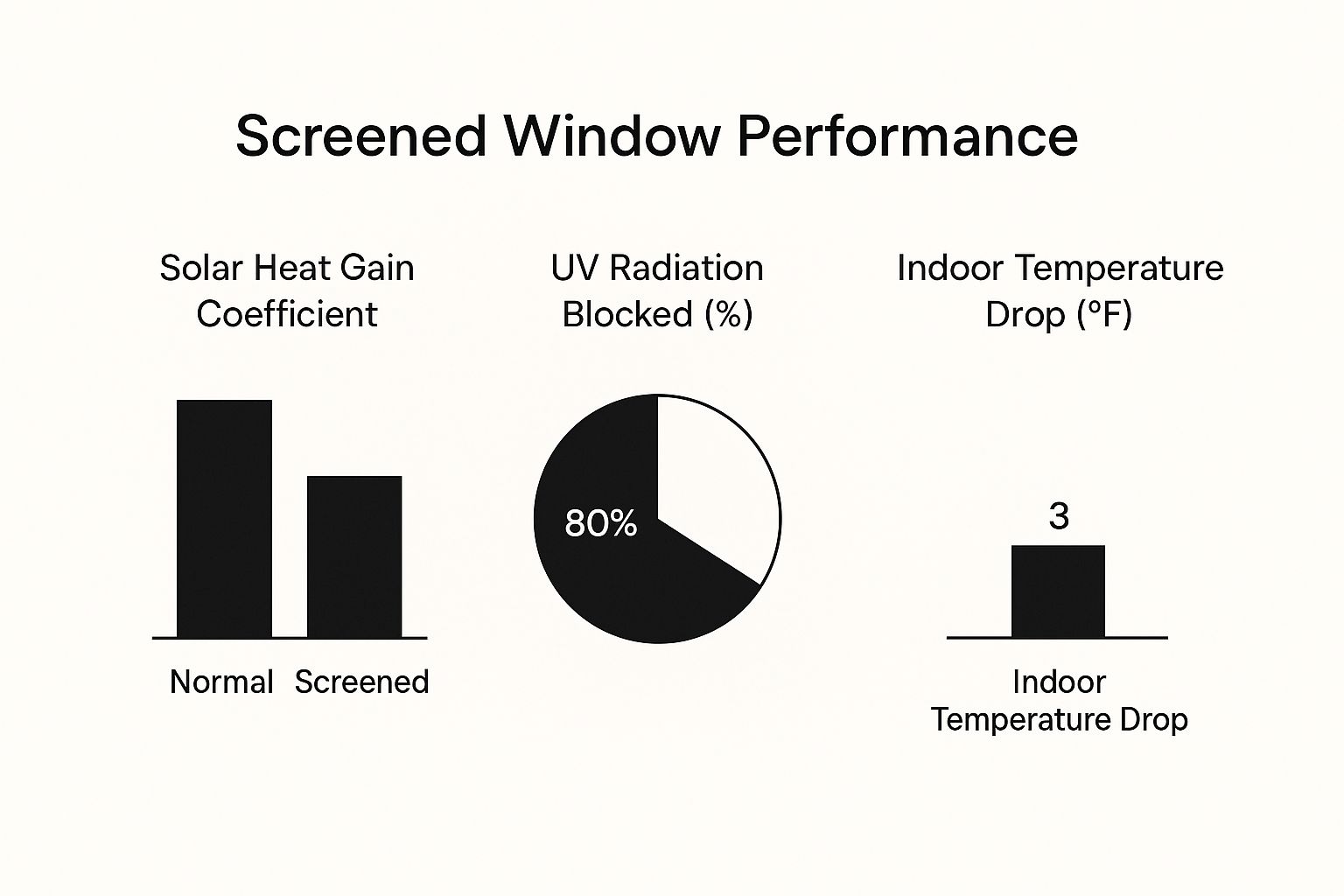
As you can see, the drop in heat gain is massive. That translates directly to a cooler home and some serious protection for your belongings.
What This Means for Your Energy Bills
All that efficient heat-blocking power leads straight to lower energy bills. It’s no surprise that the global solar screen market, valued at around USD 2.5 billion, is expected to hit USD 4.8 billion by 2033. People are catching on. With roughly 30% of a home's cooling energy lost through its windows, a solution this effective is a no-brainer.
The real magic of a solar screen is that it stops the "greenhouse effect" from happening inside your house in the first place. By tackling the heat on the exterior, it keeps your indoor temperature stable far more effectively than blinds or curtains ever could.
This proactive approach doesn't just keep you more comfortable; it also eases the constant strain on your HVAC system. A system that doesn't have to work as hard tends to last longer and require fewer repairs.
Of course, solar screens are just one piece of the puzzle. For the biggest impact, it's smart to explore other strategies to improve your home's overall energy efficiency as well. A holistic approach ensures every part of your home is working together to keep you cool and your bills down.
Choosing the Right Materials and Weave Density
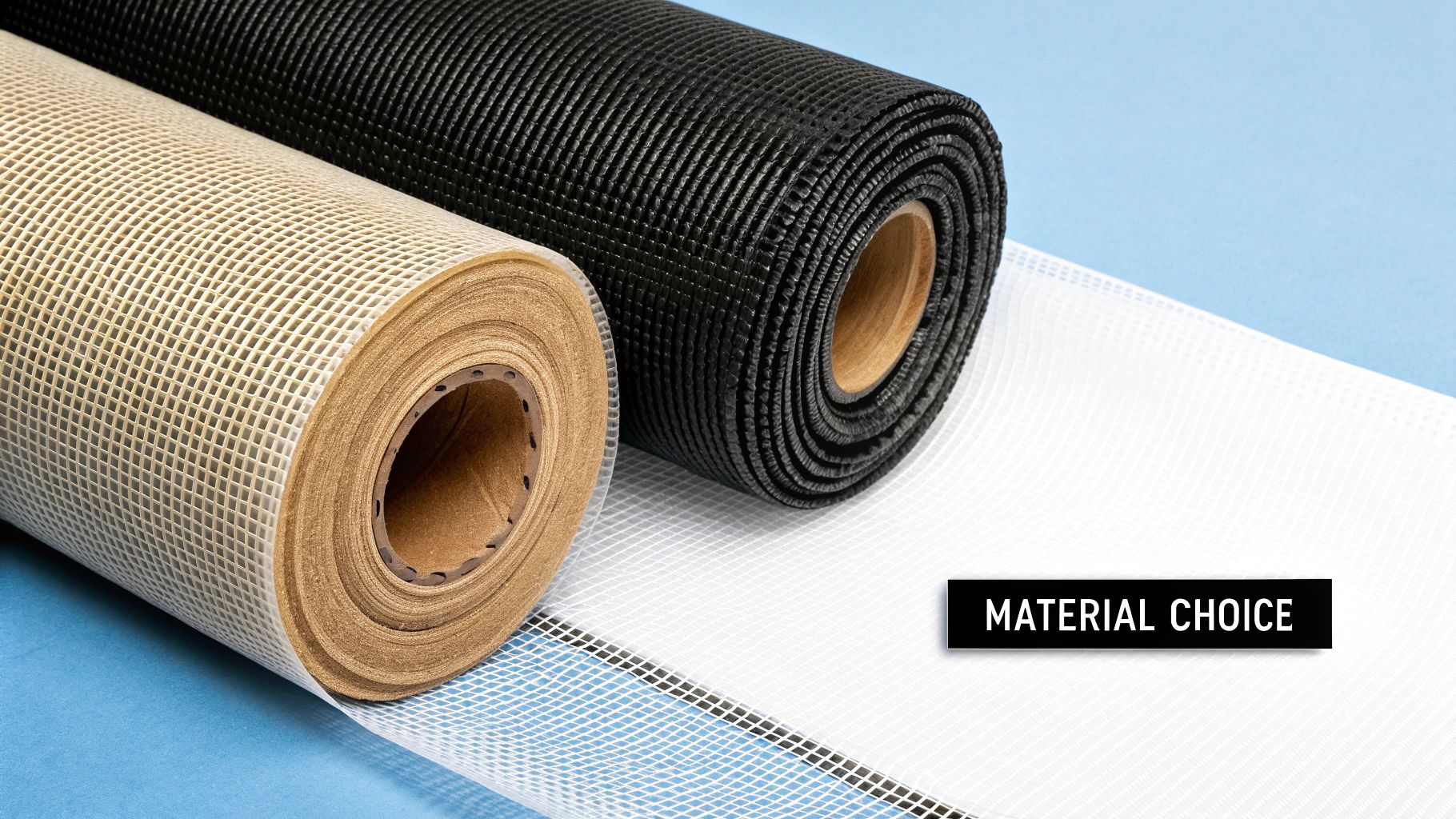
Once you know how solar screens work, the next step is picking the right one. It really comes down to two things that work together: the material the screen is made of and how tightly it's woven.
This weave is often called the screen’s density or "openness factor." Getting this combo right is the key to balancing heat reduction, natural light, and your view. Think of it like buying sunglasses—the frame material affects durability, while the darkness of the lenses determines how much light they block.
Let’s break down the options so you can make a confident choice.
Comparing Core Screen Materials
When it comes to high-quality solar screens, you'll almost always find they're made from one of two workhorse materials: fiberglass or PVC-coated polyester. They can look pretty similar at a glance, but they have some important differences.
-
Fiberglass Screens: This is often the more affordable choice, making it a popular starting point. Fiberglass is quite flexible and easy to handle, but it’s generally not as tough as polyester, especially in climates with relentless sun.
-
PVC-Coated Polyester Screens: For durability and strength, this is the top-tier option. The polyester core provides fantastic tear resistance, and the PVC coating acts like a shield against UV damage. These screens can easily last 10 years or more without getting brittle or fading.
If you live in a seriously sunny, hot place like Arizona, investing in PVC-coated polyester screens is almost always the smarter long-term move. The added strength means they can take years of intense sunlight without failing.
Want to get even deeper into the pros and cons? Our guide on the best window screen material has more detail to help you nail down your decision.
The Critical Role of Weave Density
After you’ve settled on a material, the most important decision you'll make is the screen's weave density. This is usually shown as a percentage, like 80% or 90%, which tells you how much of the sun’s heat and UV rays the screen deflects.
This number represents a direct trade-off: the more heat you block, the less light gets in and the less clear your view will be.
-
80% Density Screens: This is a fantastic all-around choice. It blocks a solid 80% of solar heat while keeping your view crisp and letting in a good amount of natural light. It’s perfect if you have a great view you don’t want to sacrifice or if you’re worried about a room feeling too dark.
-
90% Density Screens: If your main goal is maximum cooling and energy savings, this is what you want. A 90% screen makes a noticeable difference in comfort and also offers great daytime privacy. The trade-off is a slightly dimmer room and reduced visibility.
-
95% Density Screens: This is the ultimate for heat control and privacy. It's ideal for those west-facing windows that get absolutely blasted by the afternoon sun or for rooms like a home theater where you want it dark. Just know that the view will be significantly obscured.
Finding Your Perfect Balance
Deciding which screen is right for your windows comes down to your priorities. To help you weigh the options, this table compares the key features of different materials and densities.
Solar Screen Material and Density Comparison
| Feature | Fiberglass Screens | Polyester Screens | 80% Density | 95% Density |
|---|---|---|---|---|
| Durability | Good | Excellent | N/A | N/A |
| Cost | Lower | Higher | Lower | Higher |
| Heat Blockage | N/A | N/A | Good (~80%) | Maximum (~95%) |
| Outward Visibility | N/A | N/A | Very Good | Fair/Limited |
| Natural Light | N/A | N/A | High | Low |
| Daytime Privacy | N/A | N/A | Good | Maximum |
So, how do you choose? If you’re trying to cool down one "problem window" that turns a room into an oven, a 90% or 95% screen is probably your best bet. If you’re just looking for a general reduction in heat across the whole house without losing your view of the kids playing in the backyard, an 80% screen will be a great fit.
By understanding this balance between material and density, you can pick the perfect solar screens to deliver the comfort, savings, and look you want for your home.
Solar Screens Versus Other Window Treatments
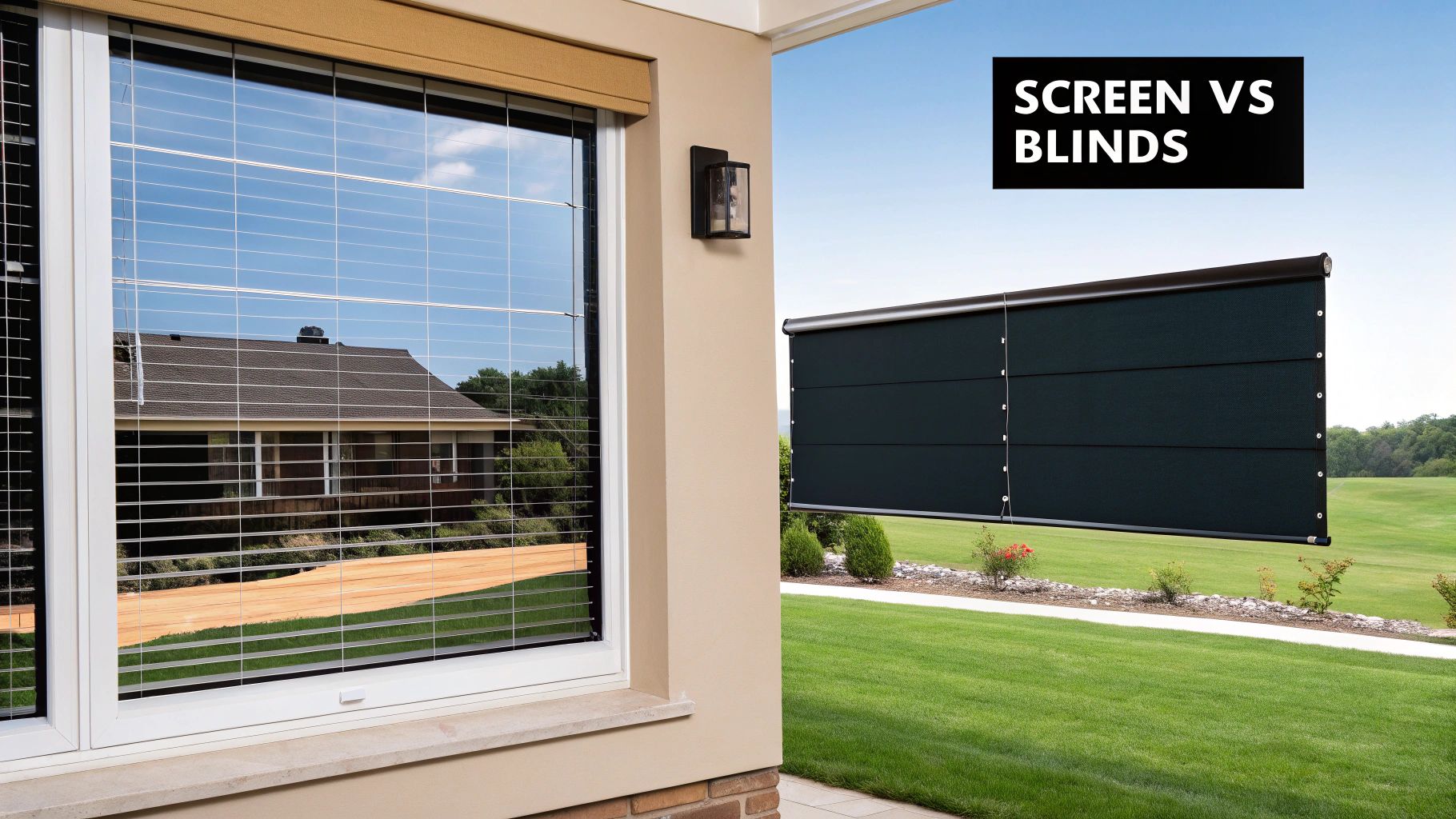
When you're trying to beat the heat and cut down on energy bills, not all window coverings are created equal. It's easy to get lost in options, but the real test is performance. Let’s break down how solar screens truly stack up against the usual suspects—blinds, curtains, and even modern window films.
The single biggest difference comes down to one simple, game-changing detail: location. Solar screens mount on the outside of your windows. This is a proactive strategy. They stop the sun's powerful heat before it ever gets a chance to touch the glass, let alone radiate into your home.
Interior treatments like blinds and curtains, on the other hand, are reactive. They’re fighting the battle from inside. By the time sunlight hits your blinds, its heat is already in your house, trapped between the fabric and the windowpane, where it just warms up your room.
Solar Screens Versus Interior Blinds and Curtains
Here's a simple analogy: on a scorching day, would you rather stand under a big shade tree or wear a heavy coat? Solar screens are the shade tree—they block the heat at the source. Blinds and curtains are the coat, merely trying to contain the heat that’s already cooking the air around you.
- Heat Blocking Effectiveness: This isn't even a close race. Solar screens are the hands-down winner, blocking up to 95% of solar heat before it ever gets in. This keeps your window glass cool to the touch. Blinds might reflect a bit of light, but they do very little to stop heat transfer and can even create a super-heated pocket of air right next to the window.
- View Preservation: Want to cut the glare without living in a cave? A solar screen for windows is your answer. You keep your view of the outside world, just without the blinding sun. Blinds and drapes have to be completely closed to do their job, which means you lose all your natural light and your view along with it.
- UV Protection: Both options will help protect against UV rays, but solar screens do it without compromise. Think of them as a powerful sunscreen for your entire home, preventing your floors, furniture, and artwork from fading while still letting you enjoy the scenery.
The real magic of an exterior solar screen is that it decouples solar heat from the window glass itself. Interior treatments can only manage heat that has already breached your home's thermal envelope, making them fundamentally less efficient at cooling.
And while a heavy curtain might offer a bit of insulation against the cold, its ability to fight off intense solar heat just doesn't compare to a properly installed exterior solar screen.
Solar Screens Versus Window Film
Window film is probably the closest competitor to a solar screen in pure function. It's a thin, see-through layer applied directly to the glass to reflect solar energy. Both get the job done, but they have some key differences that matter.
This is a big market—the global solar control window film industry is valued at around USD 773 million and climbing. It's a very popular choice, especially for commercial buildings, thanks to a push for green building standards. If you want to dive deeper into the market data, Fortune Business Insights has some great analysis.
So, how do they really compare head-to-head?
Performance and Practicality Showdown
Let's put them side-by-side to make the choice a little clearer.
| Feature | Solar Screens | Interior Blinds/Curtains | Window Film |
|---|---|---|---|
| Heat Rejection | Excellent (Stops heat outside) | Fair (Traps heat inside) | Good (Reflects from glass) |
| Glare Reduction | Excellent | Good (But blocks view) | Good |
| Outward View | Excellent (Preserves view) | Poor (Must be closed) | Excellent |
| Daytime Privacy | Excellent | Excellent | Good |
| Durability | High (Exterior grade) | Varies | Moderate (Can peel/bubble) |
| Cost | Moderate | Varies Widely | High |
Window film offers a sleek, nearly invisible solution, but it’s permanently stuck to your glass and can be pricey to have professionally installed. Solar screens, on the other hand, deliver superior heat-blocking power and can be removed for cleaning or during the winter. For homeowners serious about maximum comfort and energy savings, they're often the more robust and cost-effective choice.
Take Control with Smart and Automated Solar Screens
While standard solar screens are fantastic for round-the-clock protection, what if you want that protection on your own terms? This is where technology steps in, transforming solar screens from a simple, static fixture into an intelligent, dynamic part of your home.
Imagine having powerful sun protection only when you need it and a completely clear, unobstructed view when you don't. That’s the beauty of motorized retractable screens. With a remote or wall switch, you can lower your screens to block the intense afternoon heat and then raise them to watch the sunset. It’s the best of both worlds.
The Magic of Automation
The real leap forward comes with full automation. When you connect your screens to a smart home system, they can operate on a schedule or even react to the weather in real-time.
- Sun Sensors: These clever devices can tell the screens to lower automatically when the sunlight gets too intense, protecting your interior even when you’re not home.
- Set Schedules: You can program your screens to deploy during the hottest part of the day, say from 1 PM to 5 PM, and retract on their own in the morning and evening.
- Voice Commands: For the ultimate convenience, just tell your system what to do. Syncing with assistants like Alexa or Google Home allows for completely hands-free control.
This isn't just about comfort; it's about creating a living space that truly responds to you. For anyone thinking about upgrading their patio or porch, exploring motorized solar shades for outdoor spaces is a fantastic starting point.
Smart solar screens fundamentally change how you interact with your home's environment. Instead of a set-it-and-forget-it solution, you get an adaptive system that maximizes comfort, energy savings, and your connection to the outdoors.
This technology is becoming more and more popular. The market for smart solar tracking window shades—a sophisticated cousin to these systems—is growing at a compound annual rate of about 14.3%. These advanced shades can actually follow the sun's position throughout the day to maximize energy savings and light control. It’s no surprise they’re popping up in luxury homes and high-end commercial buildings where managing light is critical. You can find more details about this market growth.
Ultimately, choosing an automated solar screen turns a practical home improvement into a genuine lifestyle upgrade. It gives you effortless command over your home's light, temperature, and privacy, perfectly blending modern convenience with high-performance protection.
A Little TLC: Installation and Maintenance
So, you've picked out the perfect solar screens for your home. That's a huge step, but the job isn't quite done. Proper installation is what really brings all those benefits to life—a screen that fits perfectly just works better and lasts longer.
Now, you might be tempted to tackle the installation yourself. And you can! But it's worth taking a moment to decide if it's the right move for you.
Bringing in a professional installer takes all the guesswork out of the equation. They have the right tools and, more importantly, the experience to get a secure, airtight fit. This is especially true for tricky second-story windows or custom frames. A pro can also spot subtle issues with your window casings that you might overlook.
If you're a confident DIYer, this is a very doable weekend project. Just know that the success of the entire job hinges on one thing: precise measurement. A screen that's even a fraction of an inch off will leave gaps, which kind of defeats the whole purpose.
Your DIY Installation Playbook
Decided to go for it yourself? Awesome. Here’s a quick rundown of what the process looks like:
- Measure Twice, Order Once: Head outside and measure the height and width of your window frame, from one inside corner to the other. Do it again just to be sure before placing your order.
- Frame it Up: If you bought a kit, you'll start by assembling the frame pieces. Then, lay your screen mesh over it, making sure it's flat.
- Get it Taut: This is the key step. Use a simple spline roller tool to push the rubber spline into the channel on the frame. This locks the mesh in place nice and tight. Trim off the excess when you're done.
- Add the Hardware: Attach whatever mounting hardware came with your kit—usually clips or screws—onto the screen frame.
- The Final Fit: Carefully lift your new screen into place on the outside of your window. You're looking for a snug, even fit all the way around.
Keeping Your Screens Looking Great
The good news is that solar screens are incredibly low-maintenance. With just a tiny bit of care, you can expect them to look fantastic and perform perfectly for 10 years or more.
Think of your screens as the first line of defense against the sun. Keeping them clean doesn't just help your curb appeal; it makes sure the mesh can do its job of blocking UV rays and shedding heat effectively.
Cleaning them is a breeze. All you need is some mild soap, water, and a soft brush or cloth. Gently scrub away any dust and grime that's built up. Just be sure to avoid harsh chemical cleaners or a pressure washer, as they can easily damage the screen's protective coating.
For a more detailed walkthrough, check out our guide on how to clean window screens. A quick wash once or twice a year is usually all it takes.
Your Top Solar Screen Questions Answered
Even after getting the rundown on how solar screens work, you probably have a few more questions rattling around. That's completely normal. When it comes to a home upgrade, you want to know exactly what you're getting into. We've heard all the common questions over the years, so let's tackle them head-on.
This way, you'll have all the facts you need to feel good about your decision.
Will Solar Screens Make My House Too Dark?
This is easily the biggest worry we hear, but the reality is a lot brighter than you might think. How much light comes through all boils down to the screen's weave density. An 80% screen, for example, is a popular choice because it blocks a massive amount of heat while still letting plenty of soft, natural light fill the room.
If you opt for a 95% screen, you'll definitely notice a more significant dimming effect. But most people describe it as a pleasant, gentle diffusion of light—not a dark cave. It cuts down on that harsh, blinding glare, making rooms feel much more comfortable and usable, especially during the brightest parts of the day.
Here's a surprising tip from our experience: darker screens, like black or charcoal, actually provide a crisper, clearer view of the outside world. Your eyes tend to look right through the dark mesh, letting you focus on the view beyond. Lighter screens can be more noticeable.
Can I Still Open My Windows?
Of course! A solar screen for windows fits onto the outside of your window frame, pretty much exactly where a regular insect screen would go. They are designed from the ground up to work with your windows, not against them.
So go ahead and open your single-hung, double-hung, or casement windows to let in that fresh breeze. The screens won't get in the way. As a bonus, they're far tougher than standard bug screens, giving you excellent protection from pests.
Do Solar Screens Offer Any Noise Reduction?
While their main job is tackling heat and UV radiation, solar screens do offer a little bit of sound buffering. That dense, woven material creates one more layer for sound waves to get through, which can help muffle some high-frequency noises like wind or the hum of distant traffic.
Don't expect them to be a soundproofing solution, but it's a nice little perk. By adding that extra barrier between your glass and the outdoors, they can help create a slightly more peaceful atmosphere inside.
How Much Can I Realistically Save on Energy Bills?
The savings can be pretty substantial, but the exact amount depends on things like your local climate, which way your windows face, and the screen density you pick. The key is that these screens stop up to 95% of the sun's heat before it ever hits your window glass, which takes a huge load off your air conditioner.
In hot and sunny areas, it’s not uncommon for homeowners to see their summer cooling costs drop by as much as 30%. For many people, a quality solar screen for windows pays for itself in just a handful of seasons thanks to those steady, monthly savings.
Ready to make your home more comfortable and efficient? At Sparkle Tech Screen Service, we're experts in fitting high-quality solar screens that are perfect for your home. You can get a quick quote and even have them installed the same week. Find out more at https://sparkletechscreenservice.com or text/call us to get started.


