


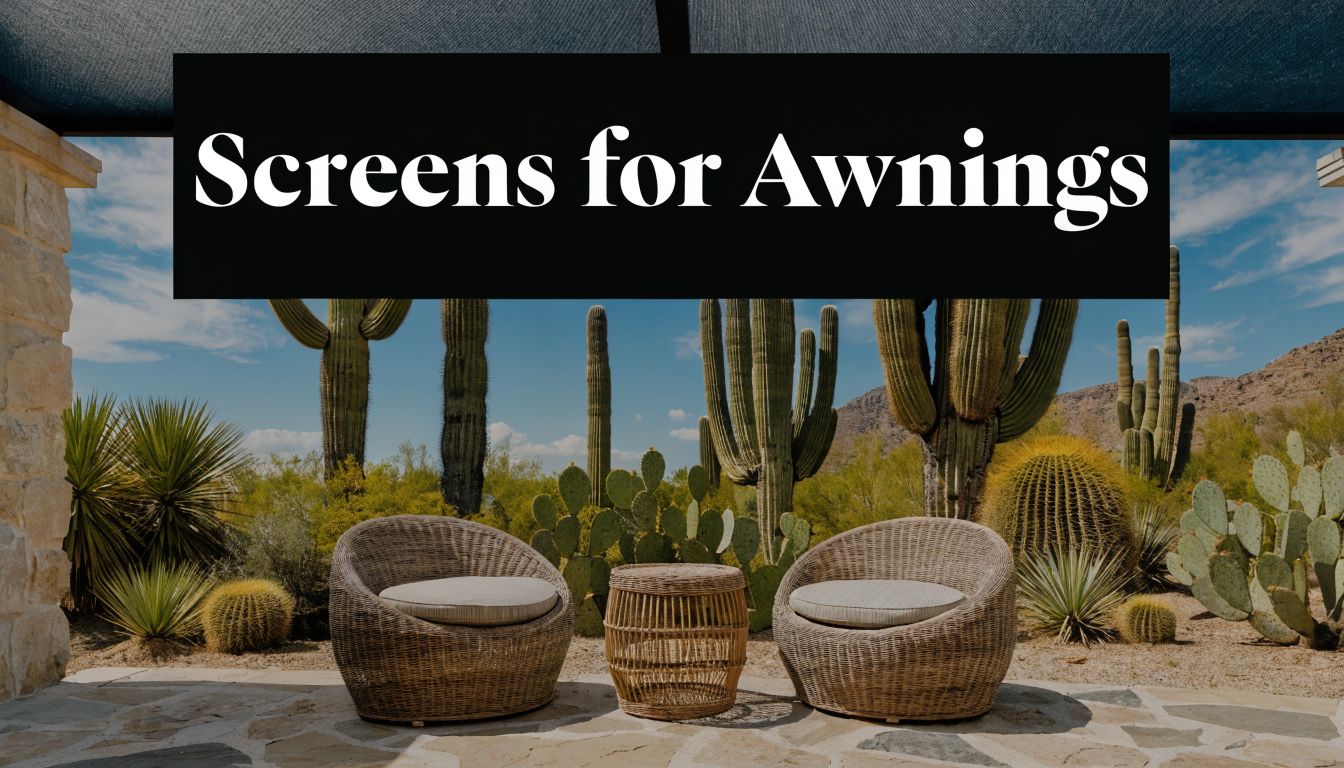

By late spring in Phoenix, a lot of patios turn into spaces nobody uses. The chairs are still out. The table is clean. The grill is ready. But by midafternoon, the heat bouncing off the slab and the glare coming through the opening make the whole area feel exposed. Add mosquitoes at dusk, and a good outdoor space starts acting like storage.
That’s usually when homeowners start looking at screens for awnings. Not because they want a fancy add-on, but because they want the patio to work. A screen changes how an awning performs. It can turn a bright opening into a shaded sitting area, cut glare, and keep bugs from owning the evening.
Reclaim Your Patio from Sun and Pests
One of the most common situations in Arizona goes like this. The patio faces west or southwest, the awning gives overhead shade, but the low-angle sun still comes in from the side and front. By dinner time, everyone moves back inside because the patio is still too hot, too bright, or too buggy to use comfortably.
That’s where the right screen setup earns its keep. A screen under or along an awning doesn’t just block pests. It adds side protection where the awning alone can’t help much. For homes with exposed patios, porches, and outdoor seating areas, that usually matters more than the awning fabric itself.

The demand behind these systems is real. The global awnings market, which includes screens for awnings, was valued at $7.3 billion in 2023 and is projected to reach $14.24 billion by 2033. In the Southwest, including Phoenix, these systems cut energy costs by 21% and can reduce indoor temperatures by up to 15 degrees Fahrenheit, according to awning market data and Southwest energy figures.
What homeowners usually want
Consumers typically aren’t shopping for “awning accessories.” They’re trying to solve one or more practical problems:
- Sun control: Stop the late-day blast that sneaks under the awning line.
- Bug reduction: Make patios usable after sunset.
- Better comfort: Reduce glare so people can sit, eat, or read outside.
- More use from the space: Turn a patio into something closer to an outdoor room.
If you’re comparing options beyond fixed patio screens, it also helps to explore MODERN LYFE's canopy insights, especially for understanding how enclosed shade changes usability in hot-weather outdoor setups.
Homeowners looking at broader patio protection can also review screen options for covered outdoor spaces to see how awning-adjacent screening fits into a full patio plan.
Understanding Awning Screens and Their Function
Think of screens for awnings as sunglasses for the open sides of your patio. The awning blocks overhead sun. The screen handles the light, heat, insects, and glare that come in at an angle.
That’s the simplest way to understand their job. They’re not all built for the same purpose, and that’s where many homeowners get tripped up.
Two different jobs
An awning screen usually does one of two things, and sometimes both.
First, it can act as an insect barrier. This is the straightforward version. The mesh is open enough to preserve airflow and visibility while stopping mosquitoes and other pests from moving through the opening.
Second, it can act as a solar control layer. This type of screen is made to cut glare, reduce heat gain, soften harsh daylight, and protect furniture and finishes from constant sun exposure. In Arizona, that’s often the bigger priority.
A patio can have plenty of shade overhead and still feel unusable if the low sun is coming straight through the opening.
Common forms you’ll see
The screen material may be similar across products, but the way it’s deployed changes how the system performs.
- Fixed panels work well when the opening size doesn’t need to change and the exposure is consistent.
- Drop-down screens are useful when you want protection only during part of the day.
- Retractable side or front screens make sense when the patio needs flexibility for airflow, views, or access.
- Integrated awning screen systems are designed to work with the awning structure instead of being added as an afterthought.
What they don’t do well
Screens help a lot, but they’re not magic. They won’t make an exposed patio feel air-conditioned. They also won’t compensate for a weak frame, bad mounting surface, or a poor fit at the edges.
That last point matters. A screen that leaves gaps at the sides may still look fine from the yard, but it won’t control insects well and it won’t manage light cleanly. Good performance starts with matching the mesh, frame, and mounting method to the actual opening, not just buying whatever says “outdoor screen.”
Bug Screens vs Solar Screens The Critical Choice
Most bad screen decisions happen because homeowners choose based on one word. They ask for “screen” when what they need is either insect control or sun control. Those are not the same thing.
A bug screen is built to keep insects out while preserving airflow and a clear view. A solar screen is built to cut heat, glare, and UV exposure while still allowing ventilation. In Arizona, that difference shows up fast.

What bug screens do well
Bug screens are the better choice when your main frustration is mosquitoes, flies, or general insect traffic. They usually feel lighter, look more transparent, and allow more natural airflow.
For patios that already have decent shade and just need pest control, bug screen mesh can be enough. It’s also easier to live with if preserving the clearest outward view matters most.
But bug screens don’t do much against Arizona glare. If the patio gets hammered by late-day sun, a standard bug screen often leaves homeowners disappointed because the space is still bright and hot.
Where solar screens win
Solar screen mesh is built for stronger sun exposure. Solar screen mesh blocks 65-95% of solar heat, reducing indoor temperatures by 10-20°F. A Phifer SunTex 80 mesh has a shading coefficient of 0.35, compared to a standard bug screen's 0.85, which translates to a 15-25% drop in cooling energy costs, based on solar mesh performance data from RiteScreen.
That’s why solar mesh is often the better fit for west-facing patios, horse stalls, screened porches, and awning openings that take direct afternoon sun. The trade-off is that the screen is denser. You get better glare control and daytime privacy, but a slightly more filtered view.
Homeowners comparing patio-facing solar fabrics can also look at solar screen options for windows and exterior openings to understand how mesh openness changes comfort.
Bug Screen vs. Solar Screen At a Glance
| Feature | Bug Screen | Solar Screen |
|---|---|---|
| Primary purpose | Insect protection | Heat, glare, UV, and insect control |
| View outward | Clearer and more open | More filtered |
| Airflow feel | Higher | Good, but more controlled |
| Sun blocking | Limited | Strong |
| Privacy in daytime | Minimal | Better |
| Best use case | Shaded patios with pest issues | Hot, bright patios with strong sun exposure |
Material trade-offs that matter
The mesh material changes lifespan and behavior.
- Fiberglass mesh: Common, workable, and often fine for lighter-duty insect screening.
- Vinyl-coated polyester: Better suited for harder sun and tougher use, especially where screen tension and long-term durability matter.
- Tighter weave solar mesh: Better at heat and glare control, but less open visually.
Practical rule: If you complain about brightness more than bugs, start with solar screen. If you complain about mosquitoes more than heat, start with bug screen.
What works in real Arizona conditions
For many Phoenix-area patios, mixed use is the deciding factor. Morning coffee needs airflow. Late afternoon needs heat control. Evening needs insect protection. In those cases, solar screen usually solves more problems with one material.
Bug screen still has its place. It just gets oversold as a complete patio solution in climates where the bigger issue is often sun angle and radiant heat, not insects alone.
Installation Systems and Mounting Options
The fabric gets most of the attention, but the mounting system decides whether the screen works smoothly or turns into a maintenance headache. In Arizona, hardware matters because sun, dust, and monsoon gusts punish weak tracks and sloppy installations fast.

The three main system types
Most awning screen setups fall into one of these categories.
Fixed screen panels
These are the simplest. The mesh is stretched into a frame or attached as a permanent panel under or around the awning area. Fixed panels work best when the opening shape is predictable and the sun exposure is constant.
They’re reliable, but not flexible. If you want open access part of the year or a cleaner open-air look when the weather is mild, fixed panels can feel limiting.
Manual drop screens
Manual systems use a pull-down or crank-style operation. They work well for homeowners who want occasional use without adding a motor. They also make sense on smaller spans where daily operation is easy.
The weakness is consistency. If the screen isn’t tensioned evenly or the guides aren’t aligned well, manual systems can drift, drag, or stop sealing properly at the edges.
Motorized retractable systems
This is the cleanest solution when the opening is large, the screen gets used often, or the homeowner wants convenience. Professional retractable screen systems support spans up to 20 ft, can withstand wind gusts up to 38 mph, and use durable extruded aluminum tracks. Integrated sensors can even auto-retract the screen in heavy rain or high winds, doubling the system's lifespan, according to retractable screen specification documents.
For larger patios and covered outdoor living spaces, homeowners often compare these systems with motorized outdoor solar shade options because the hardware and use patterns are similar.
Recessed mount or surface mount
This choice changes both appearance and installation difficulty.
- Recessed mount hides more of the hardware and usually looks cleaner.
- Surface mount is more common for retrofit work because it can attach to existing framing with less structural alteration.
- Awning-integrated mount can work very well, but only if the original awning frame and projection leave enough room for tracks, housing, and clear travel.
A lot of retrofit problems start here. The awning may look like it has enough room, but once you account for pitch, fascia depth, brackets, and the path of the moving screen, the fit gets tight.
Why retrofits are harder than they look
Older awnings and non-standard openings create most of the headaches. The challenge isn’t just hanging a screen. It’s making sure the screen has a square path, proper tension, and enough support at the attachment points.
Many online product pages skip that part, but custom-fit work is often necessary on existing structures, especially when the awning wasn’t designed for screening from the beginning.
A quick visual helps if you’re trying to understand how these systems move and mount in the field.
If the opening isn’t square, the screen won’t forgive it. The motor, track, and mesh all depend on straight travel.
DIY Installation Versus Professional Service
Some awning screen jobs are realistic for a handy homeowner. Some are not. The hard part is knowing which kind of project you have before you buy materials.
If you’re replacing mesh in a small existing frame and the frame is still straight, that’s reasonable DIY territory. If you’re trying to retrofit a retractable screen to an older awning or a non-standard patio opening, the risk goes up quickly.
DIY can work when the system already exists
A basic rescreen on an existing panel is mostly about patience. You need the right spline, the right roller, and enough control to keep tension even without bowing the frame.
DIY also makes sense when:
- The frame is in good condition: No twist, corrosion, or loosened corners.
- The opening is small: Smaller panels are more forgiving.
- The goal is simple insect control: Not a motorized shade or high-tension solar system.
That said, homeowners often underestimate fit problems. A screen can look “close enough” on the workbench and still perform poorly once it’s back in the opening.
Professional service is the safer choice for retrofits
Many homeowners save time by bringing in a screen professional. A key challenge for homeowners is retrofitting screens to existing, non-standard awnings. Many guides overlook compatibility issues, which often require professional assessment and custom fabrication to ensure a proper fit and function, a common need in diverse housing markets like Phoenix and Scottsdale, as noted in guidance on custom awning screen enclosures.
When to call a pro
- The awning is older and you don’t know what the mounting points can support
- The opening is oversized, angled, or out of square
- You want a retractable or motorized system
- The tracks need to align with masonry, stucco, or uneven framing
- You need custom fabrication instead of an off-the-shelf panel
The hidden cost of getting it wrong
The biggest DIY failure isn’t usually torn mesh. It’s poor fit. Gaps at the sides, drag in the tracks, uneven bottom bars, and screens that snap back crooked are common signs that the opening was measured or mounted incorrectly.
That’s similar to the broader service question homeowners face in other home-maintenance categories. If you’re weighing labor, tools, and long-term results, this breakdown on DIY pest control vs professional is a useful comparison mindset, even though the service itself is different.
For simple screen replacement, DIY can be fine. For anything custom, structural, or motorized, professional installation usually costs less than redoing the project after a bad first attempt.
Costs Maintenance and Lifespan in Arizona
Arizona is hard on screen materials. The combination of UV exposure, dust, wind, and repeated heat cycling changes the ownership math. A screen that looks acceptable in a mild climate can age fast here, especially if the mesh and hardware were chosen on price alone.
Most product guides fail to address how Arizona's extreme UV index and dust storms affect screen durability. While a screen might last 10 years in a temperate climate, high UV exposure in areas like Mesa or Sun City can degrade lower-quality materials in just 3-5 years, making material choice and regular maintenance critical, according to this note on climate-related screen wear.

What usually wears out first
On many installations, the first problem isn’t catastrophic failure. It’s gradual decline.
- Mesh fading and brittleness: Lower-grade material starts losing flexibility.
- Spline loosening or edge pull-out: Common on older rescreen jobs.
- Track contamination: Dust and grit build up and affect smooth movement.
- Hardware fatigue: Fasteners, guide points, and bottom bars loosen over time.
Maintenance that actually helps
The best maintenance is simple and consistent.
After a dust storm, rinse the mesh gently before scrubbing. Grinding dust into the weave with a stiff brush causes unnecessary wear. Keep tracks free of debris so the screen doesn’t drag. After monsoon weather, inspect brackets, fasteners, and any moving guide components.
For homeowners with retractable systems, don’t leave the screen deployed when conditions are rough unless the system was designed and installed for that exposure. Even strong hardware lasts longer when it isn’t being asked to fight every storm.
Clean screens with mild soap, water, and a soft brush. Harsh chemicals often do more damage than the dirt.
How to think about cost
The practical way to budget for screens for awnings is by category, not by a one-size-fits-all number. A simple remesh in an existing frame is a different job from replacing damaged hardware, and both are far cheaper than rebuilding a custom retractable setup.
The biggest money saver is choosing the right mesh the first time. If the patio takes strong afternoon sun, using cheap bug mesh because it costs less up front often leads to an unsatisfying result and an earlier redo. In Arizona, the lower-cost option can become the more expensive option once replacement and labor enter the picture.
Your Local Awning Screen Solution in Arizona
Good awning screening comes down to fit, material choice, and hardware that matches the exposure. In Arizona, the wrong mesh or a weak install shows up quickly. The right setup gives you a patio that gets used more, cuts glare, and stands up better to sun and dust.
That’s where local experience matters. Sparkle Tech Screen Service handles new screens, rescreening, repairs, solar screens, bug screens, patio screening, slider rescreening, and screen work for homes that deal with the exact conditions discussed here. Same-week service, quick quotes, and same-day pickup make a difference when a torn or worn-out screen is already affecting the space.
Service areas include Phoenix, Scottsdale, Tempe, Mesa, Chandler, Peoria, Sun City, Surprise, Cave Creek, Carefree, Anthem, Avondale, Litchfield Park, Buckeye, Queen Creek, San Tan Valley, Maricopa, Ahwatukee, Waddell, Payson, Prescott, Sedona, Flagstaff, and nearby Arizona communities.
If your awning screen is faded, loose, torn, or not doing the job, getting the opening assessed correctly is the fastest path to a result that lasts.
Frequently Asked Questions About Awning Screens
Will screens fit any awning?
No. Many can be adapted, but not every awning is automatically compatible with every screen system. Fixed awnings, older frames, unusual projections, and non-square openings often need custom fabrication or a different mounting method.
What if my awning opening isn’t a standard size?
That’s common. Non-standard openings are one of the main reasons off-the-shelf kits disappoint homeowners. A custom-fit screen usually performs better at the edges and looks cleaner once installed.
Do darker screen colors work better?
Often, yes for glare control and outward visibility. Darker solar mesh usually gives a clearer view from inside looking out during daytime and tends to handle bright conditions well. Lighter colors can reflect more light visually, which some homeowners prefer, but the best choice depends on the exposure and the look of the home.
Will a solar screen make my patio feel closed in?
Not necessarily. A well-chosen solar mesh still allows airflow and visibility. The patio will feel more filtered, but that’s usually the point. It cuts the harshness without turning the space into a dark box.
Can I rescreen my existing awning frame instead of replacing everything?
If the frame is still solid and square, often yes. That’s one of the most cost-effective fixes. If the frame is bent, loose, or poorly mounted, new mesh alone won’t solve the underlying problem.
What’s the best choice for a west-facing Arizona patio?
In most cases, a solar screen is the better starting point because west exposure is brutal in the afternoon. If bugs are the main complaint and the patio already has strong shade, bug screen may be enough. For many homes, solar mesh solves more than one problem at once.
If you need practical help with patio screens, solar screens, bug screens, slider rescreening, or screen repair in the Phoenix area, contact Sparkle Tech Screen Service. They offer same-week service, quick quotes, and same-day pickup. You can text or call 623-233-0404 or call 800-370-3998.


