


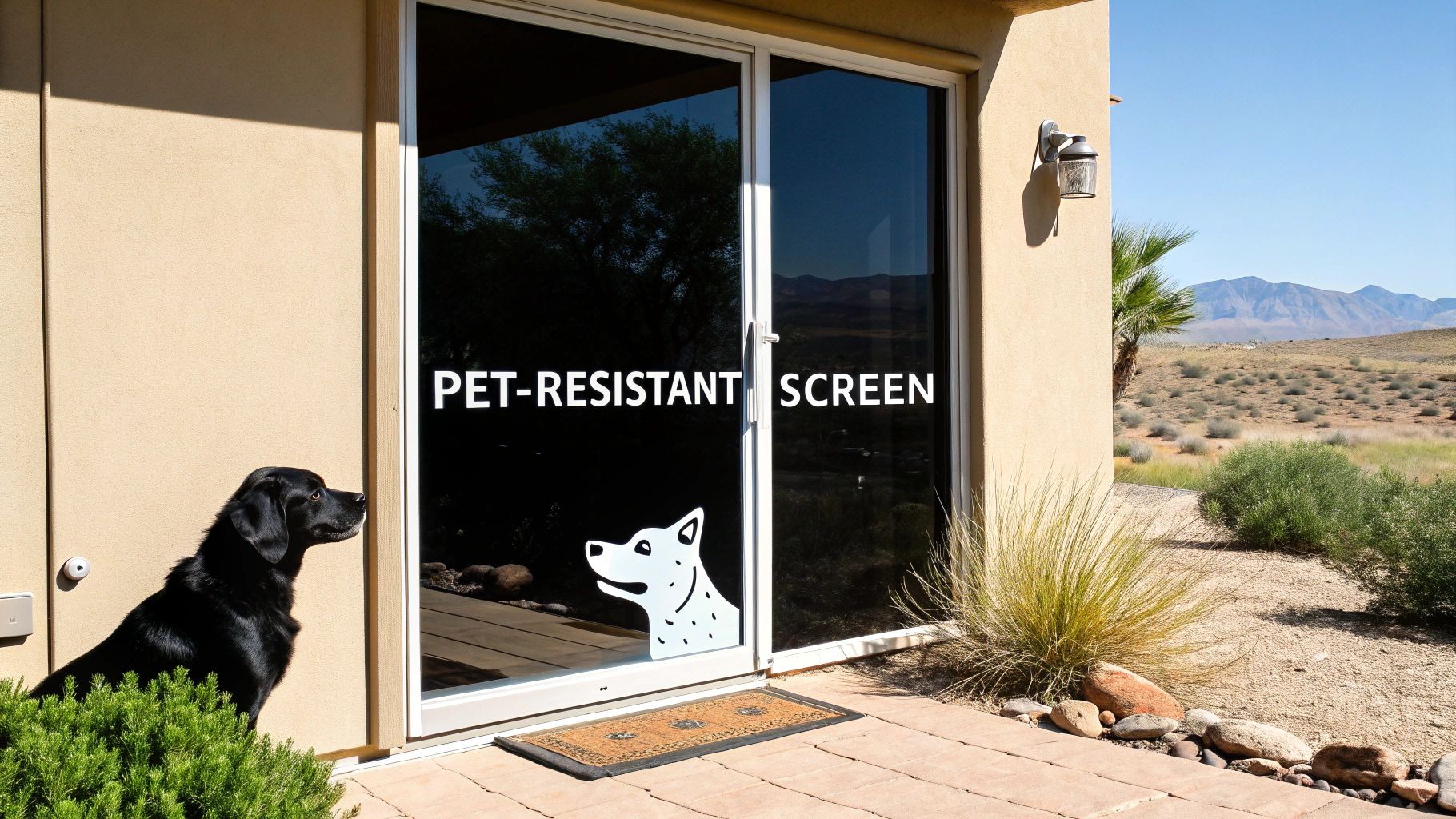

That familiar skritch-skritch-skritch of claws against your window screen? For pet owners, it’s the sound of another repair bill on the horizon. It's a frustrating cycle of patching and replacing flimsy screens that just weren't built for a life with cats and dogs.
One enthusiastic leap or a determined scratch is all it takes to create a tear, letting bugs wander in and ruining the view.

Why Standard Screens Just Can't Keep Up
That annoying rip in your screen isn't just bad luck—it's practically inevitable when you have pets. Standard fiberglass mesh simply isn't engineered to handle the focused pressure from a cat’s claws or a dog's paws. It's a bit like using a paper towel to block a spray bottle; it just won't hold up for long.
This constant vulnerability creates a never-ending cycle of repairs. And here in Arizona, a torn screen is more than an eyesore. It’s an open invitation for pests, a compromised breeze on a cool evening, and even a potential escape route for your pet. You end up losing the very benefits your screens were meant to provide in the first place.
The Problem With Standard Mesh
Traditional screens are made from thin, lightweight fiberglass strands. While this is great for visibility, it makes them incredibly easy to puncture and tear. Their tensile strength is low, meaning they break under very little pressure. This isn't just something we see in the field; it’s a problem driving a massive shift in the industry.
The global insect screen market was valued at an incredible USD 12,340.75 million in 2024, and a big chunk of that growth is from homeowners demanding tougher options. With over 70 million U.S. households owning pets, it’s easy to see why.
Here’s a quick breakdown to put things in perspective.
Standard vs Pet Resistant Screen A Quick Comparison
This table gives you a high-level look at how these two types of screens stack up against each other.
| Feature | Standard Screen | Pet Resistant Screen |
|---|---|---|
| Material | Lightweight Fiberglass | Heavy-Duty Polyester or Stainless Steel |
| Durability | Low (Tears easily from scratches) | High (Resists tears, punctures, and pushes) |
| Lifespan | 1-3 years with pets | 7-10+ years, even with active pets |
| Best For | Homes without pets or low-traffic areas | Homes with cats, dogs, or small children |
As you can see, the choice is pretty clear for anyone tired of constant repairs.
More Than Just a Nuisance
Sometimes, a torn screen points to something more than just playful energy. Persistent scratching or chewing can be a sign of underlying issues like dog separation anxiety.
While a stronger screen is a fantastic solution for the damage itself, it's also worth exploring why the behavior is happening. Upgrading your screens creates a safer, more secure home, but understanding your pet's needs is just as important for their well-being.
If you're tired of patching holes and want a permanent fix, you can start by learning to identify different types of window screen damage in our detailed guide.
The Science Behind a Stronger Screen
So, what’s the secret sauce that makes a pet-resistant screen so much tougher than the standard stuff? It’s not some space-age technology, but rather a smart combination of better materials and a stronger design. Think of it like the difference between a cheap paper plate and a sturdy ceramic one – they both hold food, but one is built to handle a lot more pressure.
Standard screens are typically made from thin fiberglass strands. A true pet-resistant screen, on the other hand, is built from a much heartier, vinyl-coated polyester. The core material itself is just plain stronger, with individual strands that are several times thicker than what you'll find in traditional mesh. That thickness alone gives it a huge head start in the durability department.
But the real game-changer is the protective vinyl coating. This coating is like a flexible suit of armor for each individual strand.
The Power of a Protective Coating
You know how good outdoor gear, like a heavy-duty backpack or a weatherproof tent, is made to take a beating? They’re designed to handle constant scrapes, friction, and pokes without falling apart. Pet screen material works on a similar principle.
When your cat’s claws or your dog’s paws scratch at the surface, that flexible vinyl absorbs the impact and spreads the force across the weave. A sharp point that would easily puncture and rip a single, brittle fiberglass strand just gets blunted and deflected. The screen gives a little, absorbing the energy instead of tearing.
That vinyl coating is the screen's first line of defense. It adds a crucial layer of elasticity, allowing the screen to "give" under pressure from claws and paws. It effectively shrugs off the kind of force that would shred a standard fiberglass screen in seconds.
This is what makes a pet screen more than just a simple barrier—it becomes a durable part of your home. It’s not just about being thicker; it’s about being engineered to handle the very specific challenges our four-legged friends throw at it.
A Tighter, Stronger Weave
It’s not just the material, but how it’s put together. Pet-resistant screens are woven much more densely, leaving less space between the individual strands. This creates a stronger, more unified surface.
This tighter construction gives you two major benefits:
- No More Snags: The dense pattern makes it incredibly difficult for a claw to hook into a single strand and pull it loose—a classic failure point for regular screens.
- Better Overall Strength: Weaving the strands so closely together makes them work as a single unit. When a pet pushes or leans on the screen, the pressure is distributed over a much wider area, which keeps the mesh from stretching, sagging, or popping out of the frame.
When you combine that strong polyester core, the flexible vinyl coating, and the dense weave, you get a seriously formidable barrier. In fact, tests show this material can be up to 7-10 times stronger than standard fiberglass. That’s the kind of resilience you need to stand up to years of scratching, pushing, and climbing from even the most persistent pets, all while keeping your home secure and bug-free.
Choosing the Right Material for Your Home
Okay, so we've covered the "why" behind stronger screens. Now for the practical part: picking the right material for your home. This isn't a one-size-fits-all deal. Think of it more like choosing the right tires for your car—what works for a daily commuter in the city is totally different from what an off-roader needs.
Your decision really comes down to a few key things: your pet's personality, your home's layout, and even our intense Arizona climate. A family in Peoria with a couple of big, rowdy dogs that love launching themselves at the patio door has very different needs than someone in Scottsdale with a curious cat and a wall of windows getting blasted by the afternoon sun.
Getting these details right is the secret to making an investment that you'll be happy with for years to come. The good news is, the first step is usually the easiest.

As you can see, the path is pretty clear. If you have pets, a specialized pet-resistant screen is the smart move to save yourself the headache of constant repairs.
Vinyl-Coated Polyester: The Popular All-Rounder
For the vast majority of homeowners with pets, vinyl-coated polyester is the go-to choice, and for good reason. This stuff is the workhorse of the pet screen world. It strikes that perfect balance between being tough enough to handle daily abuse and not breaking the bank. It's much thicker and way more resilient than standard fiberglass, easily holding its own against claws, paws, and determined noses from both cats and dogs.
Its biggest selling point is its incredible tear resistance. The flexible vinyl coating lets the screen absorb impact and stretch a bit without ripping, which is exactly what you need for the daily wear and tear our furry friends dish out. Frankly, this is the material we recommend most often at Sparkle Tech because we've seen it perform time and time again in homes all across the valley.
The numbers back this up, too. The market for scratch-resistant materials is expected to reach US$9.3 billion by 2033. And get this—studies show 65% of pet owners report screen damage within just two years when using standard screens. Making the switch to a pet-resistant material can cut down your need for rescreening by as much as 60%, especially in a hot climate like ours.
Stainless Steel Mesh: Maximum Security
Now, if you need the absolute toughest option available, we're talking about stainless steel mesh. This is less of a screen and more of a protective barrier. It's incredibly strong—practically immune to chewing, scratching, and tearing. Think of it as the Fort Knox of pet screens.
Of course, that top-tier security comes with a couple of trade-offs. Stainless steel is a bigger investment upfront and it can slightly reduce your outward visibility compared to the polyester options. It’s the perfect solution when strength is the number one priority, like securing a second-story window or a patio door for a particularly determined escape artist.
For homeowners whose main goal is stopping a pet with a history of chewing through things or preventing a potential escape, stainless steel provides unmatched peace of mind. It’s an investment in total security.
Other Material Considerations
While polyester and stainless steel are the heavy hitters, there are other options that blend pet resistance with different features. For example, some manufacturers offer solar screen blends that weave in those stronger polyester fibers. These are fantastic for Arizona homes where you want to block that harsh sun and stop your pet from tearing up the screen.
To make it a little easier to see how everything stacks up, here’s a quick comparison of the most common materials we work with.
Pet Resistant Screen Material Breakdown
| Material Type | Key Benefit | Best For | Visibility | Cost Factor |
|---|---|---|---|---|
| Vinyl-Coated Polyester | Balanced durability and cost | Most dogs and cats, general use | Good | $$ |
| Stainless Steel | Chew-proof and maximum strength | Determined chewers, escape artists | Fair | $$$$ |
| Solar Screen Blends | Combines durability with UV protection | Sun-exposed windows and patios | Varies | $$$ |
Ultimately, choosing the right material comes down to being honest about your pet's behavior and what your home really needs. If you want to go even deeper on all the options out there, check out our complete guide on the different types of window screen material.
So, Is This Upgrade Actually Worth the Money?
It’s the first thing everyone wants to know: is a pet-resistant screen really worth the extra cash? That’s a totally fair question. You'll definitely notice a higher price tag upfront compared to that standard flimsy fiberglass mesh, but looking only at that initial number is a classic case of missing the forest for the trees. The real value shows up when you look at what you’ll spend over the long haul.
Think of it less like a simple purchase and more like an investment in your home’s durability—one that actually pays you back over time. Once you factor in all the repairs and replacements you won't have to pay for, the math starts to look pretty convincing.
Breaking the Repair-Replace-Repeat Cycle
Let's be honest, a standard fiberglass screen in a house with a cat or dog is living on borrowed time. All it takes is one good scratch from a determined cat or a dog who gets a little too excited when the doorbell rings, and you’ve got a tear. Getting a professional out to fix that little rip can easily set you back $75 to $150, sometimes even more.
For most pet owners, this isn't a one-and-done deal. It becomes a frustrating, recurring expense that pops up every year, or even more often. A couple of those service calls, and you’ve already spent more than you would have on a single, permanent upgrade.
Let's Do the Math: Your Return on Investment
Here’s a simple, real-world example to illustrate the point. Let’s say upgrading your main patio door screen to a heavy-duty pet screen costs you $180. Now, imagine your old standard screen tears and a repair visit costs you $90. If you can avoid just two of those repair calls, the pet screen has officially paid for itself.
That’s really the bottom line: prevent just two or three standard screen repairs, and your investment in a pet-resistant screen is paid in full. Every repair you avoid after that is just money back in your pocket, not to mention saving you the headache of scheduling yet another service call.
And that calculation doesn't even touch on the other perks—the peace of mind, the better security, and just the simple satisfaction of not having to stare at a shredded screen every single day. When you look at the whole picture, it’s a pretty easy decision.
A Smart Move in a Pet-Centric World
Our pets are family, and we’re spending more than ever to integrate them into our lives. With the pet tech market expected to explode to USD 52.9 billion by 2035, it’s obvious that we’re investing in our furry friends' happiness. That trend also means our homes need to be able to handle the reality of living with animals.
Consider this: industry data shows that a whopping 40% of all screen repairs are caused by pets. Making the switch to a pet-resistant screen can cut those specific repair needs by an incredible 70%. You can learn more about these powerful pet industry trends and how they’re changing our homes.
This isn’t just about making life easier. It's about making a smart financial choice that stops a slow, annoying leak in your household budget and turns it into a one-time upgrade that adds real value.
Understanding Your Installation Options

Alright, you've picked the perfect pet resistant screen material for your home. Now comes the next big question: who's going to install it? You've really got two options here. You can roll up your sleeves and make it a weekend DIY project, or you can call in a professional to handle it for you.
Deciding between DIY and pro installation is just as important as choosing the right mesh. A shoddy installation can make even the best screen material fail. A screen that sags, wrinkles, or pops out of the frame isn't going to do you—or your pets—any good. Let's walk through what each choice really entails.
The Do-It-Yourself Route
For the handy homeowner, tackling a screen installation can be a pretty satisfying project. You get a real sense of accomplishment, not to mention you can save a few bucks on labor costs. But it’s not just a matter of swapping out the old material for the new; you need the right gear and a bit of know-how.
At a minimum, you'll need a few specific tools to get the job done correctly:
- Spline Roller: This little gadget is essential. It’s what you use to push the rubber spline into the frame’s groove, locking the screen in place.
- Utility Knife: A fresh, sharp blade is a must for trimming the excess mesh neatly around the edges.
- Screen Spline: Don't reuse the old stuff. Pet resistant screen mesh is thicker, so you’ll likely need a different diameter spline to get a secure fit.
The real trick, and where most DIY projects go south, is getting the tension just right. It's more art than science if you haven't done it before.
The most common DIY mistake is improper tensioning. If the screen is too loose, it will look saggy and unprofessional from day one. But if you pull it too tight, you can actually bend the screen frame, creating a “bowing” effect that might keep your window or door from closing properly.
The Professional Installation Advantage
This is where calling in a team like Sparkle Tech Screen Service really pays off. Hiring an experienced pro turns a potentially headache-inducing project into a completely hands-off experience. Sure, it costs more than doing it yourself, but for busy homeowners from Sun City to Queen Creek, the value is undeniable.
The biggest plus is the guaranteed result. Our technicians have installed thousands of screens. We have the right equipment and the practiced skill to get that perfect, drum-tight tension every single time. This ensures your pet resistant screen not only looks fantastic but can stand up to all the pushing and clawing your pet can dish out.
And then there's the time you save. A DIY screen replacement could easily eat up your entire Saturday afternoon. Our crew can often get the whole job done in a fraction of that time. We take care of everything—the precise measurements, the flawless installation, and the final cleanup. You just get to sit back and enjoy your new, durable screens, often with the convenience of our quick quotes and same-week service.
Your Guide to Getting a Professional Installation
So, you've done the research on stronger screens and decided it's time to make a change. Good call. Opting for a professional installation for your new pet resistant screen is the final step in breaking that frustrating cycle of rips and tears for good. Think of it as turning a recurring household headache into a one-time fix that brings security and peace of mind for years.
This is where Sparkle Tech Screen Service comes in. We handle the tricky parts so you don't have to, making sure your investment is installed perfectly to withstand whatever your furry friends throw at it. Our entire mission is to make the process—from the first call to the finished product—as simple and painless as possible.
Your Seamless Path to a Durable Home
Upgrading your home shouldn't be a drawn-out, complicated project. We've built our service to be quick, clear, and completely focused on what works for you. One call is all it takes to get a fast, no-strings-attached quote. We can often get you on the schedule for the very same week, and sometimes even the same day.
Here’s what our professional installation guarantees:
- A Perfect, Drum-Tight Fit to give the screen maximum strength against paws and claws.
- The Correct Spline Gauge is used to lock the thicker pet screen material into the frame so it won’t pop out.
- You Save Time and Hassle, letting you skip the hardware store run and get back to your weekend.
When you hire a professional, you're not just getting a new screen. You're buying the confidence that it will perform exactly as it's supposed to from day one, giving you real protection for your home and pets.
Making Pet-Friendly Upgrades Easy
Creating a truly pet-friendly home often goes beyond just the windows. Many of our customers are looking for tough, lasting solutions for their yards, too. If you're exploring other durable upgrades, checking out how a professional artificial pet turf installation works can provide some great ideas for another low-maintenance space for your animals to safely enjoy.
Serving Homeowners Across the Valley
Sparkle Tech is proud to bring our expert screen services to communities all over the valley. Our reach is wide, ensuring that homeowners from one end to the other can get a top-quality, durable pet resistant screen installed right.
We help clients from Phoenix to Buckeye, including:
- Scottsdale, Peoria, and Sun City
- Mesa, Tempe, and Chandler
- Queen Creek, Avondale, and Litchfield Park
Ready to put an end to screen damage for good? We've got you covered. You can learn more about our dedicated Phoenix window screen service and see how we help homeowners just like you solve this exact problem.
Getting started is easy. Call or text us today at 623-233-0404 for a quick quote and finally reclaim your home from torn screens.
Your Top Questions About Pet Screens, Answered
Deciding to go with a pet-resistant screen is a smart move, but it's natural to have a few questions before you commit. We get it. This is an upgrade for your home, and you want to be sure you're making the right call.
We hear the same questions from homeowners all the time, so we've put together some straight-to-the-point answers to help you feel confident about your decision.
Will These Screens Ruin My View or Block the Breeze?
This is probably the number one question we get, and it's a great one. You want a tough screen, but you don't want to live in a cave.
The good news is that modern pet screens are designed to be surprisingly transparent. While the material is thicker, high-quality options like vinyl-coated polyester mesh still offer fantastic visibility. You might notice a very subtle difference in brightness compared to a flimsy standard screen, but most people barely see it. You'll still get plenty of airflow for those cool Arizona evenings, just without the constant worry of rips and tears.
Are Pet Screens Really Indestructible?
Let’s be honest: if a big, determined dog really wants to chew through something, it probably can. No screen is truly indestructible.
But that’s where the term "pet resistant" comes in. These screens are built to be 7 to 10 times stronger than the standard stuff. They easily stand up to scratching, climbing, and pushing from cats and dogs. For more than 95% of the pet-related damage we see, these screens are the perfect, long-lasting fix.
The Bottom Line: Think of them as "highly resistant," not "invincible." They're designed to stop the everyday clawing and pawing that shreds normal screens in a heartbeat, giving you a reliable barrier that lasts.
Can You Put Pet-Resistant Mesh in My Current Screen Frames?
Yes, absolutely! In nearly every case, we can use your existing window or door frames. This is a huge plus because it keeps the cost down and makes the whole process much faster.
Our rescreening service is simple. We come out, pop out the old, torn screen material and the brittle spline that holds it in. Then, we professionally stretch the new pet resistant screen into the frame with the right-sized spline for a drum-tight fit. When we provide a quote, we'll confirm your frames are good to go.
How Do I Keep My New Pet Screens Clean?
Keeping your new screens looking great is incredibly easy. A quick wash once or twice a year is usually all it takes to get rid of that layer of Arizona dust.
Just follow these simple steps:
- Mix up some suds: A little bit of mild soap in a bucket of warm water is all you need.
- Wipe them down: Use a soft cloth or sponge to gently wash the screen.
- Rinse it off: A light spray from a garden hose or a wipe with a clean, wet cloth will get rid of any soap.
That’s it. Just be sure to avoid harsh chemicals or pressure washers, as they can damage the screen's coating. A little TLC will keep your view clear and the air flowing for years to come.
Ready to stop replacing torn screens for good? The team at Sparkle Tech Screen Service can give you a fast quote and often provide same-week service. Make your home more secure and beautiful today. Get started by visiting us at https://sparkletechscreenservice.com.


