


Hiring a professional to clean your solar panels is one of the smartest things you can do to protect your investment. It might seem like a simple DIY job, but the accumulation of dirt, dust, and grime—what the industry calls "soiling losses"—can quietly chip away at your system's energy output. Bringing in an expert ensures the job is done right, keeping your panels safe and your energy savings high.
Why Professional Solar Cleaning Is a Smart Investment
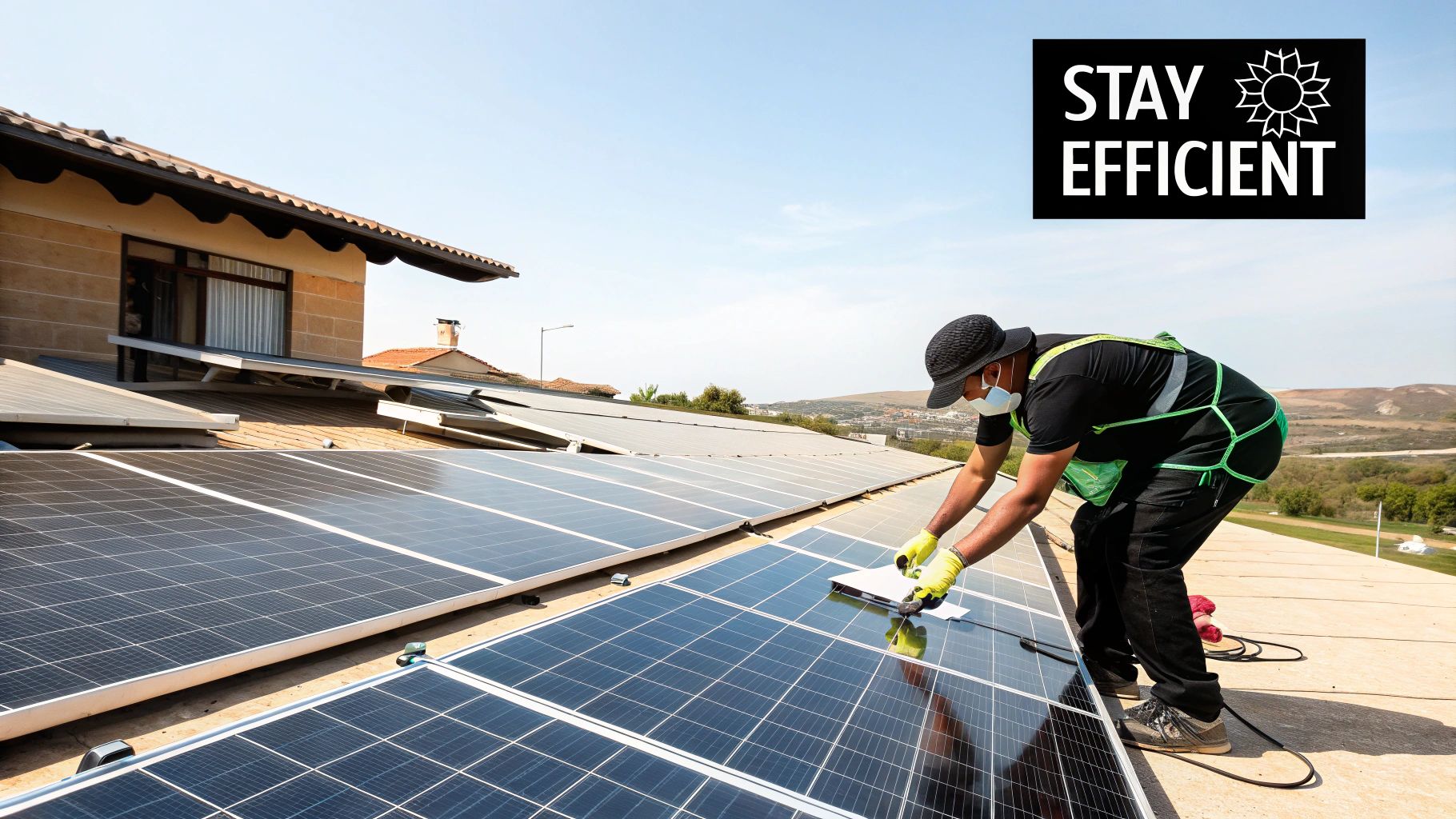
It’s easy to look up at your roof and think a thin layer of dust or a few bird droppings can't possibly make a difference. But that buildup directly blocks sunlight from hitting the photovoltaic cells, causing a very real drop in energy production. This isn't just a small annoyance; it's lost money and a lower return on your solar investment.
That's where the pros come in. They have the right equipment and safety training to work on a roof without any drama. Let's be honest, climbing up there is risky business for the average homeowner.
Protecting Your Warranty and Panels
Grabbing a garden hose and some dish soap might feel like a practical solution, but it can backfire spectacularly. You could easily do more harm than good.
- Warranty Risks: Most solar panel manufacturers have strict rules about cleaning. If you use harsh chemicals, abrasive scrubbers, or even a high-pressure washer, you could accidentally void your entire warranty.
- Panel Damage: A stiff brush can leave tiny micro-scratches on the glass. They might not be visible from the ground, but over time they add up, permanently hurting your panels' efficiency.
- Hard Water Stains: Regular tap water is full of minerals. When it dries, it leaves behind a chalky film that’s tough to get off and, you guessed it, blocks more sunlight.
A true professional service avoids all these problems by using purified, deionized water and special soft-bristle brushes. This combo guarantees a spot-free finish without scratching the glass or putting your warranty in jeopardy. It’s this attention to detail that protects the long-term health of your system.
More and more homeowners are catching on. In fact, the global market for solar panel cleaning is projected to hit nearly $2.98 billion by 2035. Why? Because people realize that soiling can slash energy generation by as much as 25%. Our guide to solar panel cleaning services dives deeper into the professional methods that make all the difference.
So, How Do You Find a Good Solar Cleaner?
Finding the right solar panel cleaning company can feel like a shot in the dark, but a few smart moves can help you build a solid list of candidates pretty quickly. Instead of just Googling and hoping for the best, start with the people who know your system inside and out.
Your original solar installer is the best place to begin. They almost always have a short list of trusted maintenance partners they recommend. They have a vested interest in your system performing well, so their recommendations usually carry a lot of weight.
Another goldmine for finding reliable pros? Local community forums or even your neighborhood’s Facebook group. A quick post asking for who your neighbors have used often brings in a flood of honest, real-world feedback. Nothing beats a recommendation from someone down the street.
Doing Your Homework: The Initial Vetting
Once you've got a few names, it’s time to do some digging before you even make a call. This quick screening process will save you a ton of time and weed out the less-than-qualified options right away.
- Look for True Solar Experience: Check out their website and photo galleries. Are you seeing pictures of them on roofs, cleaning solar arrays? Or is it a window washing company that just added "solar cleaning" to their services list? You want a specialist, not a generalist.
- Verify They’re Licensed and Insured: This is non-negotiable. A professional company will have its license and insurance info front and center. Proper liability insurance is your safety net—it protects you and your property if something goes wrong.
- Read the Real Reviews: Don't just rely on the glowing testimonials on their homepage. Dig into third-party sites like Google, Yelp, or Angi to get the full picture of their customer service and the quality of their work.
A quick tip: Don't underestimate the value of a true specialist. Someone who works with solar panels all day knows how to handle delicate wiring and can often spot other small issues—like a loose clamp or bird damage—that a general cleaner would completely miss.
This focus on professional care is a growing trend. In fact, a detailed market analysis projects the solar panel cleaning market will explode from $1.05 billion in 2025 to nearly $3.0 billion by 2035. That's a clear sign that homeowners are realizing professional maintenance is key to getting the most out of their investment. You can read more about this market growth on Future Market Insights.
A Look at Professional Cleaning Methods and Tools
When you start looking for a solar panel cleaning company, you'll quickly realize not everyone does the job the same way. The tools and techniques they use say a lot about their expertise and the quality of the result you can expect.
The most common approach, and for good reason, is a hands-on manual clean. Pros use specialized, soft-bristle brushes attached to long extension poles. This isn't just any old broom—these brushes are designed to scrub away grime without leaving a single scratch on your panel's delicate surface.
What really separates the pros from a DIY job is the water. A reputable company will never just hook up a hose to your spigot. They use purified, deionized (DI) water. Why does this matter? Tap water is full of minerals that leave behind cloudy spots (limescale) when they dry, which can actually block sunlight and reduce efficiency. DI water, on the other hand, is so pure it evaporates without a trace, leaving a perfectly clear, spot-free surface that soaks up the maximum amount of sun.
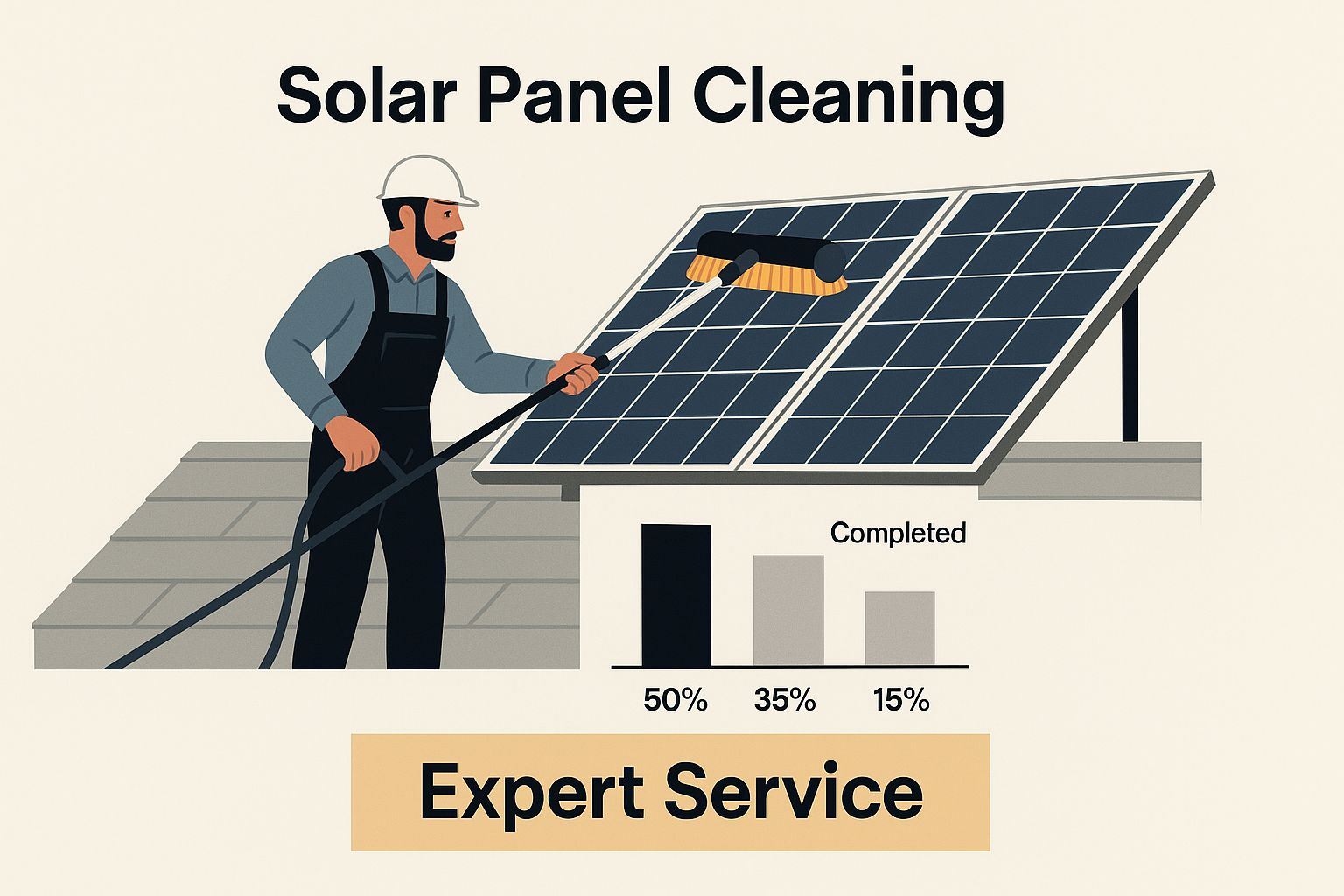
As you can see, having the right gear is crucial for working safely and effectively, especially on a sloped roof.
Advanced and Eco-Friendly Options
While manual cleaning is the gold standard for most homes, the industry is always innovating. For massive commercial solar farms, robotic cleaning systems are becoming a game-changer, offering speed and consistency across thousands of panels.
There's a big push toward sustainability, too. Waterless or dry-cleaning methods are gaining ground, especially in dry climates where every drop of water counts.
This kind of innovation is a huge part of the industry's global growth. The Asia-Pacific region, for example, holds over 42.6% of the global market share, partly because they've embraced robotic and water-saving tech.
To help you understand what a potential company might offer, here’s a quick breakdown of the common methods.
Comparing Solar Panel Cleaning Methods
| Cleaning Method | Best For | Pros | Cons |
|---|---|---|---|
| Manual Washing (DI Water) | Most residential and small commercial systems; tackling heavy, caked-on grime. | Highly effective and thorough; safe for all panel types; spot-free finish. | Labor-intensive; requires a water source; can be slower for large arrays. |
| Robotic Cleaning | Large-scale solar farms and expansive commercial rooftops. | Extremely fast and consistent; can operate at night; reduces labor costs. | High initial investment; may not be suitable for complex or angled roofs. |
| Waterless/Dry Cleaning | Light dust and pollen in arid regions; maintenance cleans between deep washes. | Conserves water; eco-friendly; can be done quickly. | Less effective on heavy soiling (like bird droppings); potential risk of scratching if done improperly. |
Ultimately, the best method depends on your specific situation—the size of your system, your local climate, and how dirty your panels get.
When you're talking to potential companies, don't be afraid to ask them to walk you through their process. A real expert will be proud to explain the tools they use and why they've chosen a particular method to protect your solar investment. For a closer look at the equipment we trust, check out our comprehensive guide on solar panel cleaning.
Digging Deeper: The Questions to Ask Before You Hire
You've got your shortlist of solar panel cleaning companies. Great. Now it's time to pick up the phone, but don't just ask for a quote. Getting the right price is important, but it's not the only thing that matters.
Think of this as an interview. You’re about to let someone on your roof to work on a very expensive and important asset. Their answers to a few key questions will tell you everything you need to know about their experience, safety standards, and whether they respect your property. A true pro will be happy to answer; a company that gets defensive is a red flag.
Look Beyond the Price Tag
Here’s a tip: don’t lead with "How much?" Start by asking questions that get to the heart of their methods and professionalism. This way, you can figure out if they're even qualified before you start talking numbers.
These are the must-ask questions to separate the pros from the amateurs:
- What kind of water and equipment do you use? The answer you want to hear is purified, deionized water and professional-grade, soft-bristle brushes designed specifically for solar panels. If they mention tap water (which leaves mineral spots) or—even worse—a pressure washer, hang up the phone. Seriously. That's a recipe for disaster.
- Are your cleaning methods approved by solar panel manufacturers? This is a big one. Using the wrong chemicals or abrasive tools can actually void your panel warranty. An experienced company knows this inside and out and will confidently tell you their process is 100% warranty-safe.
- Can you show me proof of your liability insurance and worker's compensation? Don't just take their word for it. This is non-negotiable. If an uninsured worker gets hurt on your property, you could be on the hook financially. Ask them to email you a current certificate of insurance.
- What are your safety procedures for working on my roof? Vague answers aren't good enough. You should hear them mention specific equipment like safety harnesses, ladder stabilizers, and proper roof-safe footwear. This shows they take the safety of their crew—and the integrity of your roof—seriously.
A professional's response should be detailed and reassuring. For example, instead of just saying "we're safe," they should explain how they ensure safety, like, "Our technicians are always harnessed on any roof with a steep pitch and we use ladder stabilizers to protect your gutters."
Finally, it's always a good idea to ask if they offer a service guarantee or if they perform a quick visual inspection for any obvious panel damage while they're up there. The best companies aren’t just cleaners; they’re partners in keeping your solar investment in peak condition.
How to Choose the Right Company and Schedule Service
Okay, you’ve got a few quotes. Now comes the important part, and I’ll give you a hint: it’s not just about picking the lowest number.
The cheapest bid can be a red flag. I've seen it countless times—companies that cut corners on essentials like insurance or proper equipment to offer a rock-bottom price. That's a gamble you don't want to take with a system worth thousands of dollars. Instead, you should be looking for the best value.
A high-value company is the whole package. They’re professional, use the right methods (like purified water systems that won't leave spots), and don’t hesitate to show you their liability insurance. Their communication is clear, and they provide a detailed breakdown of the work so there are no surprises.
Reviewing the Service Agreement
Before you say "yes," take a close look at their service agreement or contract. A professional, clearly written document is one of the best signs you’re working with a legitimate business.
Here’s what you should zero in on:
- Scope of Work: Does it explicitly say "cleaning" with professional tools, or just a quick "rinse"? There's a big difference.
- Pricing Breakdown: The cost should be transparent. Are there extra charges for a two-story roof or unusually dirty panels? It should all be listed.
- Service Guarantee: The best companies stand by their work. Look for a guarantee against things like streaks or residue left behind.
Don't ever feel hesitant to ask questions about the agreement. A company that values your business will gladly explain every line item until you're completely comfortable. If they rush you, that's a warning sign.
Scheduling and Day-Of Logistics
Once you’ve found your company and signed off on the agreement, getting on the calendar is usually a breeze. They'll work with you to find a convenient day.
On the day of the job, just make sure the technicians have a clear path to the panels and access to an outdoor water spigot. From there, they'll take over. A standard residential cleaning is surprisingly quick, often wrapping up in just a couple of hours.
Getting your panels professionally cleaned is one of the simplest ways to protect your investment and keep it running at peak performance. You can learn more about what a top-tier solar panel cleaning service includes to know exactly what to expect.
Answering Your Top Solar Cleaning Questions
It's smart to have questions before hiring a pro. After all, this is a significant investment for your home. Let's walk through a few of the most common things people ask, so you can feel confident you're making the right call.
So, How Often Do My Solar Panels Really Need a Cleaning?
This is the big question, and the honest answer is: it depends entirely on where you live.
If your home is in a dusty spot—think new construction nearby, a desert climate, or even just a busy road kicking up grime—you'll want to schedule a cleaning every six months. The same goes for areas with a lot of pollen or trees. That buildup happens fast and can really put a dent in your production.
For most other homeowners, a good, professional scrub-down once a year is the sweet spot. A good company won't just give you a generic answer; they'll look at your specific situation and give you a recommendation that makes sense.
Can't I Just Let the Rain or My Garden Hose Handle It?
I hear this one all the time. It seems logical, right? But the short answer is no, and here’s why.
Rain might wash away a bit of loose dust, but it does absolutely nothing for the tougher stuff like bird droppings, caked-on pollen, or oily residue. Think of it this way: would you just let the rain wash your car? It just moves the dirt around.
Using a garden hose is an even worse idea. Your tap water is loaded with minerals. When that water evaporates on your warm panels, it leaves behind a chalky, spotty film that blocks sunlight. This mineral buildup can be just as bad as the dirt you were trying to wash off.
Here's the key difference: Professionals use highly purified, deionized water. This special water has all the minerals filtered out, so it dries completely spotless. No streaks, no residue—just a crystal-clear surface ready to soak up every bit of sunlight.
Is It Actually Worth Paying for a Professional Cleaning?
Without a doubt, yes. Studies and real-world data show that heavy soiling can slash your panel's energy output by 20% or more. In some cases, it can be even higher.
The boost in efficiency you get from a professional cleaning often pays for the service itself through lower energy bills. More importantly, it keeps you safely on the ground and prevents the kind of expensive damage that can happen when you use the wrong brushes, pressure, or cleaning solutions.
At Sparkle Tech Screen Service, we're all about protecting your solar investment and helping you get the most energy possible. Reach out today for a quick quote and let us show you what a difference a truly professional clean can make.


