


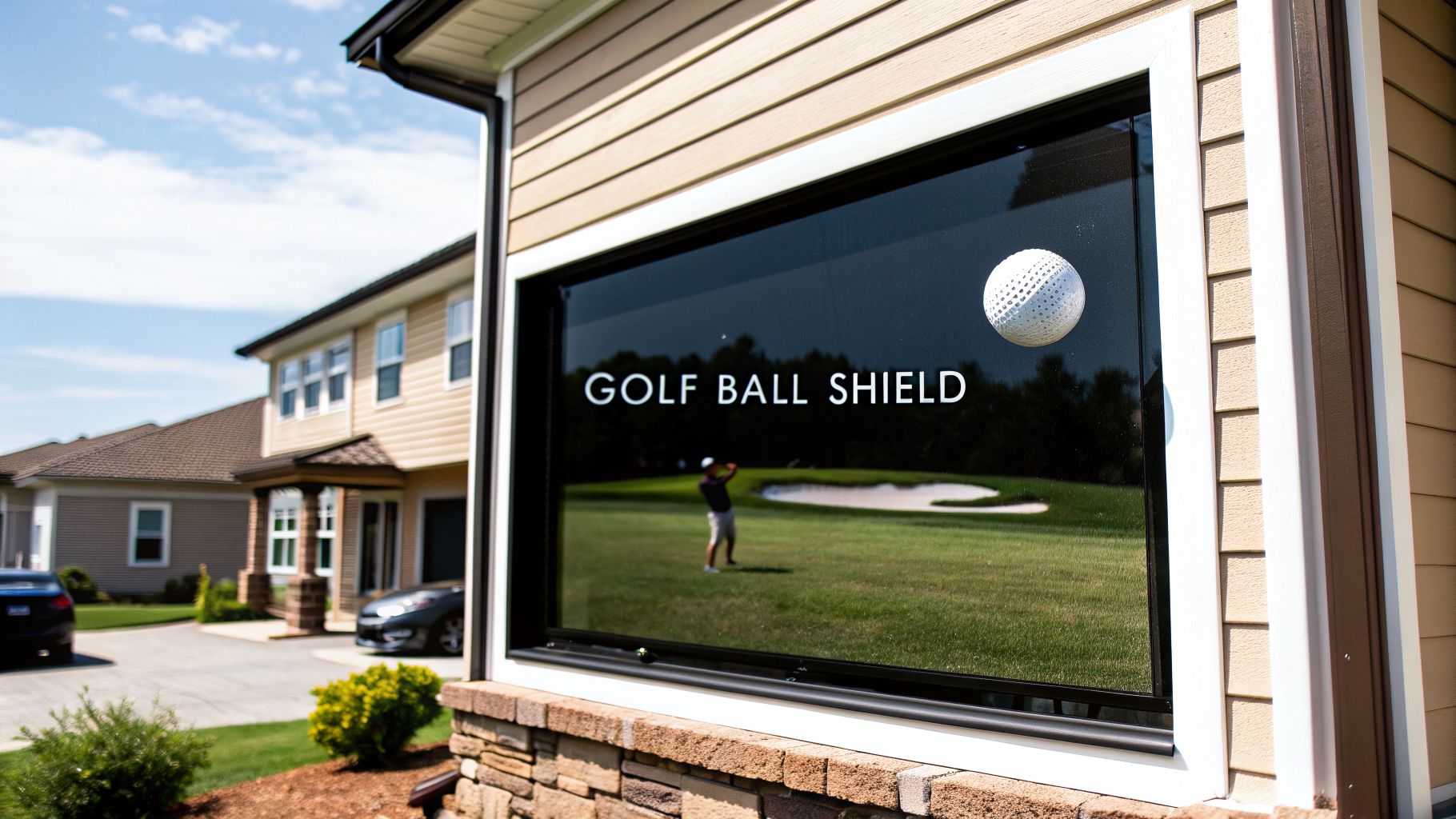

Living on a golf course seems like a dream, with those sprawling, manicured views right outside your window. But that dream can shatter—literally—with the first stray golf ball. To truly safeguard your home, you need a physical barrier that can absorb a high-speed impact. The best solutions are high-tensile strength screens, protective netting, or impact-resistant shutters.
The Reality Of Living On The Fairway
That idyllic view of the fairway often comes with the jarring crack of a golf ball hitting your house. Suddenly, your peaceful morning is replaced by a rush of anxiety and a trip to the hardware store. It’s a side of golf course living that many homeowners don't see coming until it's too late.

For some, this isn't just a once-in-a-while problem; it's a daily barrage. A single broken window can set you back hundreds of dollars, but when it happens over and over, you're looking at thousands in damages. It becomes a frustrating, expensive cycle of repair and replacement.
The True Cost Of Errant Golf Balls
The issue goes beyond just money. When you can't relax on your own patio or let your kids play in the yard for fear of a stray shot, you've lost the enjoyment of your home. Those outdoor spaces you invested in become no-go zones.
In high-risk areas, the financial toll can be truly staggering. Just ask the homeowners in Marietta, Georgia, where one family reported spending over $70,000 on window replacements alone. Their home was repeatedly pelted by balls from the adjacent country club. These aren't hypotheticals; they're real experiences that highlight why taking proactive steps is a necessity, not a luxury. You can read more about the struggles these homeowners faced and see just how bad it can get.
A common misconception is that the golf course or the golfer who hit the ball is on the hook for damages. The hard truth is that the legal principle of "assumption of risk" usually places the financial burden squarely on the homeowner, especially if your house was built after the course was already there.
Trying to get reimbursement is often a frustrating dead end. The only way to guarantee your home's safety and your own peace of mind is to install a reliable protection system.
Your Options For Protection At A Glance
Before we get into the nitty-gritty of each method, let's take a quick look at the most effective ways to protect your windows. Each one has its own set of pros and cons, making them suitable for different situations.
Quick Guide To Window Protection Methods
This table breaks down the top solutions so you can see which one might be the right fit for your home's specific needs and your budget.
| Protection Method | Best For | Pros | Cons |
|---|---|---|---|
| Durable Screens | Balanced, everyday protection with great aesthetics. | Maintains clear views and curb appeal; cost-effective. | Not as robust as netting for direct, high-impact zones. |
| Protective Netting | Homes in the direct line of fire from tee boxes. | Highest level of protection; stops balls mid-air. | Can obstruct views; more complex installation. |
| Impact Shutters | On-demand security and severe weather protection. | Provides a solid physical barrier when closed. | Can be expensive; alters home's exterior appearance. |
Think of this as your starting point. Choosing the right approach really depends on how often you're getting hit and where the impacts are concentrated. Ultimately, investing in one of these solutions is an investment in protecting your property and reclaiming your peace and quiet.
Immediate Fixes For Temporary Window Protection
You’re enjoying a quiet afternoon, and then—thwack!—a golf ball smacks the siding right next to your living room window. When you need to protect your glass right now, waiting for a permanent fix just isn't an option.
These are the quick, DIY-friendly measures you can take to get some immediate protection up. Think of them as stop-gap solutions to get you through a tournament weekend or until a more permanent solution can be installed.

The goal here is simple: create a temporary buffer that can absorb or deflect the impact of an errant shot. These aren't meant to be forever-fixes, but in a pinch, they work remarkably well.
Probably the fastest and most effective temporary shield is a sheet of clear acrylic, which you might know by brand names like Plexiglas. This stuff is shatter-resistant and can easily stop a golf ball cold. The best part? You can attach it to the exterior window frame with temporary clips or even strips of heavy-duty Velcro, making it easy to remove later without a trace.
Quick And Safe Application Tips
How you put these temporary shields up matters. You want something secure enough to work but that won’t damage your window frames or siding when you take it down.
Plywood as a Last Resort: Let's be honest, it’s not pretty. Plywood completely blocks your light and can be a pain to install without scuffing your siding. If you must use it, I'd reserve it for windows in unused rooms. Try using tension rods to hold it in place from the inside to avoid drilling holes you'll regret later.
Heavy-Duty Tarps: This one is surprisingly effective. If you hang a thick canvas or vinyl tarp so it has a few inches of slack from the glass, it acts like a net. The give in the material dissipates a golf ball's energy, slowing it down dramatically before it makes contact with the window.
Temporary Protective Film: This is basically a heavy-duty screen protector for your window. While it won't stop the glass from cracking, it will help hold the pane together if it shatters. This prevents dangerous shards from flying into your home, which is a huge safety win.
Pro Tip: Whatever you hang, whether it's an acrylic sheet or something else, leave an air gap of at least one inch between the shield and your window. That space is a critical buffer. It allows the protective material to flex on impact and absorb the shock before it ever reaches the glass.
These methods are designed for the short haul—they’ll give you instant peace of mind while you figure out a more permanent way to protect windows from golf balls.
While these fixes are great for emergencies, they aren't a substitute for a durable, professionally installed solution. When you're ready to explore options that look great and provide lasting defense, getting a custom screen installation is the logical next step.
Upgrade Your Screens for a Lasting Defense
If you’re tired of temporary fixes and the constant worry of a stray shot, it’s time to look at a more permanent—and frankly, better-looking—solution. For most of us living on or near a golf course, the best line of defense is upgrading the screens themselves.
Let’s be clear: the standard, flimsy bug screen that came with your windows offers zero protection. I’ve seen them shredded by a gentle breeze, let alone a golf ball. They simply weren't built for impact.
The real solution lies in specialized, high-tensile screen materials. Think of them less as a screen and more as a protective membrane. They're engineered to absorb and dissipate the force of an impact, much like a trampoline, stopping a golf ball dead in its tracks before it ever makes contact with the glass.
Choosing the Right High-Impact Screen
When you start looking into heavy-duty screens, you'll find a couple of fantastic options that I regularly recommend to homeowners. Each brings a unique blend of protection, visibility, and even a few extra perks.
Solar Screens: These are my go-to for homes in sunny climates. Originally made to block harsh UV rays and cut down on heat, they're woven from a thick, rugged, vinyl-coated polyester. That dense weave is incredibly durable and more than capable of deflecting an errant golf ball. As a bonus, you get added privacy during the day and a nice reduction in your cooling bills.
Pet-Resistant Screens: Anyone with a determined dog or cat knows how tough these screens are. They’re built from an extra-strong polyester yarn designed to resist tearing and scratching. That same resilience against a pet's claws makes them surprisingly effective against the blunt force of a golf ball.
The bottom line is that both of these options are in a completely different league than standard fiberglass screens. They are designed to flex under impact and snap right back into shape, giving you constant, reliable protection without you ever having to think about it.
Why Professional Installation is Non-Negotiable
You can certainly buy the screen material yourself, but this is one job where professional installation truly makes all the difference. The secret to an effective protective screen is the tension—it has to be just right.
An expert installer knows how to achieve that perfect tension, ensuring the screen can properly absorb the kinetic energy of a fast-moving ball. Too loose, and it won't be effective. Too tight, and the frame or screen could be damaged.
They also use a heavier-duty spline (the rubber cord that holds the screen in the frame) to make sure it doesn’t pop out on impact. It’s a small detail, but it’s critical for performance and longevity. If your current screens are already torn or damaged, getting a professional window screen repair is the perfect opportunity to make this upgrade.
For homeowners in golf-centric areas like Phoenix and Scottsdale, these screens are a proven lifesaver. A high-quality sun screen or reinforced slider screen can absorb the impact of a golf ball flying at up to 150 mph. That's the difference between a loud "thwack" and thousands of dollars in shattered glass.
If you're curious, you can even see these durable screens in action to get a real sense of their stopping power. It’s a smart, one-time investment that buys you permanent peace of mind without ruining your view or your home's curb appeal.
When Screens Aren't Enough: Heavy-Duty Netting And Shutters
Sometimes, you're just in the wrong place at the right time. If your home sits directly in the line of fire—maybe right off a tee box known for wicked slices or behind a green that golfers love to overshoot—even the strongest screens might not give you total peace of mind.
This is when you need to think less about reinforcing your windows and more about stopping the ball cold before it ever gets close. For homeowners who hear that dreaded "thwack" a little too often, heavy-duty netting and impact shutters are the ultimate solutions.
Golf Ball Netting: The Nearly Invisible Shield
Think of the netting you see at a driving range, but built to blend seamlessly with your home. A professional installer sets up discreet, slender poles around your patio or a vulnerable wall of windows, then stretches a high-tensile, weather-resistant net across them.
The result is a barrier that can absorb the full impact of a golf ball traveling at top speed. The best part? Modern netting is surprisingly subtle. From a distance, the fine black mesh almost vanishes, preserving your view while offering complete protection. It’s a fantastic way to protect windows from golf balls without making you feel like you're living in a fortress.
This is definitely a job for the pros. For a permanent installation like this, you'll want to connect with specialized home improvement services that have experience with these unique projects.
Impact-Resistant Shutters: On-Demand Armor
If you want protection you can deploy at a moment's notice, impact shutters are the answer. They serve a dual purpose, guarding your home against errant golf balls just as effectively as they do against severe weather.
Two options really stand out in this category:
- Polycarbonate Panels: These are ultra-strong, crystal-clear panels that act like storm shutters. Often marketed as "hurricane-proof," they can be permanently fixed or installed only when needed. Because they’re transparent, you get top-tier protection without losing any natural light.
- Roll-Down Shutters: For the ultimate convenience, nothing beats motorized roll-down shutters. They live in a sleek housing above your window and deploy with the push of a button, creating a solid metal barrier. It’s a premium choice for anyone who wants instant, effortless security.
To help you weigh your options, let’s compare these heavy-duty solutions against the screen upgrades we discussed earlier.
Comparing Screen Upgrades Vs Netting And Shutters
This table breaks down the three main approaches to window protection. It’s designed to help you quickly see the tradeoffs between cost, appearance, and how well each one actually stops a golf ball.
| Feature | Durable Screens (e.g., Solar Screens) | Protective Netting | Impact Shutters (Polycarbonate/Roll-Down) |
|---|---|---|---|
| Primary Goal | Deflects glancing blows; prevents most direct, low-speed impacts | Stops all direct impacts by catching the ball mid-air | Blocks all impacts by creating a solid barrier |
| Cost | $ (Most affordable) | $$ (Moderate to high, requires professional installation) | $$$ (Highest cost, especially for motorized roll-down types) |
| Aesthetics & View | Minimal impact; slightly darkens view | Minimal impact from a distance; can feel enclosed up close | Clear panels preserve view; roll-down shutters block view completely when closed |
| Effectiveness | Good for occasional, low-velocity hits; may dent or tear from hard hits | Excellent; stops virtually any golf ball impact | Excellent; provides a physical wall that is impenetrable to golf balls |
| DIY Potential | High (rescreening is a common DIY project) | Low (requires specialized tools, materials, and expertise for proper tensioning) | Low to Moderate (panels can be DIY, but roll-down shutters require a professional) |
| Other Benefits | Provides shade, privacy, and insect protection | Can also keep out birds and other small animals from a patio area | Provides storm protection and added security against intruders |
Ultimately, your choice comes down to your specific risk level. If you're dealing with one or two stray balls a year, a durable screen is a sensible, cost-effective upgrade. But if your home is a constant target, investing in netting or shutters is the only way to truly relax.
Both netting and shutters are a serious investment in your home’s long-term safety. They make the most sense for properties with a constant, undeniable risk, where the cost of replacing windows would quickly surpass the one-time installation expense.
For a better sense of which screen material might work for you as a first line of defense, this chart can help guide your decision.

As you can see, different screens solve different problems. While a basic screen is just for bugs, tougher materials like solar or pet screens offer the dual benefits of shade and the durability needed to stand up to an impact. When you decide on a permanent fix, learning about a professional custom screen installation is a great next step.
Who Pays For The Damage? Understanding Liability
That sickening crunch of glass, the little white ball sitting on your carpet—it’s a moment every golf course homeowner dreads. The first question that pops into your head is always, "Who's paying for this?"
Unfortunately, the answer is rarely the one you want to hear. More often than not, you are. It all comes down to a legal principle called "assumption of risk." The courts generally figure that if you chose to buy a house with a beautiful view of a fairway, you also accepted the occasional risk of a stray shot.
The Limits Of Country Club Liability
So, what about the golf course or the golfer who hit the ball? It seems only fair they should be responsible, but proving it is another story entirely.
For a club to be held liable, you typically have to prove they were negligent. This isn't easy. You'd need to show a serious flaw, like a poorly designed hole that aims shots directly at homes or a complete failure to put up basic safety netting where balls are constantly flying out of bounds.
If your home was built after the course was already there, the developer likely signed away those rights in the property deeds. This makes holding the club responsible a real uphill battle. Your first call should always be to your insurance agent. Start by understanding your homeowners insurance coverage to see exactly what your policy says about this kind of damage.
The hard truth is that chasing down a golfer or suing a country club is an expensive, time-consuming, and frustrating gamble with no guarantee you'll win.
This is exactly why taking matters into your own hands is so important. The only way to be certain you won't be paying for another broken window is to physically protect windows from golf balls before it happens again.
When Legal Action Succeeds
Winning a lawsuit against a club isn't impossible, just very rare. In a landmark 2023 Massachusetts case, a couple was awarded nearly $5 million after their home was hit by hundreds of golf balls over the years. The jury agreed the club was negligent for not installing proper netting.
While over 25 million Americans golf each year, this kind of verdict is the exception, not the rule. You can learn more about this monumental verdict and see what made it different.
Ultimately, these stories drive home a critical point: waiting for someone else to solve the problem is a risky bet. Investing in strong screens, netting, or shutters is the only strategy that puts you in control, protecting your property and giving you back your peace of mind.
Your Questions About Window Protection Answered
Choosing the right way to protect your windows from stray golf balls can feel like a big decision. You want to protect your home and your wallet, but you also don't want to feel like you're living in a fortress. I get it. Over the years, I've heard just about every question in the book, so I’ve put together some straight answers to the most common ones we hear from homeowners.
Will a Stronger Screen Really Stop a High-Speed Golf Ball?
Yes, it absolutely will. It's a common misconception that a screen is just for bugs. Your standard, flimsy fiberglass screen won't do much, but the modern, high-tensile screens we use are a different beast entirely. Think of materials like heavy-duty solar screens or pet-resistant mesh—they're engineered to take a punch.
When a golf ball hits one of these screens, the material flexes, absorbs the impact, and springs right back into shape. The ball never even touches the glass. This is precisely why upgrading your screens has become the go-to solution for homes on golf courses. It's effective protection you barely even notice is there.
The secret is in how the screen dissipates energy. Instead of the force concentrating on one small point on the glass (which causes it to shatter), it spreads out across the flexible screen. The screen acts like a trampoline, catching the ball and neutralizing the threat.
Is It Better to Install Netting or Just Upgrade My Screens?
For the vast majority of homes, just upgrading the screens is the perfect balance of protection, appearance, and cost. It’s an integrated solution that reinforces the window itself without adding a bulky structure to the outside of your house or ruining your view of the fairway.
Now, protective netting is the heavy-duty option. We typically only see it recommended for homes in what I call the "red zone"—maybe you're directly in line with a tee box or situated right in that common slice-and-hook landing area. While netting is incredibly effective, it's also much more visible and requires a more involved installation with poles and tension cables. My advice? Start by assessing your real risk. Most homeowners find that an upgraded screen is more than enough.
My HOA Has Rules About Exterior Modifications. What Can I Do?
This is probably the question I get asked most, and it's a huge concern for many. The good news is that high-quality protective screens are almost always the most HOA-friendly option. From the street, a dense solar screen or pet screen looks just like a standard bug screen. They don't alter the look of your home, which is what HOAs care about most.
Things like netting systems or shutters are a much harder sell because they fundamentally change the home's exterior appearance.
If you're worried about your HOA, here are a few tips that usually work:
- Check the Bylaws First: Always start by reading your community's guidelines on exterior modifications. Knowledge is power.
- Frame it as a Repair/Upgrade: If your current screens are old or torn, you're not adding something new—you're simply upgrading an existing feature during routine maintenance.
- Use a Pro Who Knows the Ropes: An experienced installer has likely worked in HOA communities before and can help make sure the job is done in a compliant, seamless way.
How Much Does It Cost to Replace a Window vs. Install a Protective Screen?
The difference here is night and day, and it makes a strong case for being proactive. A single broken window can easily set you back $300 to $1,200, and that's for a standard size. If it's a large custom window or a double-pane unit, you can expect that cost to jump significantly.
Compare that to the cost of rescreening a window with impact-resistant material, which is just a small fraction of the replacement cost. In fact, you can often outfit all the at-risk windows on your home for less than the cost of replacing just one or two broken panes of glass. Financially, it’s one of the smartest moves a golf course homeowner can make.
If you're tired of cringing every time you hear a "thwack" from the course, let Sparkle Tech Screen Service give you a permanent, worry-free solution. We specialize in installing top-tier, impact-resistant screens that keep your home safe without sacrificing that beautiful view. Get a quick, no-hassle quote today and get back to enjoying your home.


