


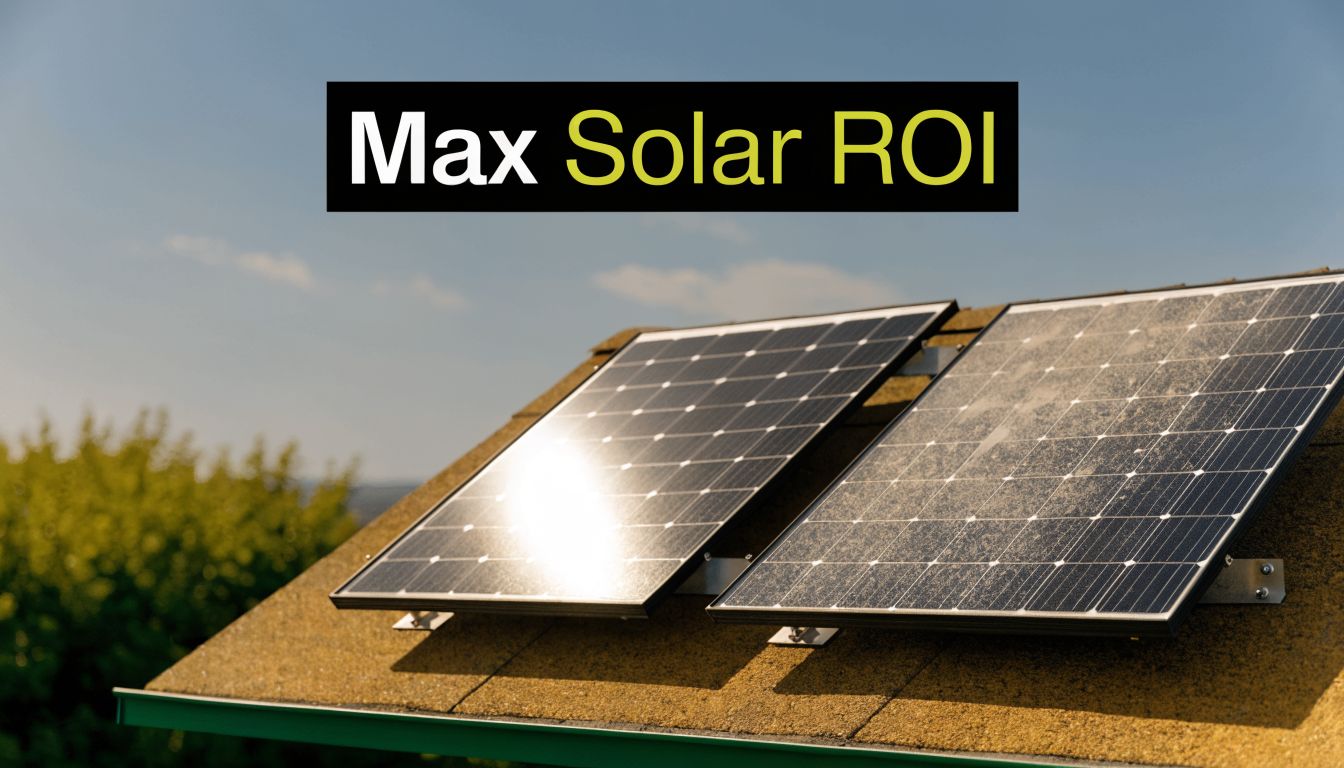

Most advice on how often to clean solar panels is too rigid. It treats every dusty panel like an emergency and every home like it sits in the same climate. That’s not how solar maintenance works in practice, especially in Arizona.
A smarter question is this: when does cleaning pay off? Sometimes the answer is “right away.” After a dust storm, bird mess, or heavy grime event, cleaning can make sense fast. Other times, the dirt looks worse than it performs, and paying for another wash doesn’t return much.
Homeowners usually need a schedule, but they also need judgment. Panel tilt matters. Weather matters. Nearby roads, farms, trees, and roof access matter. Most of all, your production data matters. A panel can look dusty and still be producing close to where it should. Another can have one ugly bird-dropping spot and suffer more from that small blockage than from a thin layer of dust across the whole array.
The Surprising Truth About Dirty Solar Panels
A lot of homeowners assume visible dust means immediate lost savings. That sounds logical, but the economics are often less dramatic.
A landmark UC San Diego study found that panels left unwashed for 145 days during a dry summer lost only 7.4% efficiency, and cleaning a typical 5-kilowatt system midway through that period would have produced only about $20 in added electricity value, according to the UC San Diego Jacobs School of Engineering release. That’s the data point that should change how you think about cleaning.
The lesson isn’t that cleaning never matters. It’s that routine cleaning on autopilot can be a bad financial habit.
Dirt is not one problem
Light, even dust is different from concentrated mess. A thin desert film across the glass usually reduces output gradually. Bird droppings, sap, leaves packed along a frame edge, or debris after a storm can create more localized performance issues and deserve faster attention.
That’s why “clean whenever they look dirty” is weak advice. What you really want is a maintenance decision based on:
- Type of soiling. Uniform dust behaves differently than sticky or shaded spots.
- Timing. A cleaning just before a rainy stretch may be wasted effort.
- Cost. If the production gain is small, the service may not pencil out.
- Access and safety. A two-story tile roof changes the decision quickly.
Practical rule: Don’t confuse visible dust with urgent financial loss.
The real goal is ROI
For most homeowners, solar maintenance should protect output without turning into a recurring expense that eats the savings. That’s the part many articles skip. They jump straight to a calendar and never ask whether the extra cleaning is worth paying for.
In dry markets like Phoenix and Scottsdale, that trade-off matters even more. Dust is common. So are periods where the panel still performs well enough that another cleaning visit doesn’t move the numbers much. The right schedule is the one that balances production, risk, and cost, not the one that makes the panel glass look perfect every month.
Key Factors That Dictate Your Cleaning Schedule
No universal schedule works for every roof. Two homes in the same ZIP code can need different cleaning intervals if one backs up to a dirt lot and the other sits in a sheltered subdivision.

What actually makes panels get dirty faster
Think of a low-slope solar array like a dusty patio table. If debris lands there, it tends to sit. A steeper array behaves more like a windshield. It still gets dirty, but gravity and rain help it shed more material.
The biggest variables are usually:
- Local environment. Desert dust, nearby traffic, agricultural activity, pollen, and industrial residue all build up differently.
- Weather pattern. Wind can either blow dust off or keep feeding new dust onto the glass. Rain can rinse panels, but not always thoroughly.
- Roof and panel angle. Steeper tilt helps debris slide and rinse away more easily.
- Soiling type. Dry dust is one thing. Bird droppings and sticky organic material are another.
- Accessibility. Homeowners are much less likely to keep up with cleaning if the array is hard to reach safely.
Why dust matters more than it looks
Dust doesn’t just make the panel look dull. It interferes with how light reaches the cells. According to Lumina Solar’s explanation of soiling effects, dust density above 5 g/m², which is common after 3 to 6 months in many climates, can scatter incoming photons and reduce module efficiency by roughly 1% for every gram of dust per square meter.
That matters because the loss isn’t always obvious from the ground. A panel can look only mildly dirty while carrying enough buildup to start trimming production.
Thin dust usually causes a slow decline. Thick buildup, sticky deposits, and shaded spots create the problems that justify faster action.
The factors that deserve priority
If you’re deciding where your own home lands, put the most weight on these conditions:
| Factor | Lower cleaning need | Higher cleaning need |
|---|---|---|
| Rain exposure | Regular natural rinse | Long dry stretches |
| Nearby land use | Paved suburban lots | Dirt lots, farms, construction, busy roads |
| Panel tilt | Steeper panels | Low-tilt or flatter panels |
| Debris type | Light dust only | Bird droppings, ash, pollen mats, sap |
| Roof access | Easy observation | Hard-to-see sections that hide buildup |
A homeowner in a rainier area can often lean on the weather. A homeowner in Arizona usually can’t assume that. Desert conditions change the schedule because the same panel can go from lightly dusty to heavily soiled after a single wind event.
Visual Cues vs Performance Data When to Clean
Most homeowners use their eyes first. That’s fine, but it’s only half the job.

A visual check tells you what’s on the panel. Your inverter app tells you whether that dirt is hurting output enough to justify action. The best maintenance decisions use both.
What a visual check does well
Visual inspection is simple and fast. From the ground, binoculars, a phone camera zoom, or a safe ladder position can reveal the difference between normal dust and something more serious.
Look for:
- Uniform haze. Usually a lower-urgency issue unless it has built up heavily.
- Bird droppings or sap spots. These deserve faster attention because they create concentrated blockage.
- Debris at edges. Leaves or trapped grime can linger around the lower frame.
- Storm aftermath. Dust events can leave a much thicker layer than your usual day-to-day buildup.
Visual checks are especially useful after wind events and during pollen season. They’re also the easiest way to catch isolated mess that won’t always show up clearly in aggregate production data right away.
Why the app matters more
Production monitoring is what keeps you from cleaning on guesswork. Most systems have an inverter portal or phone app that shows daily generation trends. Compare current production with recent clear days, and compare year-over-year if your platform allows it.
If the weather has been stable and output drops in a way that doesn’t fit the sunlight conditions, soiling moves higher on the suspect list. If you’re managing multiple properties or hard-to-see roofs, tools used for streamlining roof inspections for drone operators can also help organize visual review and documentation without turning every check into a manual scramble.
A dusty panel that’s producing normally is not the same problem as a dusty panel with a clear unexplained dip.
Use both methods together
Visual inspection answers, “What’s on the glass?”
Performance monitoring answers, “Is it worth acting on?”
That combined approach keeps homeowners from doing two expensive things. First, cleaning too often when output is still fine. Second, waiting too long when a small but concentrated mess is creating a real performance issue.
General Solar Panel Cleaning Schedules and Timelines
Homeowners still need a baseline. A schedule gives you something to follow before special conditions force adjustments.
Industry guidance generally recommends cleaning solar panels 2 to 4 times annually, while heavy soiling from dust, pollen, or pollution can reduce panel efficiency by as much as 25% to 35%, according to Lehmann Electrical’s maintenance guide. That’s a good starting point, not a commandment.
Recommended Solar Panel Cleaning Frequency by Environment
| Environment Type | Recommended Frequency | Key Considerations |
|---|---|---|
| Rainy or low-soiling area | Once or twice yearly | Let natural rainfall do part of the work. Focus on pollen, leaves, and isolated mess. |
| Typical suburban roof | Two to four times annually | Use this as a baseline if you get mixed weather and moderate dust. |
| Dusty desert setting | More frequent checks, with cleaning adjusted to actual buildup | Wind events and long dry periods can change the schedule fast. |
| Agricultural, industrial, or high-pollution area | Toward the high end of the range | Airborne residue and fine particulates build faster and can stick harder. |
| Tree-heavy or bird-heavy roofline | Condition-based cleaning | Concentrated debris matters more than light overall dust. |
Use the calendar as a starting point
A schedule works best when it is tied to what your roof sees during the year.
- Spring often brings pollen and airborne debris.
- Summer can mean prolonged dry accumulation.
- Fall may bring leaves, dust, and late-season grime.
- After storms you may need an off-cycle check.
That’s also why a service page like solar panel cleaning services is most useful when you treat it as an on-demand maintenance option, not an automatic recurring expense.
What doesn’t work
Two habits usually waste money:
- Cleaning on a fixed monthly schedule without checking production.
- Waiting until the panel is visibly filthy because you assume all dirt behaves the same.
A good timeline is flexible. Start with the environment. Adjust with observation. Confirm with performance data.
An Arizona Homeowners Guide to Solar Panel Cleaning
Arizona makes this topic more complicated than national advice suggests. A panel can sit through long dry stretches, get hammered by a haboob, then get partially rinsed by monsoon weather. That cycle changes what “often” means.

In high-dust arid regions like Arizona, soiling can cause daily efficiency losses of 0.5% to 1%, which can add up to 15% to 30% in a month without rain, and cleaning after a major haboob can restore 10% to 20% of immediate output, based on the regional guidance summarized by Energy Buster. That’s why Arizona homeowners shouldn’t copy a schedule written for Seattle, Dallas, or coastal California.
What a typical year looks like in Phoenix
A lot of Arizona arrays start the year fairly manageable. Then spring winds begin carrying fine dust. Early summer often brings long dry heat that bakes residue onto the glass. By the time a major dust storm rolls through, the issue can shift from a light film to a real performance problem.
Monsoon season adds another twist. Rain can help. It can also leave behind muddy residue, edge buildup, and uneven cleaning patterns. One storm might improve your panels enough that you hold off. Another can make them look worse the next morning.
A practical Arizona rhythm
For many local homeowners, the most sensible pattern looks like this:
- Late spring check. This is a strong time to inspect for dust buildup before peak summer production.
- Post-haboob response. If a major dust storm leaves obvious residue, don’t rely on hope. Check the array and your production.
- Monsoon judgment call. Rain may help enough to delay cleaning. It may also reveal stuck-on grime that needs attention.
- Fall reset. After dust season, many roofs benefit from a more complete cleaning and inspection.
In Arizona, the best schedule is rarely “every month” or “once a year.” It’s usually seasonal, with storm-driven exceptions.
Why local context matters so much
Arizona dust isn’t just frequent. It’s fine, airborne, and often combined with intense sun. That combination can leave residue more stubborn than a simple loose powder. Homes near open desert, horse property, new construction, major roads, or agricultural edges usually need more attention than homes in cleaner subdivisions.
If you want a useful comparison from another hot, hail-aware market, this ultimate guide to Fort Worth solar is worth reading because it shows how different regional weather patterns change maintenance decisions. The exact schedule won’t match Arizona, but the logic does.
Arizona homeowners should avoid two extremes
One extreme is over-cleaning because the panels never look perfect. The other is assuming monsoon rain solved everything.
The better approach is simple. Use a seasonal rhythm, inspect after major dust events, and trust measured performance over appearance alone.
DIY or Hire a Pro The Smart Decision Framework
There isn’t one right answer for everyone. Some homeowners can safely handle basic cleaning from the ground with the correct tools. Others should never attempt it because the roof, height, or panel layout turns a maintenance task into a fall risk.

The financial side matters too. For a typical 5kW system in a drought-prone area, the energy value of a mid-season cleaning might be only $20, while professional cleaning often costs $100 to $300, as summarized in the UC San Diego coverage of the study. That means “hire a pro every time they look dusty” isn’t automatically smart.
Start with safety, not savings
DIY makes sense only if you can do it without stepping into obvious risk.
Ask yourself:
- Can you reach the panels from the ground or a stable ladder position?
- Is the roof single-story and straightforward, or steep and complex?
- Are the panels easy to access without walking near dangerous edges?
If the answer to any of those is no, the discussion changes. Even a small drop in production isn’t worth a fall.
Warranty and technique matter
The second filter is whether you can clean the array without damaging it. Solar glass and coatings are durable, but poor cleaning methods create avoidable problems.
Bad DIY habits include:
- Pressure washing
- Harsh chemicals
- Abrasive pads or stiff brushes
- Cleaning very hot panels
- Walking on or leaning heavily over the array
A professional is often worth it when the job needs controlled water use, soft tools, and careful handling around roof-mounted hardware. For homeowners who want an outside option, solar panel cleaning is one example of a service category to compare against doing it yourself.
When DIY is reasonable
DIY can work if all of these are true:
| Situation | DIY may be reasonable | Pro is usually smarter |
|---|---|---|
| Roof height | Single-story, easy access | Multi-story or steep |
| Soiling type | Light dust, loose debris | Baked-on grime, bird droppings, storm residue |
| Tools available | Soft brush, gentle rinse setup | No safe access or proper tools |
| Experience level | Comfortable with ladder safety | Limited roof experience |
For some homeowners, a careful ground-based rinse and soft-brush approach is enough for light maintenance. For others, DIY only looks cheaper until you factor in risk, time, and the chance of doing a low-value cleaning too often.
A short visual guide can help frame the difference between casual rinsing and proper process:
Hire a pro when the roof is risky, the debris is stubborn, or the cleaning needs to protect the system as much as improve appearance.
The smartest framework
The decision comes down to three questions:
- Is it safe for you to do?
- Can you do it without risking panel damage or warranty issues?
- Will the expected production gain justify the effort or service cost?
If any answer is uncertain, slow down. The right choice is the one that protects both your roof and your return on the solar system.
Your Action Plan for Peak Panel Performance
The best answer to how often to clean solar panels is not a rigid date on the calendar. It’s a simple operating routine.
First, assess your environment. A clean suburban roof, a dusty Phoenix edge lot, and a bird-heavy tree-lined home do not need the same schedule.
Second, watch production, not just appearance. Your inverter data tells you whether dirt is a cosmetic issue or a money issue.
Third, clean only when the job is safe and cost-effective. That might mean a seasonal cleaning after heavy dust exposure. It might mean doing nothing after a light buildup because the numbers don’t justify the trip.
If you care about residue-free results, the same water-quality principles used to achieve a spot-free car wash are also relevant when people think about leaving fewer mineral marks on exterior glass surfaces. The goal is the same. Clean effectively without creating another layer of spots.
For Arizona homeowners who want a local evaluation instead of guessing, a solar panel cleaning company can help determine whether your panels need service now or just monitoring.
If you’d like a practical opinion on whether your panels need cleaning, Sparkle Tech Screen Service offers local help for Arizona homeowners who want a safe assessment and, when it makes sense, professional solar panel cleaning without turning maintenance into unnecessary recurring cost.


