


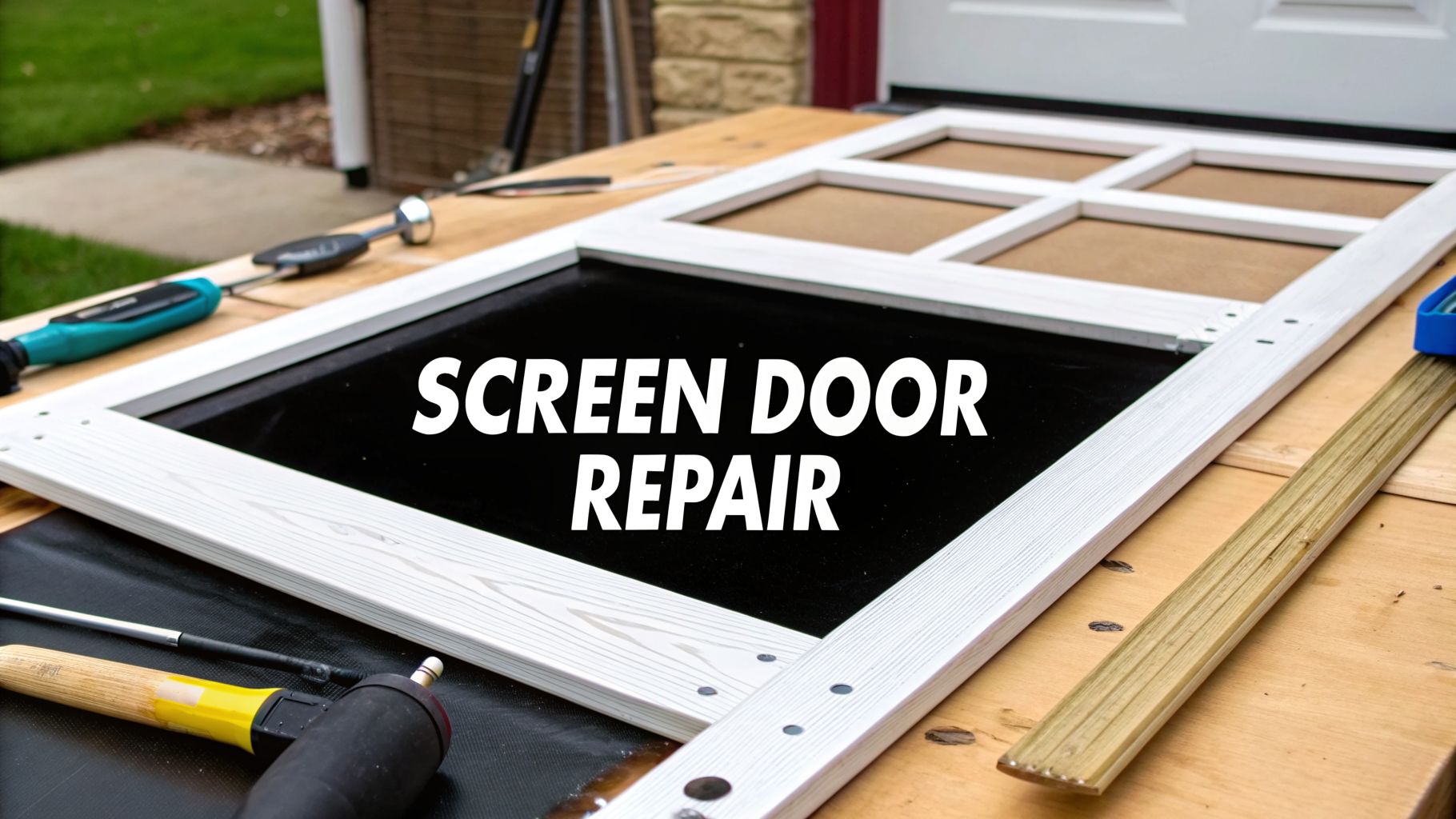

That tiny rip in your screen door? It’s easy to ignore, but it's more than just an eyesore. Think of it as a welcome mat for every fly, mosquito, and creepy-crawly in the neighborhood. A quick door screen repair patches up that hole, but it also does so much more—it brings back the breeze, spruces up your home's look, and restores your peace of mind.
The True Value of a Well-Kept Screen Door

Let's face it, a torn screen pretty much defeats the purpose of having a screen door in the first place. But beyond just blocking bugs, a fully functional screen door is an unsung hero of home life, especially in sun-drenched places like Arizona. Fixing it isn't just another weekend chore; it's a smart move for your home and your wallet.
More Than Just a Bug Barrier
A solid screen door pulls its weight in ways you might not even realize. It's working hard to make your home more comfortable and efficient. When a small rip appears, those benefits start to disappear, often in ways that sneak up on you.
Here’s what a flawless screen really brings to the table:
- Fresh Air, No Pests: It lets you throw the door open and enjoy a cool breeze without having to swat flies away from your dinner.
- Better Energy Efficiency: Here in the Phoenix and Scottsdale areas, solar screens are a must-have. They’re designed to block a huge amount of solar heat before it gets into your house, giving your air conditioner a much-needed break and trimming down your energy bills.
- A Sharper Look: There's no denying it—a clean, tight screen looks great and signals that a home is well-cared-for. A saggy, torn one sends the exact opposite message.
This isn't just a local observation. Homeowners everywhere are catching on. The global market for door and window repair services hit a massive $30.26 billion in 2026 and is expected to grow to $38.34 billion by 2030. That tells you people are choosing to repair what they have, driven by rising energy costs and a desire for comfortable living. You can find more data on this trend over at ResearchAndMarkets.com.
A prompt door screen repair isn't just about looks—it's a practical, money-saving priority. A single tear can make your home less comfortable and quietly drive up your cooling costs as your AC works overtime.
Two Paths to a Perfect Screen
So, you've got a damaged screen. You really have two ways to go. You could roll up your sleeves and tackle it as a DIY project, which can be pretty rewarding. Or, you can hand it off to a professional and get a perfect result without sacrificing your weekend.
For those of us with packed schedules or multiple screens that need attention, calling in a pro like Sparkle Tech is the no-stress option. We handle everything, from standard bug screens to heavy-duty solar and security door screens. Feel free to check out our full range of professional screen services.
Coming up, we'll walk through the DIY process step-by-step and help you figure out which path makes the most sense for you.
Gathering Your DIY Screen Repair Toolkit
Heading out to fix a door screen? You might be picturing a long, confusing trip down the hardware store aisles. But honestly, you don’t need a massive workshop to get a professional-looking, drum-tight finish. The secret isn't having a ton of tools—it's having the right ones.
Getting the right gear is what separates a frustrating afternoon of mistakes from a genuinely satisfying DIY win. Let’s walk through the absolute must-haves so you can get in, get out, and get the job done right.
The Must-Have Tools for a Flawless Finish
For a standard rescreening job, a few tools are completely non-negotiable. Trying to work around them will only lead to a loose, saggy screen or, even worse, a damaged frame.
- Spline Roller: This little gadget is the star of the show. It has two wheels (one curved, one flat-edged) designed specifically to press the spline perfectly into the frame's channel. Without it, getting that tight, even tension is nearly impossible.
- Utility Knife: A fresh, sharp blade is your best friend for trimming the excess mesh. A dull one will just snag and pull the fibers, leaving you with a frayed, unprofessional edge. Always start with a brand-new blade.
- Flathead Screwdriver or Awl: You’ll need something to dig out the old, brittle spline. A small, sturdy flathead screwdriver usually does the trick perfectly.
- Tape Measure: Don't eyeball it. A quick measurement ensures you buy enough screen mesh to work with. A good rule of thumb is to have at least two inches of extra material on all four sides.
These items are the foundation of your screen repair kit. If you're building up your general home-repair arsenal, you can find more great recommendations in an authoritative guide to essential tools for homeowners.
Choosing Your Screen Mesh Material
Once you have your tools, the next big decision is the screen itself. The material you choose has a huge impact on everything from durability and visibility to how much sun gets into your home. It’s not a one-size-fits-all situation; your climate, lifestyle, and whether you have pets or kids all play a role.
This table breaks down the most common options to help you find the perfect match.
Choosing Your Screen Mesh Material
| Material Type | Best For | Pros | Cons |
|---|---|---|---|
| Fiberglass | General use, visibility | Inexpensive, flexible, doesn't crease | Can tear more easily than other types |
| Aluminum | Durability, high-traffic areas | Strong, won't sag over time | Can dent and is more rigid to install |
| Pet Screen | Homes with cats and dogs | 7x stronger than fiberglass, resists tears | Thicker mesh reduces some visibility |
| Solar Screen | Sun-facing doors, energy savings | Blocks solar heat and UV rays | Darker appearance, higher initial cost |
As you can see, there's a material for every need, and it's no surprise that specialized screens are becoming incredibly popular. In fact, door and window repair is part of a massive industry trend, with North America leading the market.
We’re seeing a huge boom in smart and adaptive screens, a segment projected to jump from $5.15 billion in 2026 to $8.47 billion by 2030. This growth is fueled by homeowners in sunny places like Arizona who want the energy savings that come with solar control screens, which can boost a home's efficiency by 20-30%. You can see more data on this trend over at Business Research Insights.
Pro Tip: Don't forget the spline! This rubber cord is what holds the screen in the frame. The diameter is critical, so when you go to the store, take a small piece of the old spline with you to get an exact match.
Let's Get That Screen Replaced: A Step-by-Step Guide
Alright, you've got your tools and materials laid out. Now for the fun part—transforming that torn, saggy screen into something you can be proud of. We're going to walk through this just like I would if I were there in your garage, guiding you through it. Forget rigid instructions; this is about getting a feel for the process.
Think of it in three main phases: getting the frame ready, installing the new screen, and then the final trim. Let's start by getting that old screen out of there.
Prepping the Frame and Removing the Old Screen
First, find a good spot to work. A garage floor or driveway is perfect. Just be sure to lay down an old blanket or a drop cloth to keep your door frame from getting scratched up. Go ahead and pop the screen door out of its tracks and lay it down flat.
Now, look at the frame. You'll see the screen is held in place by a rubbery cord called a spline, which sits in a channel. Your first job is to get that old spline out. Grab a small flathead screwdriver or an awl and find the end of the spline—it's usually just tucked in. Pry up the end until you can get a good grip on it.
From there, you should be able to just pull it out in one long, satisfying strip. Be warned, though: if the spline is old and has seen a lot of sun, it can get brittle and break apart. It's a common issue. If it snaps, don't worry. Just patiently work your way around the frame, digging out any stubborn little pieces until the channel is clear.
Once the spline is out, the old screen mesh lifts right off. Before you move on, take a minute to clean out that spline channel. It's amazing how much dust and grime can get packed in there over the years. A stiff brush and a damp rag will do the trick. A clean channel makes installing the new spline so much easier—trust me on this.
Cutting and Aligning Your New Mesh
Time for the new screen. Unroll your mesh over the frame, making sure it extends past the channel on all sides. This is where a lot of first-timers make a mistake and cut the mesh too short, so let's avoid that headache.
Key Takeaway: Always leave at least two inches of extra screen hanging over every side of the frame. This overlap is your safety net. It gives you something to hold onto when you're creating tension and keeps the screen from slipping into the frame as you work.
With the mesh laid out, use a utility knife to trim it, leaving that generous two-inch border all around. The cuts don't have to be perfect right now; we'll handle the precision trim at the very end. Just make sure you have that overlap.
Lay the trimmed mesh smoothly over the frame. Don't pull it tight yet—just let it rest flat without any big wrinkles. Getting it positioned correctly now sets you up for a smooth installation.
As you can see, the basic components for a screen repair are pretty simple. You've got your mesh, your spline, and the roller tool to bring it all together.

This is the whole operation in a nutshell: the screen goes down, and you use the roller to press the spline in on top of it, locking everything in place.
Using the Spline Roller for a Drum-Tight Finish
This is the most satisfying step, and it’s where the magic really happens. A good splining technique is the difference between a loose, wavy screen and a professional, drum-tight finish.
Pick up your spline roller. You'll notice it has two different wheels: one is concave (curved inward) and the other is convex (curved outward).
Start at a top corner. Using the convex wheel (the flatter one), gently press the screen mesh down into the channel for about four to six inches. This creates a handy crease for you to work with.
Next, lay the end of your new spline over that creased section. Switch to the concave wheel (the grooved one) and roll it firmly over the spline, pushing both the spline and the screen into the channel. The groove in the wheel is designed to grip the spline and seat it perfectly without tearing your new screen. You’ll feel it pop right into place.
Work your way down one entire side. The key is to let the tool do the work; don't pull on the screen with your other hand. That can create weird waves and uneven tension. When you get to the corners, a flathead screwdriver can help you poke the spline in nice and snug before you turn and start on the next side.
A Pro Tip for Tension:
The secret to getting that perfectly taut screen is to work on opposite sides. Once you finish the first side (say, the top), move directly to the opposite side (the bottom).
As you roll the spline into the second side, use your free hand to pull the screen mesh gently but firmly away from the channel. This creates the opposing tension you need for a flat, tight surface.
Here's the pattern I always use:
- Install spline on the top of the frame.
- Install spline on the bottom, pulling gently for tension.
- Finish by installing the spline on the two remaining sides.
With the spline fully installed, you’re ready for the final touch. Grab your utility knife with a fresh blade—a sharp blade is crucial here. Angle the knife away from your new spline and run it along the outside edge of the channel. The frame itself acts as a guide, giving you a perfectly straight cut.
Pull away the strip of excess mesh, and that's it! Stand the door up and give it a look. You should have a smooth, tight, and professional-looking screen that's ready for action.
What to Do When Your Screen Repair Goes Wrong

So you’ve just wrapped up your DIY screen repair, but when you step back, something’s not quite right. Maybe there's a sag in the middle, an annoying wrinkle, or a section of spline that just refuses to cooperate. Don't throw your tools across the yard just yet—these are the most common hiccups we see, and thankfully, the fixes are usually pretty simple.
Think of this as your troubleshooting guide. We’ll walk through the most frequent issues that crop up and how to fix them without having to start completely over.
Fixing a Sagging or Loose Screen
You finished the job, but the screen has a noticeable dip or feels loose to the touch. A sagging screen doesn't just look bad; it’ll flap in the breeze and wear out much faster. This is almost always a problem with how you created tension.
The usual culprit is installing the spline in a circle around the frame. When you do this, you're not really stretching the screen; you're just pushing the slack from one side to the next until it all gathers on the final side.
The Fix: You don't have to pull the whole thing out. Just remove the spline from the last two sides you installed. As you re-roll the spline on the third side, use your free hand to pull the screen mesh taut, away from the frame. Then, do the same for the final side. This opposing force is the secret to a professional, drum-tight finish.
A Word of Caution: It's easy to pull too hard, which can cause the frame itself to bow inward. This is especially common with lighter aluminum frames. If you see the frame starting to bend, you’ve gone too far. Back off the tension a bit. The goal is a flat, taut surface, not a distorted door.
Sometimes, the issue goes beyond the screen itself. Screen doors are often part of a larger patio door system, and learning about adjusting patio doors can help you diagnose related problems like misaligned or stiff panels.
Dealing with Stubborn Wrinkles and Creases
Pesky wrinkles are another sign of uneven tension. This usually happens if you pull the screen diagonally or apply too much pressure in one spot before the rest of the spline is in place.
The solution here is similar to fixing a sag. You need to release the tension and reapply it evenly. Find the wrinkled spot and pull out the spline along that one side. Use your hand to smooth the mesh flat toward the channel, then carefully roll the spline back in, making sure the screen stays perfectly smooth as you go.
But what if the wrinkle is actually a hard crease from how the material was folded in its packaging? If gentle tension doesn't make it disappear, a little bit of heat is your best friend.
- Grab a hairdryer and put it on a low setting.
- Hold it 6-8 inches from the screen and keep it moving constantly.
- The gentle warmth will relax the fiberglass or polyester fibers, allowing the crease to smooth out. Just don't hold it in one spot, or you risk melting the mesh.
When the Spline Won't Stay Put
There is almost nothing more frustrating than installing spline, only to have it pop right back out of the channel. If this happens, it’s a clear sign of a mismatch somewhere in your setup.
Here’s how to diagnose and solve it:
- Check Your Spline Size: This is the problem 90% of the time. If your new spline is too thin for the channel, it won’t have enough bite to hold itself in place. The best way to get it right is to take a small piece of your old spline to the hardware store and match the diameter exactly.
- Clean Out the Channel: The spline channel has to be completely clear of debris. Old, brittle pieces of the previous spline can get stuck in there, along with dirt and grime. Use a small screwdriver to scrape it out or a can of compressed air to blow it clean.
- Use the Right Tool: Your spline roller has a concave (dished) wheel for a reason—it’s shaped to force the spline deep into the channel. Trying to use a screwdriver or putty knife just won’t work as well and can easily damage the new spline or the screen.
If you’re tackling a bigger job like a whole patio enclosure, these small problems can become major headaches. For those larger projects, our specialized guide on patio screen repair has advice tailored to more complex situations.
Deciding Between DIY and Professional Repair
You’ve got a torn screen, and you know what it’ll take to fix it. Now you’re facing the classic home improvement dilemma: do you roll up your sleeves and tackle this yourself, or do you call in a pro? There's a real sense of accomplishment in a successful DIY project, but let's be honest, there's also a ton of value in the speed and guaranteed quality you get from an expert.
The best choice really boils down to your budget, how much free time you have, the job's complexity, and your own comfort level with this kind of work. Let's walk through the pros and cons of each path to help you decide.
The DIY Approach
Going the DIY route can be a great way to save some money and learn a new skill. The biggest draw for most people is the cost. For a single, standard screen door, you can usually grab all the mesh and tools you need for about $20 to $40. If you have a free afternoon and enjoy a hands-on project, it can be a perfect fit.
But the DIY path has its share of frustrations. Those initial savings can vanish pretty quickly if things go wrong. Buying the wrong size spline, cutting the screen mesh an inch too short, or accidentally bending the frame can mean more trips to the hardware store and more money spent. What looks like a simple one-hour job on YouTube can easily turn into a three-hour headache for a first-timer.
The true cost of DIY isn't just the materials—it's your time and the potential for a major headache. A perfect finish is rewarding, but a botched job can leave you worse off than when you started.
The Benefits of Professional Service
Hiring a professional service like Sparkle Tech Screen Service is all about trading your time and effort for convenience and a perfect result. The biggest advantage is expertise. A technician who has done this hundreds of times can rescreen a door flawlessly in just 15 to 30 minutes—a tiny fraction of the time it takes most homeowners.
Professionals also show up with every tool and material needed, including specialty options like pet-resistant or solar screens that you might not find at a big-box store. They guarantee a drum-tight finish without any sags, wrinkles, or a bowed frame. This is a huge plus here in the Phoenix area, where it’s common to have several sun-rotted screens. Trying to fix three or four screens yourself can eat up your entire weekend, while a pro can knock them all out in one quick visit.
For anything more complex, like a heavy-duty security door or a large custom patio enclosure, calling a professional is almost always the right move. You can see what’s possible by checking out our guide on custom screen installation.
DIY vs. Professional Door Screen Repair
To make your decision even clearer, here’s a side-by-side comparison. This table breaks down the key factors to help you weigh your options for your door screen repair.
| Factor | DIY Repair | Professional Service (e.g., Sparkle Tech) |
|---|---|---|
| Total Cost | Lower upfront cost ($20-$40 for materials). | Higher initial cost ($50-$150+ per screen), but no risk of wasted materials. |
| Time Commitment | 1-3 hours for a first-timer, plus shopping time. | 15-30 minutes per screen. Services like same-day pickup save you even more time. |
| Required Tools | You have to buy or already own a spline roller, utility knife, etc. | The technician arrives with all professional-grade tools. |
| Guaranteed Quality | Results hinge on your skill and patience. Risk of sagging or wrinkles. | A flawless, durable, and professional finish is guaranteed. |
| Convenience | You work on your own schedule but handle cleanup and any mistakes. | Incredibly convenient. A quick quote and fast service get the job done right with no effort from you. |
Ultimately, the choice comes down to what you value most. If you have a single, simple screen repair and you're looking for a weekend project, DIY is a fantastic option. But if you're a busy homeowner in Scottsdale or Peoria with multiple damaged screens—or you just want a perfect result without the hassle—calling a professional like Sparkle Tech is the smart, efficient solution.
Common Questions About Door Screen Repair
Even with the best instructions, you probably still have a few questions rolling around in your head. It’s smart to get all the facts straight before you decide whether to tackle this yourself or hand it off to a pro. Let’s clear up the most common things we get asked.
How Much Does Door Screen Repair Cost?
The final bill really comes down to two options: doing it yourself or hiring a professional.
If you're going the DIY route, you can get a kit with the mesh and basic tools for between $20 and $40. It’s a pretty affordable project, as long as you have an hour or two to spare and a bit of patience.
Bringing in a pro like Sparkle Tech Screen Service will cost more upfront, usually somewhere in the $50 to $150+ range for a standard door. That price can shift based on the door’s size, if you want a specialty material like a pet or solar screen, and how complex the frame is.
While a DIY fix saves a few bucks initially, a professional repair is a sure thing. You get a perfect, drum-tight fit that lasts, which can save you the headache and cost of having to redo a saggy screen down the line.
Can I Just Patch a Small Hole Instead of Replacing the Whole Screen?
For a tiny hole—we’re talking smaller than a quarter—a patch can work as a temporary fix. You can grab adhesive screen patches at any hardware store, and they’re incredibly easy to stick on.
But, and it’s a big but, they’re not a perfect solution. Patches are almost always noticeable, which kind of ruins the clean look of your screen door. Worse, the adhesive often gives up after a few months under the intense Arizona sun, leaving you with a peeling, sticky mess.
For a truly clean look or for any tear larger than an inch, replacing the entire screen mesh is the way to go. It’s the only way to restore that uniform, like-new appearance and tension.
How Long Does It Take to Rescreen a Door?
This one depends entirely on who's doing the work.
- For a first-timer: Be realistic and block out 60 to 90 minutes. That gives you plenty of time to get the door off, work without rushing, and hang it back up correctly.
- For an experienced pro: We've got this down to a science. A technician from Sparkle Tech can have the whole job done in just 15 to 30 minutes.
Professionals have the right tools and have done this hundreds of times, so it’s an incredibly efficient process. When a service offers same-day pickup, it’s a no-brainer if you’re pressed for time.
What Is the Difference Between a Bug Screen and a Sun Screen?
This is a great question, and it's especially important for homeowners here in the valley. From a distance, they can look alike, but they do completely different jobs.
A standard bug screen is your classic mesh, usually made of fiberglass or aluminum. Its one and only job is to let the breeze in and keep the bugs out, giving you great airflow and clear views.
A sun screen (or solar screen) is a different beast altogether. It’s a much denser, high-tech mesh designed to block anywhere from 65% to 90% of the sun's heat and damaging UV rays. For homes in Scottsdale and Mesa, upgrading to sun screens is a game-changer for lowering A/C bills and stopping your floors and furniture from fading.
Whether you have a simple tear that needs fixing or you're ready to upgrade to energy-saving sun screens, the team at Sparkle Tech Screen Service has you covered. We pride ourselves on same-week service, fast quotes, and even same-day pickup to make your life easier. Get your screens back in perfect shape by visiting us at https://sparkletechscreenservice.com.


