


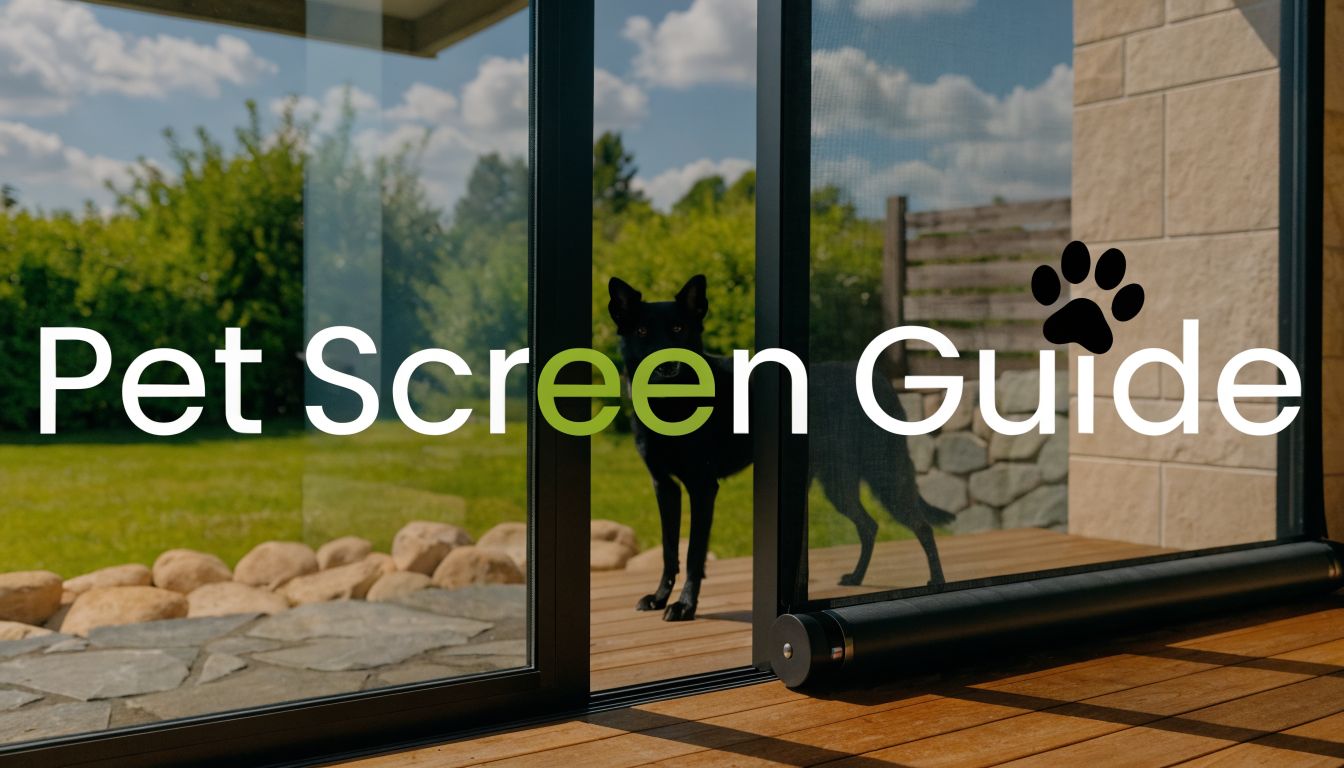

You open the door for fresh air, your dog charges the patio, and within a week the screen is bowed, loose, or torn. That’s the point where most homeowners realize a standard screen and a pet household aren’t the same problem.
A retractable pet screen door can solve that, but only if it’s built for pets from the start. A lot of products look similar online. In the field, they don’t perform the same. Some disappear cleanly into a slim housing and hold up to daily traffic. Others look good on day one and start binding, fraying, or pulling out of the tracks once a dog leans on them or Arizona heat starts working on the frame.
The fundamental difference isn’t just “retractable” or “pet-proof” as marketing terms. It’s the intersection of both. The mesh, the track design, the latch, the mounting style, and the way the unit is measured all matter. If one part is weak, the whole system becomes a repair job.
Breathe Easy Without Worrying About Your Pet
The usual scenario is simple. You want airflow through the house, especially in the morning or after sunset. Your dog wants the same open doorway, but with less patience. Cats test corners with their claws. Bigger dogs hit the lower panel with their chest or shoulder. Standard mesh loses that fight.
That’s why interest in retractable systems keeps climbing. The global retractable screen door market was valued at USD 2.14 billion in 2024, and the pet-specific segment is projected to reach USD 2.4 billion by 2033 at a CAGR of 7.8% according to Dataintelo’s retractable screen door market report. Homeowners want airflow and cleaner sightlines without giving up durability.
A retractable setup works well for people who don’t want a permanent screen blocking the doorway all year. When it’s open, it stays out of sight. When you need ventilation, it pulls across and gives you a barrier that can be built tougher than the old fiberglass screen in a sliding door.
Why pet homes need a different screen
A pet household adds stress in the exact spots where cheap screens fail first:
- Lower impact zone: Dogs push at the bottom third of the screen.
- Corners and edges: Cats and nervous dogs test the perimeter.
- Frequent cycles: A door that opens and retracts all day wears faster than one used occasionally.
- Hair and dust: Tracks collect debris, then the screen stops gliding smoothly.
Ventilation helps indoor comfort, but it also comes with housekeeping trade-offs when animals are involved. If you’re already dealing with fur, dust, and indoor air concerns, this guide on pet dander and pet allergies is a useful companion read before you decide how often you want doors and windows open.
A good retractable pet screen door should let you enjoy the breeze without feeling like you’re gambling every time the dog heads for the patio.
That’s the standard worth using. Not just a screen that retracts, but one that stays intact in real daily use.
Understanding the Mechanics of Modern Pet Screens
A retractable screen works a lot like a window shade turned sideways. The mesh rolls into a vertical cassette mounted at one side of the opening. You pull it across the doorway, it latches, and when you release it, the screen returns into the housing.
That basic mechanism has been around for a while. Retractable screens were introduced to North America in 1992, and pet-specific demand grew as homeowners looked for options that could handle active animals. In that market, dogs account for 58% of sales according to the screen door background cited on Wikipedia.

What retractable means in practice
The key moving parts are straightforward:
Cassette or housing
This holds the rolled mesh and spring mechanism.Top and bottom tracks
These guide the screen across the opening.Handle and latch
This keeps the screen closed and under tension.Mesh panel
With the mesh panel, “pet-resistant” either means something real or turns into marketing fluff.
When the system is measured and mounted correctly, the door should move smoothly with controlled tension. It shouldn’t snap violently, drag heavily, or wobble in the opening.
What makes it a pet screen instead of a regular retractable screen
Many homeowners are often misled. A standard retractable screen is built for insects and light daily use. A retractable pet screen door needs added strength where animals cause stress.
That usually means:
- tougher mesh
- stronger edge retention
- better frame rigidity
- hardware that keeps the screen aligned after repeated impact
A regular retractable screen may survive in a no-pet household for a long time. Put that same unit on a back door with a dog that leans, paws, or rushes the opening, and the weakness shows up fast.
The common misunderstanding
Many buyers assume the mesh alone is the upgrade. It isn’t.
Pet mesh matters, but if the edges can pop loose or the tracks flex, the stronger fabric won’t save the system. The whole assembly has to be designed around pet behavior. That includes the lower track, where sand, hair, and grit build up, and the latch, which takes repeated pull force.
Installer’s view: If the unit feels light, loose, or flimsy in the showroom, it won’t get tougher after installation.
Some newer systems add slow-close operation, custom finishes, or smart-home features. Those upgrades can be useful, but they don’t replace the basics. For pet households, smooth operation is nice. Secure retention is mandatory.
Essential Features of a Durable Pet-Proof Design
If you want a retractable pet screen door that lasts, start with the parts that fail in the field. Ignore the brochure language for a minute. The most durable systems win in four places: edge retention, mesh strength, frame stability, and track performance.

Captured mesh is the first thing to ask about
The single most important feature is captured mesh technology. That means the mesh isn’t just floating in the opening or lightly held at the sides. It’s secured within the track system so it resists being pushed out by paws, body weight, or wind pressure.
According to Phantom Screens’ mesh lock information, this design reduces pet-induced dislodgements from over 80% in standard systems to under 5%, and can extend service life to 5 to 7 years even with daily pet use.
Most important rule: If the mesh can pop free from the track, it isn’t pet-proof. It’s just stronger fabric waiting for the next failure.
A lot of bad retractable units don’t tear first. They fail by coming loose at the edges.
Mesh material matters, but not by itself
Pet-resistant mesh is usually heavier and stiffer than standard insect screen. Good versions are designed to resist claws, pushing, and repeated use.
The performance difference is large. DIY Screens Direct’s heavy-duty pet-resistant screen details state that pet-resistant mesh offers puncture resistance up to 200 to 300 lbs per square inch, while standard fiberglass is listed at 50 to 70 lbs, with pet mesh performing 3 to 5 times better in claw and chew testing.
That sounds impressive, but it still needs context. Strong mesh can still fail if:
- the track tolerances are sloppy
- the frame twists under heat
- the latch doesn’t hold cleanly
- the installer cuts the opening wrong
What to look for in the frame and hardware
A durable system needs a rigid frame and dependable hardware. In Arizona, that matters even more because heat exposes every shortcut.
Look for these signs of a better build:
- Aluminum housing: It holds alignment better than lightweight components that flex.
- Smooth spring tension: The screen should retract with control, not slam.
- Solid handle feel: If the handle feels thin or loose, daily use will expose it quickly.
- Clean latch engagement: A latch that half-catches becomes a service call.
The lower track tells you a lot
Homeowners often focus on the mesh and forget the bottom of the opening. That’s a mistake.
The lower track takes dirt, pet hair, blown dust, and shoe traffic. If the track design is fussy, deep, or easy to clog, operation gets rough. Once the screen starts dragging, people pull harder. That extra force shortens the life of the latch, handle, and edge retention system.
For households with sliders and patio doors, face-mount configurations often preserve a cleaner opening and can make a lot of sense depending on the frame. If you’re comparing options for stronger everyday use, this overview of pet-proof screen doors is a useful starting point.
Features that help in high-sun climates
Arizona brings a different kind of abuse than a mild climate. Sun exposure hardens plastics, fades finishes, and speeds up wear in mesh that isn’t coated for outdoor use.
What holds up better:
- UV-resistant coated mesh
- Powder-coated or well-finished aluminum
- Tight, square installation
- Simple track geometry that’s easy to clean
What doesn’t:
- bargain systems with vague mesh specs
- thin edge retention
- flimsy cassettes
- units installed on out-of-square openings without correction
Here’s a quick reality check before buying.
| Part | What works | What usually fails |
|---|---|---|
| Mesh | Pet-resistant, coated material | Basic fiberglass or light insect mesh |
| Edge retention | Captured mesh track design | Loose side retention |
| Frame | Rigid aluminum assembly | Flex-prone lightweight construction |
| Track | Easy to clean, stable guide path | Debris-catching track that binds |
| Latch | Positive close with repeatable alignment | Weak catch or awkward pull point |
A retractable pet screen door isn’t durable because one component sounds strong. It’s durable when the whole system is engineered around the way pets use a doorway.
Here’s a close look at how a retractable system operates in practice:
Retractable vs Traditional Screens A Clear Comparison
Homeowners usually compare three choices for a pet door opening. A retractable pet screen, a fixed pet screen, or a standard sliding screen door. Each can work, but they don’t solve the same problem.
The fastest way to choose is to stop asking which one is “best” and ask what you care about most. Visibility. Durability. Simplicity. Repairability. Upfront cost. Day-to-day use.

Where pet mesh changes the equation
A standard sliding screen usually starts with standard mesh, and that’s where many pet homes run into trouble. Pet-resistant mesh has a major strength advantage. As noted by the same product data cited earlier, it offers puncture resistance up to 200 to 300 lbs per square inch, compared with 50 to 70 lbs for standard fiberglass, with performance 3 to 5 times better in claw and chew testing.
That doesn’t automatically make retractable systems the winner in every home. It does mean a pet-specific screen material can dramatically outperform the basic mesh found in many traditional doors.
Screen Door Option Comparison
| Feature | Retractable Pet Screen | Fixed Pet Screen | Standard Sliding Screen |
|---|---|---|---|
| Design and aesthetics | Disappears when not in use, keeps doorway visually open | Always visible, more noticeable on the opening | Always present and can interrupt the view |
| Pet durability | Strong when built with captured mesh and pet-resistant fabric | Can be very durable because fewer moving parts | Often vulnerable if using standard mesh |
| Airflow control | Open only when you want it | Permanent screen barrier | Permanent screen barrier |
| Space use | Clean for entries where a swinging or visible screen feels bulky | No moving panel across the opening | Familiar option for patio sliders |
| Installation complexity | More exacting measurement and mounting | Usually simpler than retractable | Usually straightforward when replacing like-for-like |
| Maintenance | Track cleaning and occasional hardware attention | Mostly mesh and frame checks | Rollers, track wear, and mesh damage are common issues |
| Best fit | Homeowners who want airflow without a permanent screen showing | Homeowners who prioritize toughness over appearance | Homeowners replacing an existing slider on a tighter budget |
Practical trade-offs homeowners feel right away
Retractable screens do two things better than the alternatives. They preserve the look of the doorway, and they get out of the way when you don’t want a screen there.
That matters on front entries, French doors, and patio doors where people don’t want a permanent panel visible all year. It also matters in homes where kids, guests, and pets all use the same opening.
Fixed pet screens have one big advantage. Simplicity. Fewer moving parts usually means fewer mechanism issues. If appearance doesn’t matter much and you want a strong permanent barrier, a fixed screen can be the straightforward choice.
Standard sliding screens still have a place, especially when replacing an existing patio setup. But if they’re fitted with ordinary mesh, they’re often the first thing a dog damages.
The right screen isn’t the one with the flashiest brochure. It’s the one that matches how your household uses the door every day.
Who should choose what
- Choose retractable if you care about appearance, flexibility, and a cleaner opening.
- Choose fixed pet screen if you want durability and don’t mind seeing the screen all the time.
- Choose standard sliding replacement if you’re solving a basic patio need and keeping the setup simple.
For many pet owners, the retractable route wins when the product is actually engineered for pet use. Without that, it can become the most expensive way to buy a fragile screen.
Sizing Compatibility and Installation Planning
A retractable pet screen door only works well if the opening is measured correctly. Small errors show up immediately. The screen drags, the latch misses, the cassette sits crooked, or the mesh wrinkles because the frame is compensating for an opening that isn’t square.
That’s why measurement comes before brand selection.

Measure the opening, not just the door slab
Homeowners often measure the visible door and stop there. For a retractable unit, you need the actual mounting area.
Take these measurements:
Width at top, middle, and bottom
Openings vary more than people expect.Height on both sides
Don’t assume the patio slab and header are perfectly level.Depth and trim clearance
Check whether the cassette and tracks have enough surface to mount cleanly.Handle and hardware interference
Existing locksets, trim, and thresholds can affect where the unit can sit.
Single doors, French doors, and sliders need different planning
A single back door is usually the simplest case. French doors need extra attention because the active span is wider and the center meeting point has to align properly. Patio sliders often look easy, but frame details and track conditions can complicate the install.
If you have a large dog, don’t size your opening around the pet squeezing through sideways. Think about normal movement. The same practical thinking used when reviewing large dog kennel dimensions applies here. Measure for how the animal enters and exits, not the smallest possible clearance.
In-jamb vs face-mount
This decision affects appearance and function.
In-jamb mounting
This places the screen within the door frame.
It can look clean and integrated. But it also demands a more cooperative opening. If the jamb is tight, uneven, or crowded by existing hardware, installation gets less forgiving.
Face-mount installation
This places the unit on the surface of the frame or trim.
It’s often more flexible in retrofit situations. On some slider applications, face-mount can preserve usable pass-through space and simplify alignment.
If the frame condition is questionable, face-mount often gives the installer more room to build a screen that works smoothly.
Common planning mistakes
A few errors show up repeatedly:
- Measuring one point only: Openings are rarely that consistent.
- Ignoring out-of-square conditions: Retractable systems don’t hide crooked framing well.
- Forgetting threshold details: Bottom tracks need a clean plan.
- Ordering too early: Measurements should come after you confirm mounting style.
When to get an installer involved
A homeowner can gather basic dimensions, but final measure should be exact. That matters more on French doors, patio sliders, and any opening with uneven stucco, tile transitions, or trim irregularities.
If you’re comparing fit options and want to understand what a site visit usually covers, this page on retractable screen door installation gives a practical reference point for the process.
The best installation plans are boring on paper. That’s a compliment. It means the opening was measured correctly, the mount style was chosen for the frame you have, and no one is trying to force a universal kit into a non-universal opening.
Maintenance Repair and Real-World Costs
A retractable pet screen door isn’t a set-it-and-forget-it product. It needs light maintenance, and when something goes wrong, repairs are usually more specialized than a basic window screen rescreen.
That’s the part many buying guides skip.
A source focused on retractable screen maintenance notes a major content gap around repair realities in pet homes, and points out that these systems have many moving parts. It also notes that repair costs can be high, with an inferred range of $200 to $500 due to specialized labor, according to Michele’s Hide-Away Screens’ discussion of pets and retractable screens.
What usually needs service
In pet households, the common problems are predictable.
Torn or stretched mesh
Usually from claws, repeated pushing, or one hard impact at the edge.Dirty or rough tracks
Hair, dust, and debris build up and affect glide.Latch misalignment
This often starts small. Homeowners notice they have to “wiggle it” to close.Retraction issues
The screen closes too fast, too slow, or unevenly.
What maintenance actually helps
Most homeowners don’t need to do much. But they do need to do the right things.
Keep the tracks clean
Use a soft brush or vacuum to remove dust, pet hair, and grit. Don’t let buildup sit in the lower guide.
Wipe the mesh gently
Use mild soap and water when needed. Aggressive scrubbing can create unnecessary wear.
Watch the latch early
If alignment starts drifting, don’t force it for months. Small adjustments are easier than repairing secondary damage caused by repeated slamming and pulling.
A retractable screen usually gives warning before it fails. Rough movement, drag, or a latch that doesn’t meet cleanly are the warning signs.
Repair or replace
Not every damaged screen needs full replacement.
If the frame is still sound and the mechanism is worth saving, a rescreen or hardware repair can make sense. If the cassette is failing, the tracks are bent, and the screen was a low-grade product to begin with, replacement is often the better spend.
That judgment matters. A lot of homeowners either replace too much or patch too little.
What ownership feels like over time
The long-term value of a retractable pet screen door depends on the original product quality and the install quality. A strong system with pet-rated materials can justify the higher initial cost because it avoids repeated cheap-screen failures. A poorly chosen system becomes expensive through callbacks and frustration.
This is also where local service matters. A company that handles repairs, remeshing, and retractable system work can often save a usable unit instead of defaulting to replacement. For example, homeowners comparing local options for adjustments or rescreening can review retractable screen door repair services to see what kind of issues are typically handled.
Cost trade-offs that are easy to miss
The cheapest screen option on day one isn’t always the lowest-cost option after pets start using it. Retractable units cost more to buy and repair. That part is real. But standard screens that fail repeatedly can become their own cycle of waste.
A practical buying mindset looks like this:
| Situation | Usually the better move |
|---|---|
| Good frame, damaged mesh | Repair or rescreen |
| Rough operation from dirty track | Clean and inspect before replacing parts |
| Persistent misalignment | Professional adjustment |
| Low-end unit with repeated failures | Replace with a better-built system |
For pet owners, the smartest money usually goes into a better system once, then maintaining it before small issues turn into bigger ones.
Your Next Step DIY or Professional Service
Some retractable screen doors are sold as DIY-friendly. That doesn’t mean every opening is DIY-friendly.
If the doorway is square, the mounting surface is clean, the instructions are solid, and you’re comfortable cutting, fastening, and fine-tuning hardware, a homeowner can install some systems successfully. That works best on simple single-door openings with predictable trim and no unusual threshold issues.
When DIY can make sense
DIY is worth considering if:
- you’re replacing a simple setup
- the opening is straightforward
- you have the tools to measure accurately
- you’re patient with adjustments
The biggest DIY mistake isn’t usually assembly. It’s measurement. Once the opening is off, the installer starts chasing problems that weren’t in the product at all.
When professional installation is the safer call
Professional service usually makes more sense when:
- the opening is out of square
- you’re dealing with French doors or large sliders
- the trim and frame don’t offer easy mounting surfaces
- Arizona sun and exposure make long-term durability a priority
A pro should be thinking beyond whether the unit can be attached. The key question is whether it will still glide properly after daily use, dust, heat, and pet traffic.
The Arizona factor
High-sun climates punish bad installs. Heat exposes alignment issues. Dust works into tracks. Heavy pet use adds side load and impact right where many cheaper systems are weakest.
That’s why the best decision often comes down to risk. If your time, the product cost, and the chance of ordering the wrong size all add up to a stressful project, professional installation usually pays for itself in fewer problems later.
If a retractable pet screen door is going on the most-used door in the house, precision matters more than DIY pride.
There’s also a middle ground. Some homeowners measure and research on their own, then bring in a pro for final sizing and installation. That approach avoids a lot of avoidable mistakes.
For Phoenix-area homeowners dealing with patio sliders, active dogs, sun exposure, or damaged existing screens, local support matters because the job often doesn’t end at installation. Sooner or later, tracks need cleaning, mesh may need replacement, and hardware may need adjustment.
For homeowners who want a practical local option, Sparkle Tech Screen Service handles screen installation, rescreening, and repair work in the Phoenix metro area. If you want a retractable pet screen door that’s measured correctly, matched to the opening, and supported by a local service team, you can text or call 623-233-0404 or call 800-370-3998 for a quote.


